
How to Value a Business: Complete Guide to Business Valuation
Valuing a business isn’t just about numbers on a spreadsheet; it’s about understanding what drives worth and using proven frameworks to translate that into an objective market value. How to value a business is one of the most searched-for topics by entrepreneurs preparing to sell, investors assessing acquisition targets, and owners planning long-term strategy, including exit planning and growth. Whether you call it a business valuation, a company valuation, or simply valuing a company, the goal is the same: arrive at a defensible figure that reflects what buyers are willing to pay and what sellers should expect to receive. This guide walks through the valuation of a business and valuation of a company side by side, since the underlying principles apply whether you’re valuing a limited company, a sole trader operation, a startup, or an established firm.
In this complete guide, you’ll learn the most common business valuation methods, explained from the widely used Discounted Cash Flow (DCF) analysis to income, market, and asset-based approaches. You’ll discover step-by-step processes for business valuation, how to gather the right data, and real examples of valuation scenarios. We’ll also cover the valuation factors that affect worth, how to value businesses of different types, and practical tips to improve your valuation before a sale or investment. Whether you’re searching for how to value my business, how to value my company, or a simple business valuation you can run yourself, this article equips you with the insights to make smarter decisions and understand what truly drives enterprise value.
What Is Business Valuation?
At its core, business valuation, sometimes written as business valuations or simply “valuation business,” is the process of estimating a business’s economic and strategic value. It combines financial performance, assets, growth prospects, market factors, and risk into a single value estimate that reflects a willing buyer and seller in an arm’s-length transaction. This is the same exercise people mean when they ask how to valuate a company, how to do a company valuation, or how businesses are valued in practice.
Valuation is not price; the price is negotiated, but the valuation sets expectations. Think of it as the analytical backbone that supports decisions such as selling the company, bringing on investors, planning for the estate, or securing loans. Typically, valuation outputs are expressed as fair market value, investment value, or intrinsic value, and the process itself is often referred to simply as company valuation or business valuation depending on the audience.
Why Business Valuation Matters
Business valuation matters most obviously when you’re selling your business, since a credible asking price depends on knowing how do you value a business rather than guessing. It matters just as much in investment discussions, where demonstrating worth to investors or partners can make or break a deal. Formal valuations are also required for legal and tax strategy, including tax planning, divorce settlements, and other regulatory scenarios where an informal number won’t hold up to scrutiny. And for owners simply asking how do i know how much my business is worth, valuation supports growth planning by revealing the specific value drivers that can unlock future gains. Accurate valuation gives owners clarity and leverage, especially when negotiating with informed buyers or bankers, which is why business analysis and valuation tend to go hand in hand.
Core Valuation Approaches
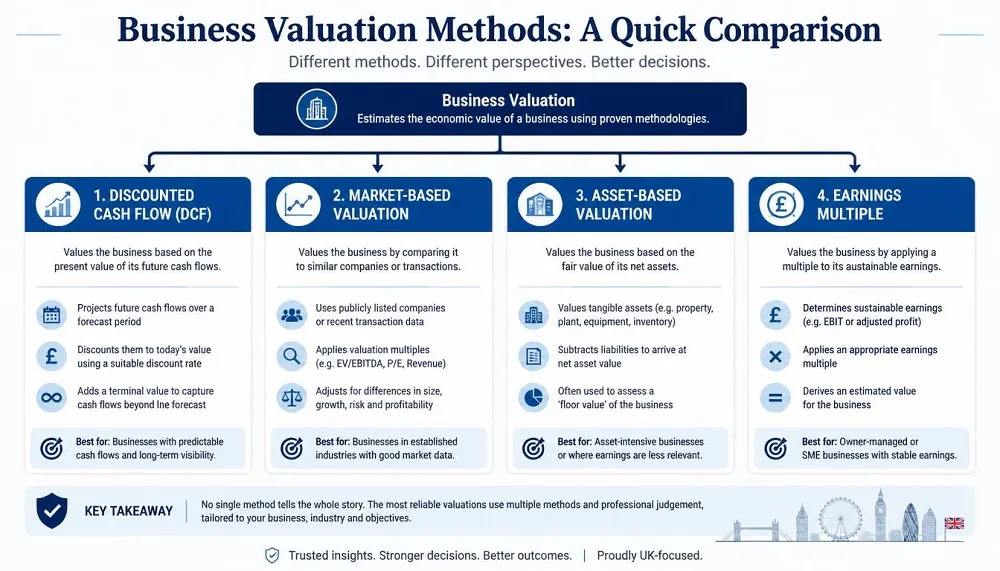
When people ask ways to value a business or ways to value a company, they’re usually asking about one of three core approaches: income, market, and asset-based. Each answers a slightly different question about how a business is valued, and most credible valuations blend more than one.
Income Approach
The income approach estimates business worth from future earnings potential. The most common method is Discounted Cash Flow (DCF), where future cash flows are forecasted and discounted back to today’s value based on the Weighted Average Cost of Capital (WACC). This method is ideal for stable, mature businesses with predictable profits, and it’s frequently the backbone of any serious valuation of a firm or valuation of a company where forecasting is reliable.
Market Approach
Valuation here is based on what comparable companies have been valued or sold for. The two main techniques are Comparable Company Analysis (CCA), which benchmarks your business against similar public or private companies, and Precedent Transaction Analysis, which looks at actual sale prices in past deals. Both rely on multiples such as EV/EBITDA or P/E ratios to benchmark relative value, and this approach is often the fastest way to answer how to value a business quickly when there’s good comparable data available.
Asset-Based Approach
This method totals all business assets minus liabilities, effectively what you’d receive if you liquidated everything today, and it draws directly on the figures shown in your balance sheet. It’s commonly used for asset-heavy companies like manufacturing or real estate, and it also acts as a useful floor value when valuing a business based on profit alone would understate what the company is genuinely worth.
Which Business Valuation Method Should You Choose?
| Valuation Method | Best For | Main Advantage | Limitation |
|---|---|---|---|
| Discounted Cash Flow (DCF) | Established businesses with predictable cash flow | Focuses on future earnings | Requires accurate financial forecasts |
| Market Approach | Businesses with comparable market data | Reflects current market conditions | Suitable comparable businesses may be difficult to find |
| Asset-Based Approach | Asset-rich businesses | Simple and based on tangible assets | May undervalue businesses with strong brands or intellectual property |
| EBITDA Multiple | Profitable SMEs | Quick and widely used by buyers | Multiples vary by industry and market conditions |
| Revenue Multiple | High-growth or early-stage businesses | Useful when profits are limited | Does not consider profitability |
Step-by-Step Valuation Process
Anyone learning how to do a business valuation, or looking for a simple way to value a business, benefits from following a consistent process rather than jumping straight to a number.
The first step is gathering financial documents: collecting three to five years of profit and loss statements, balance sheets, cash flow statements, tax returns, and asset registers. From there, you normalize the financials, adjusting for non-recurring costs, owner perks, and accounting anomalies so the figures reflect true earnings rather than accounting noise. Next comes selecting valuation methods; most practitioners use multiple methods, including DCF, earnings multiples, and comparables, weighting each based on the type of business being valued. Once the methods are chosen, you apply the calculations, producing value outputs for each approach and reconciling them into a coherent valuation range rather than a single fragile figure.
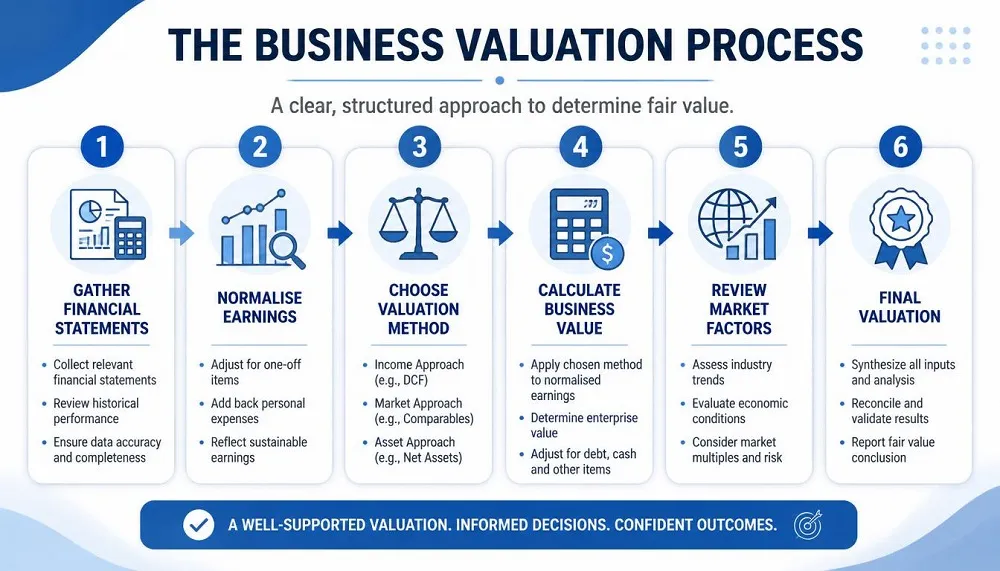
No process for how to value a company is complete without adjusting for intangibles, accounting for brand value, customer loyalty, and intellectual property that don’t appear on the balance sheet but often drive a meaningful share of enterprise value, particularly for service and technology firms. Finally, you review and finalize the estimate, weighing the market environment and strategic factors before settling on a defensible valuation.
Key Valuation Methods Explained
Discounted Cash Flow (DCF) Analysis
DCF projects future free cash flows and discounts them back at a risk-adjusted rate. Because it’s forward-looking rather than historical, this method is highly respected for valuing growth potential and is central to most rigorous business valuation and analysis work.
For example, a company expected to generate $1M of free cash flow annually for five years, discounted at an appropriate rate of 10%, will have a present value of those cash flows plus a terminal value that together support an enterprise valuation buyers and investors can negotiate around.
Comparable Company Analysis
Here, you look at what similar companies in your industry trade for, typically expressed as EBITDA multiples, and apply comparable multiples to your company’s own metrics. This gives a market-aligned valuation benchmark and is one of the more accessible ways to value a company without building a full financial model from scratch.
Earnings Multiplier & EBITDA
Multiplying earnings by industry norms offers a quick valuation snapshot, especially for profitable small businesses researching how to value a business based on profit. A firm earning $500,000 annually at an industry multiple of 5 yields a $2.5M valuation, which illustrates why understanding your specific industry valuation multiple matters more than any generic rule of thumb.
Times-Revenue and Entry-Cost Methods
The times-revenue method multiplies top-line revenue by an industry-appropriate factor, while the entry-cost method simply asks what it would cost to build this business today from scratch. Both are more surface-level than DCF or comparables, but they’re useful as sanity checks when you need to place a value on a business quickly, or when you’re valuing a business that doesn’t yet have consistent profit to work from.
Factors That Affect Business Value
Financial performance sits at the top of the list: revenue, margins, stability, and growth trends all influence valuations, and a company with consistent cash flow commands higher multiples than one with erratic earnings. Market conditions matter almost as much, since industry forecasts, competitive pressure, and broader economic cycles all tilt valuation expectations up or down regardless of how well an individual business is run. Intangible assets, including brand reputation, technology, customer base, and patents, often add significant value beyond the physical assets on the balance sheet, which is why two companies with similar revenue can have very different valuations. Finally, risk and opportunity shape the final number: dependence on a single client or a lack of diversification tends to reduce worth, while genuine expansion opportunities can add a real premium to the price a buyer is willing to pay.
Industry Valuation
Every industry valuation is different because each sector has unique profit margins, growth expectations, customer behaviour, and investment risks. For example, technology companies often receive higher valuation multiples than traditional manufacturing businesses because investors expect faster future growth. Understanding the typical valuation range within your industry helps you compare your business more accurately with similar companies
How to Value Your Business Before Selling
If you’re planning to sell your business, valuation should begin well before you put it on the market. Buyers are interested in much more than annual profit. They will assess the consistency of your revenue, customer retention, recurring income, business systems, staff stability, and future growth opportunities. Before seeking a valuation, ensure your financial records are accurate, remove any personal expenses from company accounts, document business processes, and resolve outstanding legal or tax issues. Businesses with predictable cash flow, diversified customers, and efficient operations generally achieve stronger valuations because they present lower risk to potential buyers. Preparing your business in advance can significantly improve both its market value and buyer confidence during negotiations.
Valuation for Different Business Types
Not every business is valued the same way, which is why industry valuation norms differ so much between sectors. Smaller, main-street businesses may rely more on earnings multiples and seller discretionary earnings (SDE) than on complex DCF modeling, since buyers of these businesses are usually owner-operators rather than institutional investors. E-commerce companies and startups require a different lens: valuation here weighs growth trajectory, customer acquisition economics, and scalability, often blending DCF with custom multiples that reflect the business’s stage rather than its current profit.
Asset-heavy firms, by contrast, lean on book and liquidation values, while service firms stress earnings and market comparisons, since their value lives largely in people and relationships rather than physical assets. If you’re specifically valuing a limited company for sale or refinancing, the same logic applies, but you’ll also want to factor in company structure, retained earnings, and any shareholder agreements that could affect a buyer’s calculations.
Business Valuation Example
| Item | Amount |
|---|---|
| Annual Revenue | £1,200,000 |
| EBITDA | £250,000 |
| Industry EBITDA Multiple | 5× |
| Estimated Enterprise Value | £1,250,000 |
| Outstanding Debt | £150,000 |
| Cash in Business | £50,000 |
| Estimated Equity Value | £1,150,000 |
This simplified example shows how many buyers estimate the value of a business using an EBITDA multiple. In practice, the chosen multiple depends on several factors, including the company’s industry, growth prospects, customer base, financial stability, and market conditions. Buyers will also adjust the valuation for outstanding debt, surplus cash, and any unusual assets or liabilities. Although this example provides a useful starting point, every business is unique, and professional advice may be appropriate for larger or more complex transactions.
A Practical Guide to Business Valuations for SMEs
For small and medium-sized enterprises, a practical approach to business valuation usually starts simple and adds complexity only where it’s justified. Begin with normalized earnings and a reasonable industry multiple to get a ballpark figure, then sanity-check that number against an asset-based floor and, where possible, a couple of comparable transactions in your sector. This layered approach is often enough for owners who just want a working answer to how to value your business without commissioning a full formal report, while still leaving room to bring in a professional appraiser if the number will be used in a sale, dispute, or investment round.
How Do I Value My Business?
Most business owners eventually ask themselves, “How do I value my business?” Whether you’re preparing to sell, attract investors, apply for finance, or simply understand your company’s financial position, the process starts with reliable financial information. Begin by reviewing your recent profit and loss statements, balance sheets, and cash flow statements to understand your business’s financial health. Next, identify a suitable valuation method based on your business type, industry, and purpose. Many small businesses begin with an earnings multiple or asset-based valuation before comparing the result with similar businesses in the market. While these methods can provide a reasonable estimate, a professional business valuation may be worthwhile for significant transactions or legal purposes. Understanding how to value your business regularly also helps you identify areas where profitability, efficiency, and long-term growth can increase the company’s overall value.
Business owners also ask how do I value a company when preparing for investment, succession planning, or a future sale. The overall process remains the same, although the valuation method should match the company’s size and industry.
Business Valuation Tips
Getting an accurate valuation starts with keeping your financial records up to date and ensuring your accounts reflect the true performance of the business. Always compare more than one valuation method instead of relying on a single calculation. Understanding current industry trends, maintaining recurring revenue, reducing unnecessary costs, and documenting business processes can also improve both the quality of your valuation and buyer confidence. Finally, review your valuation regularly as your business grows because changes in profitability, assets, or market conditions can significantly affect its value over time.
Related Guides for UK Business Owners
- Balance sheet explained: how to read one
- Profit and loss statement: a simple UK guide
- Sole trader vs limited company UK
- Business cash flow management
- Business record keeping requirements UK
Conclusion
Valuing a business is an essential exercise for owners, investors, and stakeholders aiming to understand true enterprise worth before a major transaction. Whether you’re preparing to sell, considering investment, or planning a strategic exit, knowing how to value a business equips you to make informed decisions rooted in real economic and market logic. As we’ve seen, valuation isn’t one-size-fits-all; it’s a thoughtful process involving multiple approaches, from forward-looking discounted cash flows and market comparables to asset-based backstops.
Effective valuation starts with clean, normalized financials and a strong grasp of what drives your industry’s multiples and growth prospects. A rigorous process also includes reconciling outputs from different valuation techniques into a cohesive range rather than fixating on a single number. Doing so helps you negotiate from a position of strength and frame your business story in ways investors and buyers can easily understand.
Remember that valuation is part analytics, part strategy. By focusing on underlying performance drivers and aligning expectations with real market data, you can unlock higher valuations and smoother deals. When stakeholder scrutiny is high, consider professional valuation appraisers or third-party experts to validate your approach and add credibility. Ultimately, accurate valuation empowers you to make smart business decisions that drive growth, not guesswork.
FAQs
1. What is the best method to value a business?
The best method depends on purpose and business type: DCF for forecast-based tech firms, comparables for market-ready entities, and asset-based for asset-heavy companies. Use at least two methods for cross-validation.
2. Can I value my business myself?
Yes, with accurate financial data and an understanding of valuation models, most owners can produce a credible working estimate. But professional appraisers add credibility for legal or investment scenarios where the number needs to hold up under scrutiny.
3. How does intangible value affect worth?
Intangible assets like brand, IP, and customer loyalty often uplift valuations significantly, especially in tech and services sectors where physical assets are limited.
4. When should I get a formal business valuation?
Before a sale, during investor negotiations, for tax compliance, or for legal purposes, a formal valuation gives defensible results that a self-calculated estimate typically can’t match.
5. How often should valuations be updated?
Ideally, annually or whenever major changes occur, such as revenue shifts, acquisitions, or market disruptions that would meaningfully change what a buyer is willing to pay.
6. How do you value a business for acquisition?
Acquisition valuation typically leans more heavily on comparable transactions and DCF than a routine internal valuation, since a buyer will also factor in synergies, integration costs, and how the target fits their existing strategy.