
Starting a business in the United Kingdom is one of the most accessible paths to entrepreneurship in Europe. The UK offers a transparent legal system, online registration, and a supportive environment for both local and international founders. However, many new entrepreneurs feel overwhelmed by the legal steps involved in understanding how to register a business in the UK correctly.
Whether you’re launching a side hustle, freelancing full-time, or building the next scalable startup, registering your business is a legal requirement that protects you, your customers, and your finances. The process varies depending on your chosen business structure, tax obligations, and growth plans, but when broken down step by step, it becomes far more manageable.
In this comprehensive guide, you’ll learn how to register a business in the UK online, choose the right legal structure, register with HMRC and Companies House, handle tax and VAT requirements, avoid common mistakes, and stay compliant after registration. By the end, you’ll have a clear roadmap and practical checklist to register your UK business and start trading legally confidently.
Understanding Business Structures in the UK
Before you register your business, you must choose a legal structure. This decision affects your taxes, liability, paperwork, and how much personal risk you carry. The UK recognises several business structures, but most new businesses fall into three main categories.
Sole Trader
A sole trader is the simplest and most popular option for freelancers, consultants, and small service businesses. You run the business as an individual and keep all profits after tax. Registration is done with HMRC, not Companies House.
Pros
- Easy and free to register
- Minimal paperwork
- Full control of the business
Cons
- Unlimited personal liability
- Less credibility with investors
- Harder to scale
Partnership and LLP
A partnership involves two or more people sharing responsibility for a business. In a general partnership, partners share liability and profits. A Limited Liability Partnership (LLP) offers liability protection similar to a limited company while maintaining partnership flexibility.
Limited Company
A limited company is a separate legal entity registered with Companies House. It offers personal liability protection and is often preferred for growth-focused businesses.
Unique insight: Many UK founders start as sole traders, then switch to a limited company once profits exceed £30,000–£40,000 annually due to tax efficiency.
Choosing the Right Structure for Your Business
Choosing the right structure isn’t just about simplicity; it’s about long-term strategy.
Key Factors to Consider
- Personal liability: Do you want protection from business debts?
- Tax efficiency: Corporation tax vs. income tax
- Credibility: Limited companies are often trusted more
- Growth plans: Will you seek investment or hire staff?
When to Change Structures
Many UK businesses start as sole traders and later incorporate as limited companies. This is common and allowed, though it involves notifying HMRC and transferring assets properly.
Non-Resident Entrepreneurs
Non-UK residents can register a UK limited company, provided they have a UK-registered office address.
Step 1: Choose and Check Your Business Name
Your business name must comply with UK regulations and should align with your brand.
UK Naming Rules
- Must not be identical or too similar to existing names
- Cannot include sensitive words without permission
- Must include “Ltd” or “Limited” for limited companies
Trademark and Brand Checks
Before registering, search:
- Companies House name checker
- UK Intellectual Property Office (IPO) trademark database
- Domain name availability
Unique insight: Many rebranding issues arise because founders skip trademark checks, which can cost thousands later.
Step 2: How to Register as a Sole Trader
Registering as a sole trader is straightforward.
Registration Process
- Register for Self Assessment with HMRC
- Do this by 5 October after your first tax year
- Keep records of income and expenses
Taxes You’ll Pay
- Income Tax
- National Insurance Contributions (Class 2 & 4)
Deadlines
- Self Assessment tax return: 31 January
- Late registration can lead to penalties
Step 3: How to Register a Limited Company in the UK
This is the most formal registration process.
What You Need
- Company name
- Registered office address (UK)
- Director(s) and shareholder(s)
- SIC code (business activity)
- Articles and Memorandum of Association
Registration Process
- Register online via Companies House
- Usually completed within 24–48 hours
Public Record Consideration
Most details become publicly searchable;e, use service addresses if privacy matters.
Registering a Partnership or LLP
Partnerships must register with HMRC, while LLPs register with Companies House.
Nominated Partner
One partner is responsible for:
- Tax filings
- Record keeping
- Communication with HMRC
Tax Registrations After Business Registration
Registration doesn’t end with formation.
Corporation Tax
Limited companies must register within 3 months of starting trading.
VAT Registration
Mandatory if turnover exceeds £90,000 (current threshold).
PAYE
Required if you employ staff or pay yourself a salary.
Unique insight: Many founders register for VAT voluntarily to reclaim startup costs.
Opening a UK Business Bank Account
Most banks require:
- Certificate of incorporation
- Proof of address
- Director ID
Digital banks often approve accounts faster than traditional banks.
Post-Registration Legal Obligations
Annual Requirements
- Confirmation Statement
- Annual accounts
- Corporation tax return
Record Keeping
Keep records for at least 6 years. Failure to comply can result in fines or the company being struck off.
Costs and Timeline for UK Business Registration
| Structure | Cost | Timeline |
|---|---|---|
| Sole Trader | Free | Same day |
| Limited Company | £50–£71 | 1–2 days |
| LLP | £50+ | 2–5 days |
Common Mistakes to Avoid
- Choosing the wrong structure
- Missing tax registration deadlines
- Using a non-compliant business name
- Mixing personal and business finances
Unique insight: Most HMRC penalties are caused by missed deadlines, not fraud.
Special Cases: Foreign & Online Businesses
- Non-residents can register UK companies
- E-commerce businesses still need UK registration
- Overseas companies may need a UK branch
Quick Takeaways
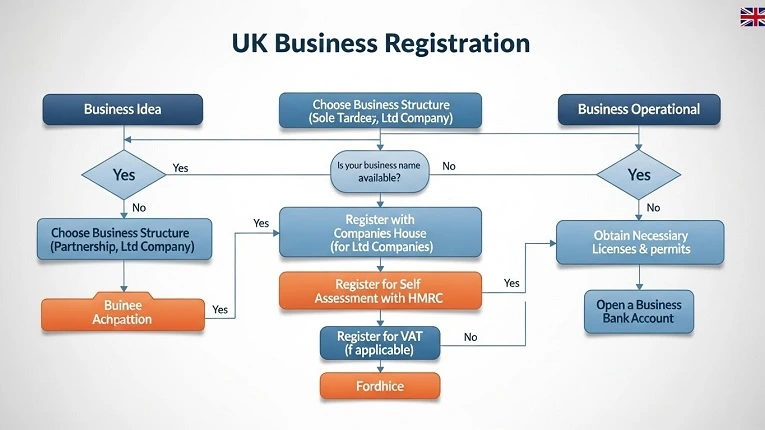
- Choosing the right structure is critical
- Sole traders register with HMRC; companies with Companies House
- Tax registration is mandatory after formation
- Online registration is fast and affordable
- Compliance continues after registration
Conclusion
Registering a business in the UK is a foundational step that sets the tone for your company’s future success. While the process may seem complex at first, understanding the legal structures, registration requirements, and tax obligations simplifies everything. Whether you register as a sole trader for speed or form a limited company for protection and growth, the UK offers one of the most efficient systems in the world for new businesses.
By following the steps in this guide, you’ll avoid common pitfalls, stay compliant with HMRC and Companies House, and position your business for sustainable growth. Take the time to choose wisely, register correctly, and keep accurate records. If you’re unsure, professional advice can save you time and money in the long run.
Your next step: choose your structure, gather your details, and start your registration today.
Frequently Asked Questions
1. Do I need to register a business before trading in the UK?
Yes. You must register with HMRC or Companies House, depending on your structure.
2. Can I register a UK business online?
Yes, most registrations are completed online within 48 hours.
3. How much does it cost to register a business in the UK?
Sole trader registration is free; limited companies cost around £50–£71.
4. Can foreigners register a UK business?
Yes, non-residents can register UK companies with a UK address.
5. Do I need an accountant to register a business?
No, but an accountant helps with tax efficiency and compliance.