
A business credit score is a number, usually between 0 and 100, that shows how likely your company is to pay its debts and bills on time. Credit reference agencies calculate it from your payment history, public records and company filings, and lenders, suppliers and other businesses use it to decide whether to offer you credit and on what terms. This guide explains how UK business credit scores work, how to check yours, and what you can do to improve it.
Key takeaways
- UK business credit scores typically run from 0 to 100, with higher numbers meaning lower risk.
- Several credit reference agencies calculate business credit scores in the UK, including Experian, Equifax and Creditsafe, and your score can differ between them.
- You can check your business credit score for free through most agencies without harming it.
- New businesses start with a thin or empty credit file, which is normal and can be built up over time.
- Paying bills on time, filing accounts promptly and keeping credit use low are the biggest levers for improving your score.
What Is a Business Credit Score?
A business credit score measures how reliably your company manages its financial obligations. Credit reference agencies, often shortened to CRAs, collect data on your company’s payment behaviour, borrowing history and public records, then turn that data into a single number that represents your creditworthiness.
Unlike a personal credit score, a business credit score belongs to the company itself, not to any individual director or owner. It is also generally public, which means suppliers, potential customers and other companies can check it before agreeing to do business with you, not just banks and lenders.
How a Business Credit Score Differs From a Personal Credit Score
The two scores measure different things and are calculated separately, although they can overlap for smaller or newer businesses.
| Feature | Business Credit Score | Personal Credit Score |
|---|---|---|
| What it measures | Company’s payment and borrowing history | Individual’s payment and borrowing history |
| Typical scale in the UK | 0 to 100 | Varies by provider, often 0 to 999 |
| Who can see it | Generally public | Private, visible only to you and lenders you apply to |
| Cost to check | Often free for a basic report | Free through consumer credit apps |
| Used by | Lenders, suppliers, landlords, potential business partners | Lenders and, in some cases, employers or landlords |
If you are a sole trader, there is no separate legal entity, so lenders will usually look at your personal credit history alongside any business trading data. Directors of small or new limited companies may also be asked to give a personal guarantee, which brings personal credit into the picture even though the scores themselves stay distinct.
Business Credit Score vs a “700 Credit Score”
If you have searched for information on getting a 700 credit score, it is worth knowing that this figure relates to personal, FICO-style consumer credit scoring used in the United States, not to UK business credit scoring. UK business credit scores use a 0 to 100 scale, so a “700” figure does not apply here. If you are researching your own personal credit standing in the UK, that is a separate topic from the business credit score covered in this guide.
How Are Business Credit Scores Calculated in the UK?
Each credit reference agency uses its own formula, but most weigh a similar set of factors when working out your score.
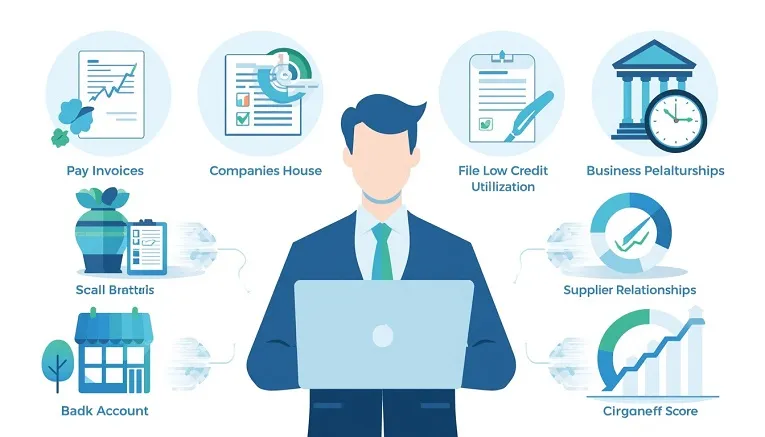
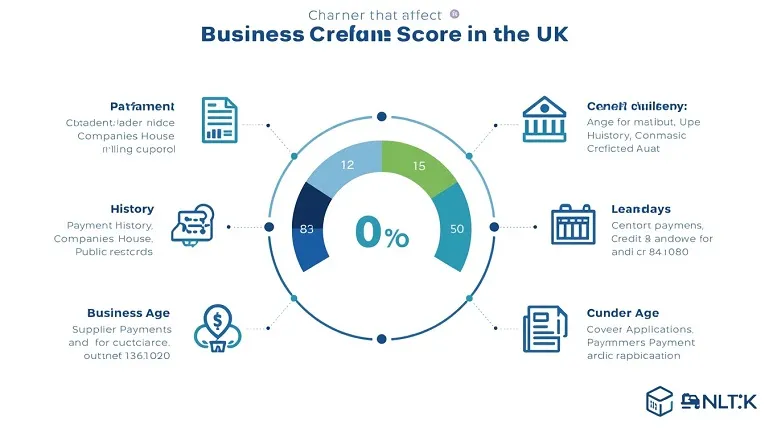
The Main Factors Credit Reference Agencies Assess
- Payment history: whether you pay invoices, bills and loan repayments on time
- Credit utilisation: how much of your available credit you are currently using
- Company age: how long your business has been trading
- Filing history: whether your accounts and confirmation statements reach Companies House on time
- Industry risk: how your sector performs historically in terms of failure and late payment rates
- Public records: County Court Judgments, insolvency notices and other legal markers
- Credit applications: how many times you have recently applied for credit
- Company size and structure: turnover, assets and legal form
Payment history usually carries the most weight of any single factor. A pattern of on-time payments, built up over months and years, tends to have a bigger effect on your score than any other single action you can take.
Why Your Score Differs Between Experian, Equifax and Creditsafe
There is no single, standardised business credit scoring system in the UK. Each agency gathers slightly different data and applies its own model, so it is entirely normal to see a different number from Experian than you do from Equifax or Creditsafe. This is one reason many businesses check more than one report before applying for significant finance.
UK Business Credit Reference Agencies Compared
| Agency | Typical score range | What it focuses on | Free option | Best for |
|---|---|---|---|---|
| Experian | 0 to 100 | Commercial Delphi Score, general creditworthiness | Basic report often free | Widely used by lenders and suppliers |
| Equifax | 0 to 100 | Payment behaviour, public records | Basic access available | Cross-checking against Experian |
| Creditsafe | 0 to 100 | Financial analysis, real-time alerts | Free basic report | Monitoring and alerts |
| Dun & Bradstreet | Multiple scores (for example PAYDEX, Viability Rating) | International trade credit, supplier risk | Limited free access | Businesses trading internationally |
| TransUnion | 0 to 100 | General commercial risk | Varies | Alternative view alongside the main three |
| Crediva | 0 to 100 | Commercial risk assessment | Varies | Supplementary check |
| Credit Passport | Score plus narrative report | Small business financial health | Free tier available | Businesses wanting a plain-English breakdown |
Do You Need to Check More Than One Agency?
For most day-to-day purposes, checking one or two agencies gives you a reasonable picture. If you are preparing for a significant loan application, applying for a large supplier contract, or trying to understand why you were declined credit, it is worth checking two or three reports, since the specific agency a lender used can make a real difference to the outcome.
What Is a Good Business Credit Score?
Featured answer: A good business credit score in the UK generally means a score above 80 out of 100 with Experian, which places a business in a low-risk band. Most lenders look for a score of at least 45 to 50 before approving finance, though requirements vary by lender and product.
Experian Risk Bands Explained
| Score range | Risk band |
|---|---|
| 91 to 100 | Very low risk |
| 81 to 90 | Low risk |
| 51 to 80 | Below average risk |
| 26 to 50 | Above average risk |
| 16 to 25 | High risk |
| 2 to 15 | Maximum risk |
What Counts as a Poor or High-Risk Score
A score in the lower bands does not mean you cannot get finance, but it usually means higher interest rates, lower credit limits, requests for a personal guarantee, or, in some cases, a straightforward decline. Suppliers may also ask for payment upfront rather than offering standard trade credit terms.
How to Check Your Business Credit Score in the UK
Step-by-Step: Checking Your Score for Free
- Choose a credit reference agency, such as Experian, Equifax or Creditsafe
- Register using your company name and Companies House registration number
- Verify your identity and business details as requested
- View your basic score and risk rating online, usually within minutes
- Repeat with a second agency if you want a broader picture
Free vs Paid Business Credit Checks
Most agencies offer a free basic report showing your score and risk band. Paid tiers typically add a full breakdown of the factors affecting your score, ongoing monitoring with alerts, and the ability to check other companies. A free check is normally enough to understand where you stand; a paid plan becomes more useful if you want early warning of changes or a detailed audit trail before a major finance application.
Does Checking Your Own Score Affect It?
Featured answer: No. Checking your own business credit score is a soft check and does not affect your score. Only hard checks, carried out by lenders when you formally apply for credit, can have an impact, and even then the effect is usually small and temporary.
Does a New Business Have a Credit Score?
New businesses typically start with a thin or blank credit file, since credit reference agencies need trading activity, filed accounts or credit applications before they can generate a meaningful score. This is completely normal and not a sign of a problem.
How New Businesses Start Building a Credit File
- Register with Companies House and keep company details accurate and up to date
- Open a business bank account to establish a trading footprint
- Take on small, manageable trade credit from suppliers and pay it on time
- File your first set of accounts and confirmation statement promptly
- Register with the major credit reference agencies so they have data to work with
How Long Does It Take to Build Business Credit?
There is no fixed timescale, but many businesses start to see a meaningful score, based on real trading data, within their first six to twelve months, provided they are filing on time and managing supplier payments responsibly. Consistent, on-time behaviour matters more than speed.
Should a New Business Rely on a Personal Guarantee?
Lenders sometimes ask newer or smaller companies for a personal guarantee from a director, which means the director agrees to repay the debt personally if the company cannot. This can help a new business access finance sooner, but it also ties personal finances to business risk, so it is worth weighing up carefully rather than accepting automatically.
Business Credit Score by Business Structure
Sole Traders and Business Credit
As a sole trader, your business and personal finances are legally the same, so lenders and suppliers typically assess your personal credit history rather than generating a separate business score. Some credit checking tools now offer sole trader-specific reports, but these still draw heavily on personal financial data.
Partnerships and Business Credit
In a partnership, lenders often review the personal credit history of each partner alongside any trading data the business has built up, since partners can be jointly liable for business debts.
Limited Companies and Business Credit
A limited company has its own legal identity and its own credit score, separate from the personal credit files of its directors. However, directors of newer or smaller limited companies may still be asked for a personal guarantee, particularly where the company’s own credit history is limited.
| Business structure | Separate business score? | Does personal credit matter? | Who typically checks it |
|---|---|---|---|
| Sole trader | No | Yes, primarily | Lenders, some suppliers |
| Partnership | Sometimes, limited | Yes, for all partners | Lenders, suppliers |
| Limited company | Yes | Sometimes, via personal guarantee | Lenders, suppliers, other businesses |
Understanding these differences matters when you are choosing how to set up or grow your business. See our guide to business structures in the UK for a full comparison.
Why Is My Business Credit Score Low?
Common Causes Checklist
Featured answer: A low business credit score is usually caused by late or missed payments, high credit utilisation, County Court Judgments, late filing with Companies House, too many recent credit applications, a thin credit file, or operating in a higher-risk industry.
- Late or missed payments to suppliers, lenders or creditors
- Credit utilisation above roughly 30 percent of your available limit
- A County Court Judgment or insolvency notice on your record
- Accounts or confirmation statements filed late with Companies House
- Several credit applications made in a short space of time
- A thin credit file with little trading history for the agency to assess
- Trading in an industry that credit reference agencies treat as higher risk
How to Check for Errors on Your Business Credit Report
Request your full report from the relevant agency and check the payment history, public records and company details sections carefully. Look for outdated addresses, incorrect director information, payments marked late that were actually made on time, or records that belong to a different company entirely. Errors are more common than many business owners expect, and they are worth catching early.
How to Improve Your Business Credit Score
Pay Bills and Invoices on Time
On-time payment is the single biggest factor in most scoring models. Set up reminders or use accounting software to track due dates, and pay early where cash flow allows.
Keep Credit Utilisation Below 30 Percent
If your business has a credit limit of £10,000, try to keep your outstanding balance below £3,000. Lower utilisation signals that your business is not overly reliant on borrowed funds.
File Accounts and Confirmation Statements on Time
Late filing with Companies House is a matter of public record and can drag your score down even if your day-to-day payment behaviour is strong. Set calendar reminders well ahead of each deadline.
Limit the Number of Credit Applications You Make
Each formal application can trigger a hard search, and several in a short period can make your business look financially stretched. Space applications out and check for soft eligibility checks where available.
Correct Errors on Your Credit File
If you find a mistake, contact the credit reference agency directly with supporting evidence. Correcting inaccurate information can lift your score once the change is processed.
Build a Trade Credit History With Suppliers
Taking on small, manageable credit accounts with suppliers and repaying them reliably helps build a track record that agencies can report on, particularly useful for newer businesses.
Monitor Your Score Regularly
Checking your score every few months, rather than only when you need finance, helps you spot problems early and understand which actions are making a difference.
Disputing Errors on Your Business Credit Report
Your Rights Under UK Data Protection Rules
Under the Data Protection Act 2018 and the UK’s Credit Reporting Code of Practice, you have the right to see the information held about your business and to have inaccurate data corrected. Credit reference agencies are required to investigate disputes you raise.
Step-by-Step: How to Raise a Dispute
- Gather evidence, such as bank statements, invoices or correspondence, that supports your claim
- Identify which agency’s report contains the error
- Submit a formal dispute directly to that agency with your evidence attached
- Ask the original source of the error, such as a lender or supplier, to update their records if relevant
- Follow up if you have not heard back, since agencies typically have around 28 to 45 days to investigate
- Keep records of all correspondence in case you need to escalate further
How Your Business Credit Score Affects Financing
Loan Approval, Interest Rates and Credit Limits
A stronger score generally means access to better interest rates, higher credit limits and a smoother approval process when you apply for a business loan. A weaker score does not automatically rule out finance, but it tends to narrow your options and increase the cost of borrowing.
Supplier Terms and Trade Credit
Suppliers often run credit checks before agreeing to flexible payment terms. A strong score can help you negotiate better terms and build trust with new trading partners, which in turn supports healthier cash flow management.
What Happens If You’re Turned Down for Finance?
A low score does not mean the end of the road. Options worth exploring include specialist or alternative lenders who work with businesses that have a shorter or weaker credit history, Community Development Finance Institutions that support underserved small businesses, the government-backed Start Up Loans scheme, which weighs your business plan alongside your credit history, and secured lending, where assets such as equipment or property back the loan. You can also review grants for small businesses as a non-debt alternative while you build up your credit profile.
Business Credit Score FAQs
What is a business credit score?
A business credit score is a number, usually between 0 and 100 in the UK, that reflects how likely your company is to pay its debts on time. Credit reference agencies calculate it from your payment history, public records and company filings.
How do I check my business credit score in the UK?
Register with a credit reference agency such as Experian, Equifax or Creditsafe using your company details and Companies House number, then view your basic score online, usually for free.
Is checking my own business credit score free?
Most agencies offer a free basic report showing your score and risk band. More detailed reports and ongoing monitoring often sit behind a paid plan.
Does a new business have a credit score?
New businesses typically start with a thin or blank credit file, since agencies need trading history, filed accounts or credit applications to generate a meaningful score. This builds up over the first six to twelve months of trading.
Does opening a business bank account affect my credit score?
Opening a business bank account does not directly harm your credit score. It can support your score indirectly over time by helping you manage payments reliably and by establishing a clear trading history.
Why is my business credit score low?
Common causes include late payments, high credit utilisation, County Court Judgments, late filing with Companies House, too many recent credit applications, or a thin credit file.
Does my personal credit score affect my business credit score?
The two are calculated separately. However, if you are a sole trader, in a partnership, or a director giving a personal guarantee, lenders may consider both when assessing an application.
Can I check another company’s business credit score?
Yes. Business credit scores are generally public, so you can check another company’s score through a credit reference agency, which is useful when assessing a new customer or supplier.
How often should I check my business credit score?
Reviewing your score every three to six months is a reasonable habit, and more often if you are actively applying for finance or working to improve your score.
Key Takeaways: Managing Your Business Credit Score
A UK business credit score reflects how reliably your company manages payments and credit, and it directly shapes the finance and supplier terms available to you. Scores typically run from 0 to 100 and vary between agencies, so checking more than one report gives a fuller picture. New businesses start with little or no history, which is normal, and can build a stronger profile through on-time payments, timely filing with Companies House and sensible use of credit. If your score is lower than you would like, correcting errors and addressing the underlying causes tends to produce steady improvement over several months rather than an overnight fix.
For more on strengthening your company’s financial foundations, see our guide to working capital.
Written by the Businessmine editorial team, covering UK business finance, banking and compliance topics for small business owners, sole traders and company directors. Our guides are researched using primary sources including Companies House, government guidance and established UK credit reference agencies, and are reviewed for accuracy before publication.
This article is for general information only and does not constitute financial advice. Speak to a qualified financial adviser or accountant before making decisions about your business’s credit or finances.