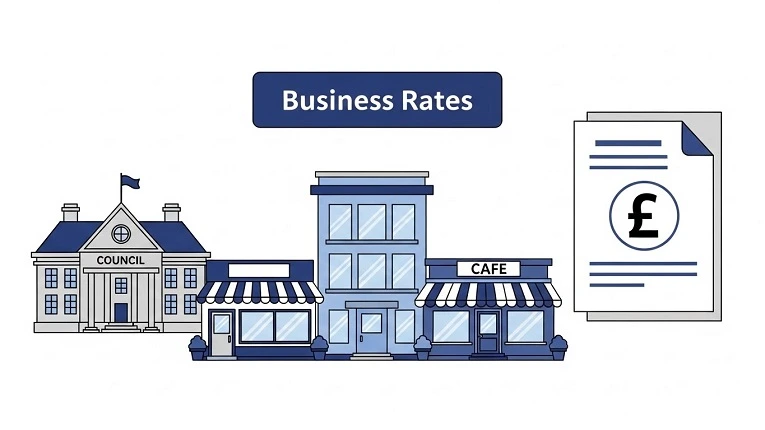
Business rates are one of the most misunderstood yet unavoidable costs for UK businesses that operate from commercial premises. If you rent or own a shop, office, warehouse, café, or other non-domestic property, chances are you’ve encountered a business rates bill, sometimes before fully understanding what it is you’re paying for.
So, what are business rates, and why do they matter so much to small businesses, retailers, and landlords across the UK?
In simple terms, business rates are a tax charged on most non-domestic properties. They function similarly to council tax for homes, but instead apply to business premises. However, unlike income tax or corporation tax, business rates are not based on profit; they are based on the value of the property itself. This makes them a fixed cost that can significantly affect cash flow, especially for small businesses.
In this guide, we’ll explain what business rates are, how they are calculated, who pays them, what reliefs are available, and how to reduce your bill where possible. Whether you’re opening your first premises or reviewing rising costs, this article will give you a clear, practical understanding of UK business rates.
What Are Business Rates?
Business rates, officially called National Non-Domestic Rates (NNDR), are a property tax charged on buildings or parts of buildings used for business purposes in England and Wales. Scotland and Northern Ireland operate similar systems with slight variations.
They apply to most non-domestic properties, including:
- Shops and retail units
- Offices and co-working spaces
- Pubs, cafés, and restaurants
- Factories and warehouses
- Hotels and guesthouses
The purpose of business rates is to help fund local services, such as roads, waste collection, policing, and public infrastructure. Local councils collect the rates, and under the current system, they keep a proportion of what they raise, which links business growth directly to local authority funding.
Key distinction: Business rates are charged based on property value, not on how much profit your business makes. This is why even struggling businesses may still face large bills, a major criticism of the system among high-street retailers and hospitality businesses.
Which Properties Must Pay Business Rates?
Most properties used for business purposes are liable for business rates. This includes permanent buildings and some temporary or shared spaces if they are used commercially.
Liable Properties
You’ll usually pay business rates if your property is used as:
- A shop, salon, or takeaway
- An office or studio
- A warehouse or storage unit
- A pub, bar, or restaurant
- A holiday let rented out commercially
Mixed-Use Properties
Some properties are classed as composite properties, meaning they are partly residential and partly commercial. For example, a flat above a shop may pay:
- Council tax on the residential part
- Business rates on the commercial part
Exempt Properties
Some properties are exempt or partially exempt, including:
- Agricultural land and farm buildings
- Places of worship
- Buildings used for charity (subject to conditions)
- Some empty properties for a limited time
How Are Business Rates Calculated?
Business rates are calculated using a straightforward formula, but understanding the components is essential.
Rateable Value
The rateable value is an estimate of the annual rent your property could have been let for on the open market at a fixed valuation date. It is set by the Valuation Office Agency (VOA), not your local council.
You can check your property’s rateable value on the VOA website.
The Multiplier
The multiplier (sometimes called the Uniform Business Rate) is set by the government each year. There are two main multipliers:
- Standard multiplier
- Small business multiplier (lower, for eligible properties)
Example Calculation
If:
- Rateable value = £25,000
- Small business multiplier = 0.49
Your annual business rates bill would be:
£25,000 × 0.49 = £12,250
Reliefs are then applied to reduce this figure.
Business Rates Revaluations
Business rates are revalued periodically to reflect changes in the property market. Revaluations ensure that bills are based on up-to-date rental values rather than outdated data.
Why Revaluations Matter
- Properties in high-growth areas may see increases
- Properties in declining areas may see reductions
- Changes are phased in to avoid sudden spikes
The next major revaluation cycle is scheduled for 2026, continuing the government’s move toward more frequent updates to improve fairness.
Business Rates Reliefs and Exemptions
Many businesses pay less than the full amount thanks to relief schemes.
Small Business Rates Relief
If your property has a low rateable value, you may qualify for:
- Up to 100% relief
- Reduced multipliers
Retail, Hospitality and Leisure Relief
Shops, cafés, pubs, and hotels may qualify for temporary or sector-specific reliefs, often introduced during economic downturns.
Charitable Relief
Registered charities can receive up to 80% mandatory relief, with possible additional discretionary relief.
Empty Property Relief
Empty properties may receive relief for:
- 3 months (most properties)
- 6 months (industrial properties)
Paying Your Business Rates
Your local council sends your business rates bill annually, usually between February and March.
Who Pays?
- The occupier of the property usually pays
- This applies even if you rent the premises
How to Pay
- Monthly instalments
- Online, direct debit, or bank transfer
Late payment can result in enforcement action, so budgeting for business rates is essential.
Appealing Your Rateable Value
If you believe your rateable value is incorrect, you can challenge it.
When to Appeal
- Your property details are wrong
- Comparable properties have lower values
- Your property’s condition has changed
How the Process Works
- Check the valuation
- Submit a challenge to the VOA
- Provide supporting evidence
Successful appeals can significantly reduce future bills and sometimes lead to refunds.
Impact of Business Rates on UK Businesses
Business rates are often cited as one of the highest fixed costs for physical businesses, especially in retail and hospitality.
Unique insight: Unlike online businesses that operate without premises, high-street businesses face business rates regardless of sales performance. This imbalance has fuelled ongoing debate about reforming the UK business rates system to better reflect modern commerce.
Tips to Reduce Your Business Rates Bill
-
Check eligibility for all reliefs
-
Review your rateable value regularly
-
Appeal if your valuation is inaccurate
-
Factor rates into lease negotiations
-
Seek professional advice for complex cases
Conclusion
Understanding what business rates are is essential for any UK business operating from commercial premises. As a property-based tax, business rates can represent a substantial and ongoing cost that exists regardless of profitability. That’s why it’s so important to know how rates are calculated, what reliefs you’re entitled to, and how revaluations may affect your future bills.
While the system can feel complex, taking the time to check your rateable value, apply for reliefs, and budget accurately can make a meaningful difference to your bottom line. With continued debate around reform and revaluation cycles becoming more frequent, staying informed is no longer optional;’s a smart business decision.
Next step: Check your property’s rateable value today and make sure you’re not paying more than you should.
Frequently Asked Questions
1. What is the business rate in the UK?
They are a tax on non-domestic property used for business purposes.
2. Who pays the business rate, the owner or the tenant?
Usually, the occupier, even if they rent the property.
3. How are business rates calculated?
Rateable value × government-set multiplier.
4. Do small businesses pay business rates?
Some do, but many qualify for small business rates relief.
5. Can I appeal my business rates bill?
Yes, through the Valuation Office Agency if the valuation is incorrect.