

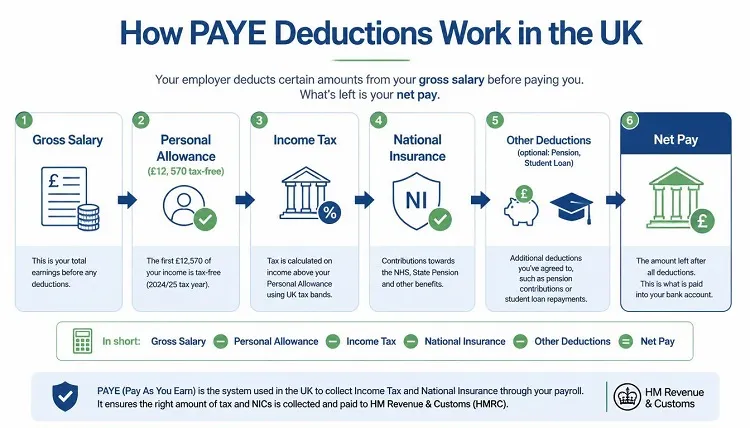
PAYE (Pay As You Earn) is the system HMRC uses to collect Income Tax and National Insurance directly from your wages before you’re paid. Your employer works out the deductions each payday, based on your tax code, and sends the money straight to HMRC. That’s why most employees never need to file a tax return for this income.
If you’ve ever looked at your payslip and wondered where a chunk of your salary went, this guide walks through exactly what PAYE is, how it’s worked out, and why the deduction sometimes looks bigger than you’d expect.
What Does PAYE Stand For?
PAYE stands for Pay As You Earn. It describes exactly what it does: rather than settling a single tax bill at the end of the year, you pay Income Tax and National Insurance gradually, in instalments, as you earn each payslip’s worth of income.
The Meaning Behind the Acronym
The name comes from HMRC’s original goal, spreading a worker’s tax bill evenly across the tax year instead of asking for one large payment. Each time your employer runs payroll, they calculate what you owe, take it from your gross pay, and forward it to HMRC on your behalf.
A Short History: Why the UK Introduced PAYE in 1944
PAYE was introduced in the UK in 1944, devised by Sir Paul Chambers. Before this, many workers faced a large, lump-sum Income Tax bill once a year, which caused genuine hardship for households on modest wages. Spreading deductions across each payday made the system fairer and far easier for HMRC to administer at scale, and it remains the backbone of UK personal taxation today.
Is PAYE the Same as Income Tax?
No. PAYE is not a tax itself, it’s the collection method. Income Tax and National Insurance are the actual taxes; PAYE is simply the mechanism your employer uses to deduct and pay them to HMRC on your behalf.
Who Pays Tax Through PAYE? (PAYE Employee Meaning)
If you’re employed and paid a wage or salary, you’re almost certainly a “PAYE employee”. This also applies to most people receiving a workplace or private pension.
What Counts as a “PAYE Employee”
A PAYE employee is anyone whose Income Tax and National Insurance are deducted automatically by an employer or pension provider, rather than being worked out and paid personally through a tax return. This includes full-time staff, part-time staff, zero-hours workers, and most casual employees.
PAYE vs Self-Assessment: Who Uses Which
Self-employed people, company directors, and those with additional untaxed income (such as rental income or dividends above certain thresholds) typically use Self-Assessment instead, or alongside PAYE.
| PAYE | Self-Assessment | |
|---|---|---|
| Who it applies to | Employees, most pensioners | Self-employed people, company directors, high earners with other income |
| Who calculates the tax | Employer or pension provider | The individual |
| When tax is paid | Every payday, throughout the year | Once, or twice, a year, by deadline |
| Do you file a tax return? | Usually not | Yes |
What Is PAYE Used For?
PAYE exists to collect two things from your pay: Income Tax and National Insurance.
Funding Public Services
The Income Tax collected through PAYE helps fund public services such as the NHS, schools, and infrastructure. It’s the government’s main route for collecting tax from employment income throughout the year rather than waiting until the tax year ends.
Building Your National Insurance Record
The National Insurance portion of PAYE isn’t just a tax, it also builds your entitlement to the State Pension and certain other contributory benefits. Paying National Insurance consistently through PAYE, even in relatively low-paid work, helps protect your future entitlement.
How Is PAYE Calculated? (Step by Step)
PAYE calculations follow the same basic process for almost everyone, though the exact figures depend on your income and tax code.
Step 1: Your Tax Code Determines Your Tax-Free Personal Allowance
Your tax code tells your employer how much you can earn before any Income Tax is due. The standard code for the 2026/27 tax year is 1257L, reflecting the £12,570 Personal Allowance.
Step 2: Income Above Your Personal Allowance Is Taxed in Bands
Anything you earn above your Personal Allowance is taxed at increasing rates as your income rises.
2026/27 Income Tax bands (England, Wales and Northern Ireland)
| Band | Rate | Taxable income |
|---|---|---|
| Personal Allowance | 0% | £0 to £12,570 |
| Basic rate | 20% | £12,571 to £50,270 |
| Higher rate | 40% | £50,271 to £125,140 |
| Additional rate | 45% | Over £125,140 |
Scotland uses different Income Tax bands and rates, so if you live there, your figures will differ slightly from the table above.
Step 3: National Insurance Is Deducted Separately
National Insurance is calculated independently from Income Tax, using its own threshold and rates.
2026/27 Employee National Insurance
| Earnings | Rate |
|---|---|
| Up to £12,570 a year (£242 a week) | 0% |
| £12,570 to £50,270 | 8% |
| Above £50,270 | 2% |
Step 4: What’s Left Is Your Take-Home (Net) Pay
Once Income Tax and National Insurance have been deducted (along with anything else, such as pension contributions), what remains is your net pay, the amount that actually lands in your bank account.
Worked Example: Sarah’s Payslip Explained
Sarah earns £30,000 a year and is on the standard 1257L tax code, paid monthly.
- Her Personal Allowance is £12,570, so £1,047.50 of her monthly pay is tax-free.
- The rest of her salary above the allowance is taxed at the basic rate of 20%.
- Her monthly Income Tax deduction works out to roughly £290.
- Her monthly National Insurance deduction, at 8% on earnings above the threshold, comes to roughly £117.
- After both deductions, Sarah’s take-home pay is around £2,093 out of a gross monthly salary of £2,500.
The exact figures vary slightly depending on how HMRC applies the calculation across the tax year, but this gives a realistic picture of how gross pay becomes net pay under PAYE.
How Much Is PAYE Tax in the UK?
There’s No Single “PAYE Rate”: Here’s Why
PAYE itself doesn’t have one rate, because it isn’t a tax. What you pay depends on how much of your income falls into each Income Tax band, plus how much National Insurance applies above the relevant threshold. Someone earning £25,000 and someone earning £80,000 will have very different PAYE deductions, even though both are taxed under exactly the same system.
Quick Reference: What You’ll Pay at Different Salaries
| Annual salary | Approximate annual Income Tax | Approximate annual National Insurance |
|---|---|---|
| £25,000 | £2,486 | £994 |
| £35,000 | £4,486 | £1,794 |
| £60,000 | £11,432 | £2,715 |
| £110,000 | Higher, due to Personal Allowance tapering (see the 60% tax trap below) | £3,915 |
These figures are approximate and assume the standard tax code with no other adjustments.
How Is PAYE Calculated Monthly in the UK?
Why Deductions Can Vary Slightly Month to Month
PAYE is usually calculated on a cumulative basis, meaning HMRC and your employer look at your total pay and tax paid so far in the tax year each time they run payroll. This can cause your deduction to shift slightly if you receive a bonus, get a pay rise, or have your tax code changed partway through the year.
Weekly vs Monthly PAYE: Does It Make a Difference?
Whether you’re paid weekly or monthly, the underlying calculation is the same, just applied over a shorter or longer period. Your Personal Allowance and tax bands are simply divided into weekly or monthly portions to match your pay frequency.
PAYE and NI on Your Payslip: What Each Line Means
Reading Your Payslip Line by Line
Most UK payslips list several standard items alongside your gross pay:
- Tax code: shown as a short code such as 1257L, telling your employer your Personal Allowance
- PAYE Income Tax: the amount deducted for Income Tax this pay period
- National Insurance: shown separately from Income Tax, calculated on its own threshold
- Net pay: your total after all deductions, the amount actually paid into your account
Common Payslip Deductions Besides PAYE and NI
You may also see other deductions, such as workplace pension contributions, student loan repayments, or salary sacrifice arrangements. These are separate from PAYE itself but are often processed through the same payroll run.
Why Am I Paying PAYE Tax? (And Why It Might Feel High)
It’s a completely normal question to ask, particularly if your take-home pay looks smaller than you expected.
You’re Probably Not on the Wrong Tax Code: Here’s How to Check
Most PAYE deductions are calculated correctly. You can check your tax code on your payslip, your P60, or through your personal HMRC online account, and compare it against the standard 1257L code for your situation.
Common Reasons Your PAYE Deduction Looks Bigger Than Expected
- An emergency tax code: applied when HMRC doesn’t yet have full details about your income, often when starting a new job
- A second job or multiple income sources: your Personal Allowance may already be allocated to your main job, meaning a second income is taxed from the first pound earned
- A taxable benefit in kind: such as a company car or private medical insurance, which reduces your available Personal Allowance
- Underpaid tax from a previous year: HMRC may adjust your current tax code to recover a shortfall gradually
What Is the 60% Tax Trap?
How the Personal Allowance Taper Works
Once your income passes £100,000, your Personal Allowance starts to shrink. For every £2 you earn above that threshold, you lose £1 of allowance, until it disappears completely at £125,140.
Why It Creates an Effective 60% Rate
Because you’re paying 40% Higher Rate tax on that extra income and simultaneously losing tax-free allowance you’d otherwise have kept, the combined effect works out to an effective marginal rate of around 60% on earnings between £100,000 and £125,140.
The 60% tax trap illustrated
| Income band | What happens | Effective marginal rate |
|---|---|---|
| £100,000 to £125,140 | Personal Allowance tapers away completely | Around 60% |
| Above £125,140 | Personal Allowance fully gone, standard Additional Rate applies | 45% (plus National Insurance) |
Legitimate Ways People Reduce the Impact
Some people reduce their adjusted net income below £100,000 through pension contributions or Gift Aid donations, which can restore some or all of the Personal Allowance. This is a genuinely useful area to plan around if it affects you, though everyone’s situation is different, and this article isn’t a substitute for personalised financial advice.
What Happens If You’ve Paid the Wrong Amount of PAYE?
How to Check If Your Tax Code Is Correct
Compare the tax code shown on your latest payslip against your circumstances. If you have one job, no company benefits, and no other income, it should normally read 1257L. Anything else may be worth checking through your HMRC online account.
What to Do If You’ve Underpaid or Overpaid
If you’ve underpaid, HMRC will usually adjust your tax code to collect the shortfall gradually over the following tax year, rather than demanding a lump sum. If you’ve overpaid, you’re entitled to a refund, which HMRC will either pay automatically or which you can claim through your online account.
Frequently Asked Questions
What is the PAYE tax rate in the UK?
There’s no single PAYE rate. Income Tax under PAYE ranges from 0% within your Personal Allowance up to 45% on earnings above £125,140, while National Insurance is charged separately at 8% and then 2% above the relevant thresholds.
How is PAYE calculated monthly in the UK?
Your annual Personal Allowance and tax bands are divided by twelve, and Income Tax and National Insurance are worked out on that month’s pay, usually on a cumulative basis that accounts for your total earnings so far in the tax year.
Why is PAYE so high?
PAYE deductions can feel high because they combine both Income Tax and National Insurance in one visible line. Common reasons for a higher-than-expected deduction include an emergency tax code, a second job, or a taxable benefit reducing your allowance.
What is the 60% trap?
The 60% tax trap refers to the effective marginal tax rate created when your Personal Allowance tapers away between £100,000 and £125,140 of income, meaning you effectively lose 60p of every extra £1 earned in that band.
What is PAYE used for?
PAYE collects Income Tax and National Insurance from employees throughout the year. The Income Tax helps fund public services, while the National Insurance element builds your entitlement to the State Pension.
Is PAYE the same as Income Tax?
No. PAYE is the system that collects Income Tax and National Insurance from your wages. Income Tax is one of the two taxes it collects, not a separate thing from PAYE itself.
What does PAYE stand for?
PAYE stands for Pay As You Earn, the system introduced in the UK in 1944 to collect Income Tax and National Insurance gradually from wages, rather than as a single annual bill.
Do I need to do anything myself under PAYE?
Generally not. Your employer calculates and pays your Income Tax and National Insurance automatically. It’s still worth checking your tax code occasionally to make sure it’s correct for your circumstances.
Related Reading
- Payroll for Small Businesses UK, for the employer’s side of running PAYE
- Business Structure UK, to understand how employment status affects your tax position
- HMRC Business Tax Account, for managing your HMRC account online
This article is accurate as of the 2026/27 tax year. Tax codes, thresholds and rates can change, so always check the latest guidance on GOV.UK or speak to a qualified accountant for advice specific to your circumstances.