

Working Capital Explained: The Complete UK Guide (With Formula and Examples)
Running a business is not just about winning sales. It is about having enough cash on hand to keep the lights on while you wait to get paid. That gap between spending and earning is where working capital comes in.
If you have ever wondered why a profitable business can still run out of cash, this guide will make it click. We will cover the working capital formula, walk through a simple example, and explain every variation you are likely to come across, from net working capital to the working capital cycle.
What Is Working Capital?
Working capital is the money a business has available to cover its short-term costs. It is the difference between what you own that can quickly turn into cash, and what you owe that is due soon.
In plain terms:
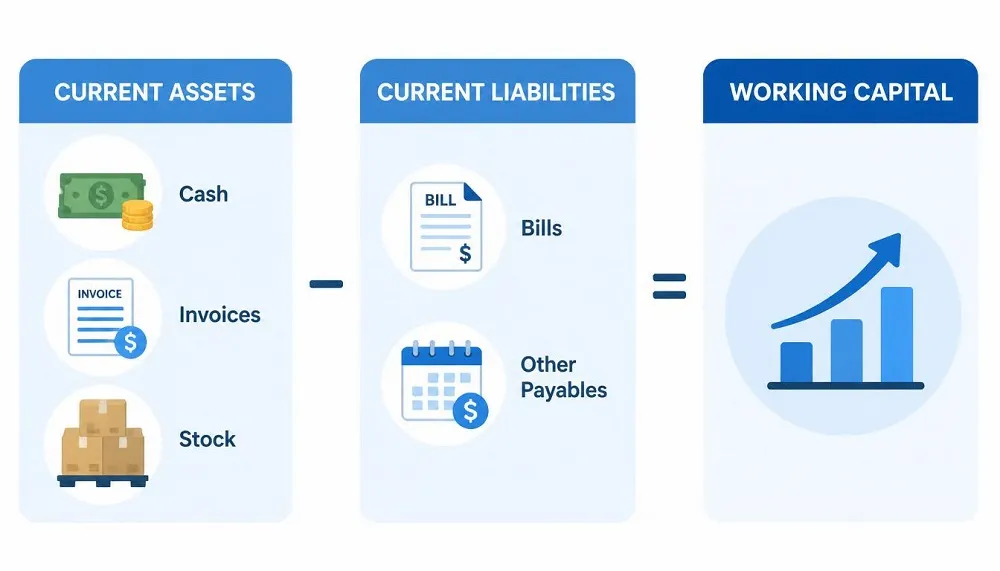
Working Capital = Current Assets − Current Liabilities
Current assets are things you can turn into cash within a year, such as cash itself, money owed to you by customers, and stock. Current liabilities are bills due within a year, such as supplier invoices, short-term loans, and tax owed.
If your current assets are bigger than your current liabilities, you have positive working capital. That means you can pay your near-term bills without stress. If it is the other way round, you have negative working capital, which can be a warning sign or, in some cases, a sign of a very efficient business model. We will cover both later.
The Working Capital Formula
The formula itself is simple. The hard part is gathering accurate numbers for current assets and current liabilities from your balance sheet.
Working Capital = Current Assets − Current Liabilities
Current assets typically include:
- Cash and cash equivalents
- Accounts receivable (money owed by customers)
- Stock and inventory
- Prepaid expenses
Current liabilities typically include:
- Accounts payable (money owed to suppliers)
- Short-term loans and overdrafts
- The portion of long-term debt due within a year
- Accrued expenses, including tax and payroll
A Simple Working Capital Example
Say you run a small furniture retailer. At the end of the month, your balance sheet shows:
- Cash: £15,000
- Accounts receivable: £10,000
- Stock: £25,000
- Total current assets: £50,000
On the liabilities side:
- Accounts payable: £20,000
- Short-term loan repayment due: £8,000
- Accrued tax and wages: £4,000
- Total current liabilities: £32,000
Working Capital = £50,000 − £32,000 = £18,000
This means you have £18,000 of breathing room to cover day-to-day costs, restock inventory, or handle an unexpected bill, without needing to borrow or sell long-term assets.
How to Find Working Capital on a Balance Sheet
Your balance sheet splits everything into assets, liabilities, and equity. To work out working capital, you only need two sections.
- Look for “current assets,” usually listed near the top of the assets section, above fixed assets like property or equipment.
- Look for “current liabilities,” usually listed above long-term liabilities like a mortgage or long-term loan.
- Subtract the current liabilities total from the current assets total.
Most accounting software, including Xero and QuickBooks, will show these totals automatically on a standard balance sheet report. If you use a bookkeeper or accountant, ask them to point out these two figures. It takes seconds once you know where to look.
Net Working Capital Explained
Net working capital and working capital are, in most everyday use, the same thing. Both describe current assets minus current liabilities.
Where the terms sometimes split is in financial analysis. Some analysts use a narrower version of net working capital that strips out cash and short-term debt, focusing purely on the operating items like receivables, stock, and payables. This gives a cleaner view of how efficiently the core business is run, separate from financing decisions.
For most small and medium UK businesses, you do not need to worry about this distinction day to day. If your accountant or lender mentions net working capital, they almost certainly mean the standard formula above.
Change in Net Working Capital Explained
The change in net working capital looks at how your working capital shifts from one period to the next. It matters because a growing business often needs more working capital, not less.
Change in Net Working Capital = Net Working Capital (Current Period) − Net Working Capital (Prior Period)
If this figure is positive, your working capital has grown, which usually means cash is getting tied up in things like stock or unpaid invoices. If it is negative, working capital has shrunk, which can free up cash but might also signal slower sales or tighter supplier terms.
This metric matters most to lenders and investors, since it feeds directly into free cash flow calculations. A business that keeps needing more and more working capital to support the same level of sales is worth a closer look.
Operating Working Capital Explained
Operating working capital narrows the focus to the assets and liabilities directly tied to your core operations. It usually excludes cash, short-term investments, and short-term debt, since these relate more to financing than to running the business.
Operating Working Capital = (Accounts Receivable + Inventory) − Accounts Payable
This version strips out the noise from financing decisions, like how much cash you happen to be holding or how much you have borrowed. It is a cleaner way to judge how well you manage receivables, stock, and supplier payments, which are the levers you can actually control day to day.
Negative Working Capital Explained
Negative working capital happens when current liabilities are higher than current assets. On paper, that can look alarming, but the story depends heavily on your industry.
When Negative Working Capital Is a Warning Sign
For most businesses, negative working capital means trouble is brewing. If you cannot cover bills due in the next year using assets you can convert to cash in that time, you may need to borrow, delay payments, or sell assets to stay afloat. This is common in struggling businesses with slow-paying customers or excess unsold stock.
When Negative Working Capital Is a Sign of Efficiency
Some business models are built around negative working capital, and it works in their favour. Supermarkets and many hospitality businesses collect cash from customers immediately, sell through stock quickly, but pay their own suppliers on 30 or 60-day terms. That gap means customers are effectively funding operations, which is a strength rather than a weakness, as long as sales stay steady.
The key is context. A negative figure alone tells you little. You need to look at why it is negative and whether the business can comfortably meet its obligations as they fall due.
Trade Working Capital Explained
Trade working capital zooms in on the parts of working capital that come directly from trading activity, buying, holding, and selling goods or services.
Trade Working Capital = (Accounts Receivable + Inventory) − Accounts Payable
You will notice this looks identical to operating working capital in most definitions. That is because both terms describe the same core idea from slightly different angles, one from an operations lens and one from a trading lens. What matters more than the label is understanding that this figure isolates the cash tied up specifically in your buying and selling cycle, separate from loans, cash reserves, or one-off costs.
The Working Capital Ratio Explained
The working capital ratio, also called the current ratio, shows how many times over your current assets could cover your current liabilities.
Working Capital Ratio = Current Assets ÷ Current Liabilities
Using our earlier example: £50,000 ÷ £32,000 = 1.56
A ratio above 1 means you have more current assets than current liabilities, which is generally healthy. A ratio below 1 means your current liabilities outweigh your current assets, which can point to liquidity pressure.
What Counts as a Healthy Working Capital Ratio
There is no single number that fits every business. As a rough guide, a ratio between 1.2 and 2 is often considered comfortable for many UK SMEs. A ratio that is too high, well above 2, is not automatically good news either. It can mean cash is sitting idle in stock or unpaid invoices instead of being reinvested into growth. The right ratio depends on your sector, how quickly you turn over stock, and how reliably your customers pay on time.
Working Capital Requirement: How Much Do You Need?
Your working capital requirement is the amount of cash you need to bridge the gap between paying your costs and receiving customer payments. It is a forward-looking figure, unlike working capital itself, which is a snapshot from your balance sheet.
Working Capital Requirement Formula
Working Capital Requirement = Current Assets (excluding cash) − Current Liabilities (excluding short-term debt)
In practice, most small businesses estimate this by mapping out their cash flow cycle. Work out how long it takes to sell stock, how long customers take to pay, and how long you have before you must pay suppliers. The longer the gap between spending and getting paid, the more working capital you need to cover it comfortably. Building in a margin of safety for unexpected costs, like a tax bill or a slow month, is worth doing too.
The Working Capital Cycle Explained
The working capital cycle measures how many days it takes for your business to turn money spent on stock or materials back into cash from customers.
Working Capital Cycle = Inventory Days + Receivable Days − Payable Days
- Inventory days: how long stock sits before it sells
- Receivable days: how long customers take to pay after a sale
- Payable days: how long you take to pay your own suppliers
Working Capital Cycle Formula and Example
Imagine a small manufacturer. It takes 45 days to sell stock, customers pay in 30 days after that, and suppliers are paid within 40 days.
Working Capital Cycle = 45 + 30 − 40 = 35 days
This means cash is tied up for 35 days between paying for materials and getting paid by customers. A shorter cycle is generally better, since it frees up cash faster. Some UK sectors, particularly hospitality and fast-moving retail, manage negative cycles, where they collect cash before they need to pay suppliers, effectively letting customers fund the business.
Why Working Capital Matters
Working capital is often called the lifeblood of a business, and that is not an exaggeration. Even a profitable company can fail if it runs out of cash to pay staff, suppliers, or tax bills on time.
Strong working capital gives you room to:
- Cover payroll and rent without stress during slower months
- Take advantage of bulk discounts or early payment terms from suppliers
- Handle unexpected costs, like an equipment repair or a late-paying customer
- Invest in growth, such as new stock or marketing, without taking on debt
- Reassure lenders and investors that your business is financially stable
Weak or negative working capital, on the other hand, often forces businesses into expensive short-term borrowing, missed supplier discounts, or difficult conversations with creditors. Keeping an eye on this figure regularly, not just once a year at accounts time, helps you spot problems before they become serious.
Working Capital Management: How to Improve It
Managing working capital well comes down to speeding up cash coming in and slowing down cash going out, without damaging relationships with customers or suppliers.
Practical steps that tend to make the biggest difference:
- Invoice promptly and chase payment early. Send invoices the moment work is complete, and follow up before the due date, not after.
- Offer easy payment methods. Card payments and online invoicing tend to get paid faster than bank transfer requests.
- Negotiate supplier terms. Ask for 45 or 60-day terms instead of 30, particularly once you have built a reliable payment history.
- Keep stock lean. Order closer to when you need it rather than buying in bulk “just in case,” unless the discount clearly outweighs the cost of tied-up cash.
- Forecast your cash flow monthly. A simple spreadsheet showing money in and out over the next three months will flag gaps before they become emergencies.
- Consider short-term finance carefully. An overdraft or invoice finance facility can bridge a temporary gap, but it should support a healthy business, not paper over a structural problem.
Common Mistakes UK Businesses Make
A few patterns show up again and again in businesses that struggle with working capital:
- Confusing profit with cash. A business can be profitable on paper while still being short of cash if customers pay slowly.
- Overstocking. Buying too much inventory ties up cash that could be used elsewhere.
- Ignoring the cycle until it is urgent. Waiting until cash is tight to think about working capital makes problems harder to fix.
- Growing too fast without planning. Rapid growth increases the need for working capital, since more stock and receivables are needed to support higher sales.
- Not reviewing supplier and customer terms regularly. Payment terms agreed years ago may no longer suit your current cash position.
Frequently Asked Questions
What is working capital in simple terms?
It is the cash a business has left to cover its short-term bills after accounting for what it owns and owes in the next year. Current assets minus current liabilities.
What is a good working capital ratio?
For most UK SMEs, a ratio between 1.2 and 2 is considered healthy, though this varies by sector.
Can working capital be negative?
Yes. It can signal financial trouble, or it can reflect an efficient business model where customers pay before suppliers need to be paid, common in retail and hospitality.
How often should I check my working capital?
Monthly is a sensible minimum for most small businesses, especially those with seasonal sales or slow-paying customers.
What is the difference between working capital and cash flow?
Working capital is a snapshot from your balance sheet at a single point in time. Cash flow tracks money moving in and out over a period. They are related but measure different things.