

Profit and Loss Statement: A Simple Guide for UK Small Businesses
If you have ever looked at your bank balance and wondered whether your business is actually making money, a profit and loss statement is the answer. It is one of the most useful documents you will ever produce, and once you understand the basics, it takes very little time to read or build.
This guide walks through what a profit and loss statement is, what it looks like, how to build one step by step, and how to read the numbers once it is done. We will use a UK lens throughout, including how HMRC and Companies House fit into the picture.
What Is a Profit and Loss Statement?
A profit and loss statement is a financial report that shows how much money your business earned and spent over a set period, and whether you ended up with a profit or a loss. It lists your revenue at the top, subtracts your costs and expenses, and leaves you with a single figure at the bottom: your net profit or net loss.
You will also hear it called an income statement or a P&L. These all mean the same thing. Some industries prefer “income statement,” but in everyday UK business conversation, “profit and loss statement” or simply “the P&L” is the more common term.
Unlike a bank statement, which just shows cash moving in and out, a P&L organises that activity into categories so you can see exactly where your money is coming from and where it is going.
Other names you’ll see
- Income statement
- P&L or P&L statement
- Statement of operations
- Profit and loss account (a term still used in UK company law)
All four describe the same report. If your accountant mentions any of these, they are talking about your P&L.
Why Every Business Needs One
A profit and loss statement earns its place as one of the three core financial statements, alongside the balance sheet and cash flow statement, for three practical reasons.
Checking profitability. Your bank balance can be misleading. You might have cash sitting there from a customer who paid early, while unpaid bills are due next week. A P&L strips out that noise and shows your actual trading performance for the period.
Meeting HMRC and Companies House requirements. If you run a limited company, you are required to produce a profit and loss statement as part of your annual accounts, and HMRC uses your profit figure to work out your Corporation Tax. Sole traders are not legally required to produce a formal P&L, but the figures you report on your Self Assessment tax return are built from the same information.
Winning investors and loans. Lenders and investors almost always ask for recent P&L statements before they commit money. They want to see a track record of revenue, costs, and profit trends, not just a single snapshot.
| Report | Main Purpose | Shows |
|---|---|---|
| Profit and Loss Statement | Business performance | Income, expenses, profit |
| Balance Sheet | Financial position | Assets, liabilities, equity |
| Cash Flow Statement | Cash movement | Cash received and paid |
What Does a Profit and Loss Statement Look Like?
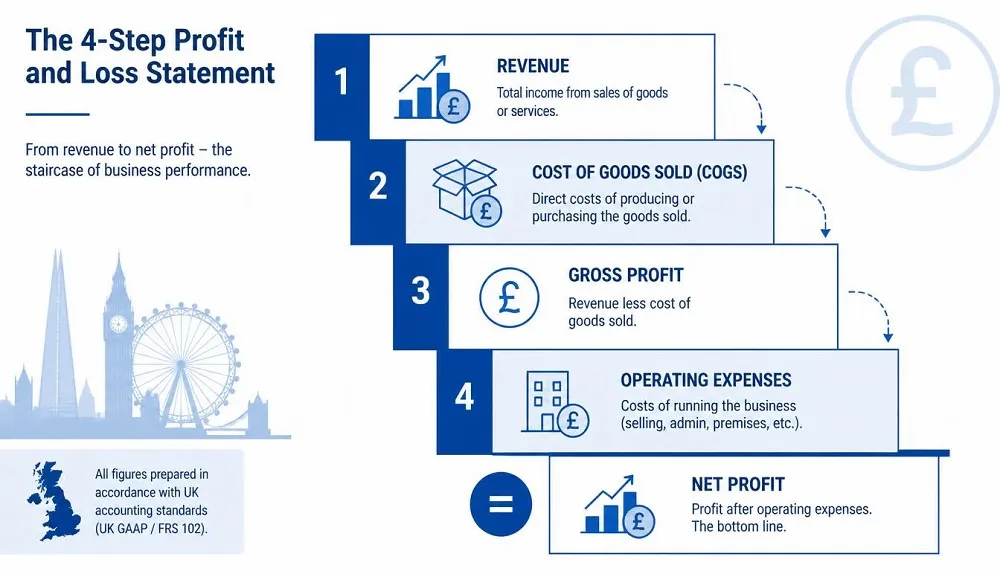
A basic profit and loss statement has four building blocks, always in the same order.
- Revenue – everything you earned from sales, services, or other trading income during the period.
- Cost of goods sold (COGS) – the direct costs of producing what you sold, such as materials, stock, or direct labour.
- Operating expenses – the overheads needed to run the business, such as rent, salaries, insurance, and marketing.
- Net profit or loss – what’s left after every cost has been subtracted from revenue.
Picture it as a simple staircase: you start at the top with total revenue, and each step down subtracts another category of cost, until you land on your bottom line.
The four main sections explained
Revenue sits at the very top and is often called the “top line.” Cost of goods sold comes next and is subtracted from revenue to give you gross profit. Operating expenses are subtracted from gross profit to give you operating profit. Finally, any other income, interest, or tax is accounted for to arrive at net profit, commonly called the “bottom line.”
Profit and Loss Statement Format: Single-Step vs Multi-Step
There are two common formats, and the right one depends on how much detail you need.
The single-step format lists all your revenue in one block and all your expenses in another, then subtracts one from the other in a single calculation. It is quick to prepare and easy to read, which makes it popular with sole traders and very small businesses.
The multi-step format breaks the calculation into stages: revenue minus COGS gives gross profit, gross profit minus operating expenses gives operating profit, and operating profit minus tax and interest gives net profit. This format takes a little longer to build but tells you far more about where your money is actually going, which is why most growing businesses and their accountants prefer it.
If you only want a quick sense of whether you are profitable, single-step will do. If you want to understand what is driving that profit, or you plan to show the statement to a lender, choose multi-step.
How to Create a Profit and Loss Statement (Step-by-Step)
Building your first P&L is far less daunting once you break it into stages.
Step 1: Choose your reporting period
Decide whether you are reporting for a month, a quarter, or a full year. Monthly statements are best for spotting problems early. Quarterly and annual statements matter more for tax returns and investors. Many small businesses do both: a quick monthly check and a more formal annual version.
Step 2: Add up your revenue
Total every source of trading income for the period: product sales, service fees, commissions, or rental income if that applies to your business. This is your gross income, before any costs are removed.
Step 3: List your cost of goods sold
Add up the direct costs tied to what you sold, such as raw materials, stock purchases, packaging, and direct labour. If you run a service business with no physical stock, this section may be small or even zero.
Step 4: Calculate gross profit
Subtract your cost of goods sold from your revenue. The result is your gross profit, which shows how efficiently you are producing or delivering what you sell before overheads are considered.
Step 5: Add your operating expenses
List your overheads: rent, utilities, salaries, insurance, software subscriptions, marketing, and any other cost needed to keep the business running day to day, regardless of how much you sold.
Step 6: Work out net profit or loss
Subtract your operating expenses (plus any interest or tax) from your gross profit. What remains is your net profit if the figure is positive, or your net loss if it is negative. This is the number everyone, from HMRC to a potential investor, cares about most.
Worked Example: A Simple Profit and Loss Statement
Here is a plain example for a small business over one month.
| Line item | Amount |
|---|---|
| Revenue | £12,000 |
| Cost of goods sold | £4,500 |
| Gross profit | £7,500 |
| Rent | £1,200 |
| Salaries | £2,800 |
| Marketing | £600 |
| Insurance | £150 |
| Total operating expenses | £4,750 |
| Net profit | £2,750 |
This business made £12,000 in sales, spent £4,500 producing what it sold, and paid £4,750 to keep the doors open. What is left, £2,750, is the true profit for the month, the figure that matters most for tax and decision-making.
How to Read a Profit and Loss Statement
Once your P&L is built, reading it well matters just as much as building it correctly.
Start at the bottom line first. A positive net profit means your business earned more than it spent. A negative figure, or net loss, means spending outpaced income for that period and it is worth investigating why.
Then work upward. Compare gross profit to revenue to see your gross margin, which tells you how much of every pound in sales is left after direct costs. Compare net profit to revenue for your net margin, which tells you how much is left after everything, including overheads.
What healthy gross and net margins look like
There is no single “correct” margin because it varies hugely by industry, but as a general guide, a gross margin above 50% is considered strong for many product-based businesses, while service businesses often run higher. Net margins between 10% and 20% are typical for a healthy small business, though thinner margins are normal in sectors like retail and hospitality. Track your own margin over time rather than chasing an industry average. A steady or improving trend usually matters more than the exact number.
Monthly vs Quarterly vs Year to Date Profit and Loss Statements
A monthly profit and loss statement is the most useful for active management. It lets you catch a cost spike or a slow sales month while there is still time to act.
A quarterly statement smooths out month-to-month noise and is often what accountants and lenders ask for.
A year to date profit and loss statement adds up every month since the start of your financial year, giving you a running total that is especially useful when comparing performance against the same point last year, or when preparing figures for your accountant ahead of tax season.
Most businesses benefit from keeping a rolling monthly P&L and reviewing the year-to-date figures at least once a quarter.
Profit and Loss Statement vs Balance Sheet vs Cash Flow Statement
These three reports work together, but each answers a different question.
A profit and loss statement shows performance over a period, such as a month or a year. It answers: “Did I make money?”
A balance sheet shows a snapshot at a single point in time, listing what your business owns and owes. It answers: “What is my business worth right now?”
A cash flow statement tracks the actual movement of cash in and out. It answers: “Do I have enough cash to pay my bills?”
A profitable business on paper can still run into trouble if cash is tied up in unpaid invoices, which is exactly why lenders and investors ask to see all three reports together rather than relying on the P&L alone.
Sole Trader vs Limited Company: What Changes
If you are a sole trader, you are not legally required to produce a formal profit and loss statement, but you still need the same information to complete your Self Assessment tax return. Your net profit figure is what HMRC uses to calculate the Income Tax and National Insurance you owe.
If you run a limited company, producing a profit and loss statement is a legal requirement as part of your annual accounts filed with Companies House. HMRC also uses this figure to calculate Corporation Tax. Getting into the habit of preparing a P&L regularly, rather than scrambling at year end, makes both filings far less stressful.
Either way, keeping accurate records throughout the year, rather than reconstructing them later, is the single biggest factor in making this process painless.
Cash Basis vs Accrual Basis: Which Should You Use?
Cash basis accounting records income and expenses only when money actually changes hands. It is simple to understand and is available to many smaller sole traders in the UK, which is why it remains popular for straightforward businesses with few transactions.
Accrual basis accounting records income when it is earned and expenses when they are incurred, regardless of when the cash actually moves. This gives a more accurate picture of performance, especially if you invoice clients on payment terms, and is required for larger or more complex businesses.
If your business is small and straightforward, cash basis is usually easier to manage yourself. If you have significant unpaid invoices, stock, or you are seeking investment, accrual basis will give you and anyone reading your P&L a truer picture.
Where to Get a Free Profit and Loss Statement Template
You do not need to build a profit and loss statement from a blank page. Free templates are widely available in Excel, Google Sheets, PDF, and Word formats, and most follow the same basic structure covered in this guide: revenue, cost of goods sold, gross profit, operating expenses, and net profit.
Look for a template that already includes formulas for gross profit and net profit, so you only need to enter your own figures. A simple monthly template with a year-to-date column is usually the most practical starting point for a small business.
Common Mistakes to Avoid
A few errors show up repeatedly in P&L statements prepared without an accountant’s input.
Mixing personal and business expenses. This distorts your true profit and can cause problems with HMRC if the figures are ever queried.
Forgetting non-cash costs. Depreciation on equipment, for example, is a real cost even though no cash leaves your account that month.
Confusing cash in the bank with profit. A healthy bank balance does not always mean a healthy P&L, particularly if you have just been paid for work completed months ago.
Inconsistent categorisation. If you label the same expense differently from month to month, comparing periods becomes unreliable.
Frequently Asked Questions
What is a profit and loss statement in simple terms?
It is a report that adds up everything a business earned, subtracts everything it spent, and shows whether the result was a profit or a loss over a chosen period.
How do I make a profit and loss statement?
List your total revenue, subtract your cost of goods sold to get gross profit, subtract your operating expenses to get net profit, then compare that figure to previous periods to track your trend.
What does a profit and loss statement look like?
It typically appears as a simple table, with revenue at the top, costs and expenses listed below in categories, and net profit or loss as the final line.
In a profit and loss statement, how is income recorded?
Income is recorded as revenue at the top of the statement, either when cash is received (cash basis) or when it is earned (accrual basis), depending on which accounting method your business uses.
Do sole traders need a profit and loss statement?
There is no legal requirement, but the same figures are needed for your Self Assessment tax return, so most sole traders prepare one anyway to stay organised.
How often should I prepare a profit and loss statement?
Monthly is best for day-to-day management, with quarterly and annual versions prepared for tax purposes and for sharing with lenders or investors.
Final Thoughts
A profit and loss statement is not just a document for your accountant. Reviewed regularly, it becomes one of the clearest ways to understand whether your business decisions are actually working. Start with a simple monthly version, keep your categories consistent, and revisit the figures every month rather than only at tax time. Once the habit is in place, the numbers stop feeling like a chore and start becoming a genuinely useful guide for running your business.
This article is for general informational purposes and does not constitute tax, accounting, or financial advice. For guidance specific to your business, speak to a qualified accountant or visit GOV.UK for current HMRC guidance.