Balance Sheet Explained UK: What It Is and How to Read One
If you have ever opened a set of company accounts and felt lost at the balance sheet page, you are not alone. It looks like a wall of numbers, but once you know what you are looking at, it only takes a few minutes to understand.
This guide breaks down what a balance sheet is, what each section means, and how UK companies actually file one with Companies House. You will also see a worked example using real UK terms, so you can compare it against your own accounts.
What Is a Balance Sheet?
A balance sheet is a snapshot of a business on one specific date. It shows three things: what the business owns, what it owes, and what is left over for the owners once the debts are paid.
Unlike a profit and loss account, which covers a period of time such as a year, a balance sheet is frozen at a single moment. Think of a photograph rather than a video. On 31 March, the business looked like this. A month later, the numbers may have shifted.
The Accounting Equation, Explained Simply
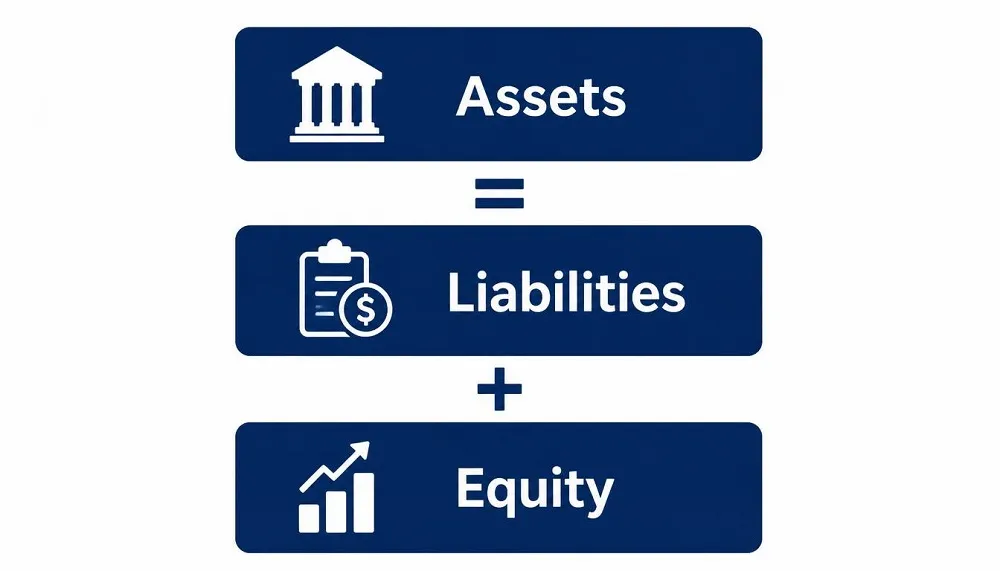
Every balance sheet follows one rule, and it always has to hold true:
Assets = Liabilities + Equity
In plain terms, everything the business owns was paid for either by borrowing (liabilities) or by the owner’s own money and retained profit (equity). If the two sides do not match, something in the bookkeeping is wrong. This is why it is called a “balance” sheet. It has to balance, every single time.
Is a Balance Sheet the Same as a Statement of Financial Position?
Yes. UK and international accounting standards now officially call it a statement of financial position, though almost everyone, including accountants, still says “balance sheet” in everyday conversation. You will see both names used on the same document, so do not worry if a set of accounts uses one term on the cover and the other inside.
What a Balance Sheet Is Also Known As
Beyond “statement of financial position”, you might come across a few other names depending on the context:
- Statement of assets and liabilities
- Net worth statement (more common for individuals or sole traders)
- Financial position report
They all describe the same thing: a summary of what is owned, what is owed, and what is left.
The Three Parts of a UK Balance Sheet
A UK balance sheet is built from three sections, and they always appear in this order.
Assets (Current and Non-Current)
Assets are everything the business owns that has value. They are split by how quickly they could be turned into cash.
- Current assets are things that will likely become cash within 12 months. This includes cash in the bank, money owed by customers (debtors), and stock.
- Non-current assets (sometimes called fixed assets) are held for the long term. Think property, equipment, vehicles, and intangible assets like patents or goodwill.
Liabilities (Current and Non-Current)
Liabilities are what the business owes to other people.
- Current liabilities are due within the next 12 months, such as supplier bills, VAT owed, corporation tax, and the portion of a loan due this year.
- Non-current liabilities are debts due after more than a year, such as the remaining balance on a long-term bank loan.
Shareholders’ Equity
Equity is what would be left for the owners if every asset were sold and every liability paid off. For a limited company, this usually includes share capital (money put in by shareholders) and retained earnings (profit kept in the business rather than paid out as dividends).
A Balance Sheet UK Example
Numbers make this far easier to follow than definitions alone. Here is a simple balance sheet example with answers built in, using a fictional small UK company.
Worked Example: Riverside Joinery Ltd
Riverside Joinery Ltd is a small limited company. Here is its balance sheet as at 31 March 2026.
| Item | Amount (£) |
|---|---|
| Non-current assets | |
| Workshop equipment | 18,000 |
| Current assets | |
| Stock (timber and fittings) | 6,000 |
| Debtors (owed by customers) | 4,500 |
| Cash at bank | 3,200 |
| Total assets | 31,700 |
| Current liabilities | |
| Trade creditors (owed to suppliers) | 4,700 |
| Corporation tax owed | 2,000 |
| Non-current liabilities | |
| Bank loan (remaining term) | 10,000 |
| Total liabilities | 16,700 |
| Equity | |
| Share capital | 1,000 |
| Retained earnings | 14,000 |
| Total equity | 15,000 |
Check the equation: Total assets (£31,700) = Total liabilities (£16,700) + Total equity (£15,000). It balances, which tells you the figures have been recorded correctly.
Balance Sheet UK Format: How It’s Laid Out
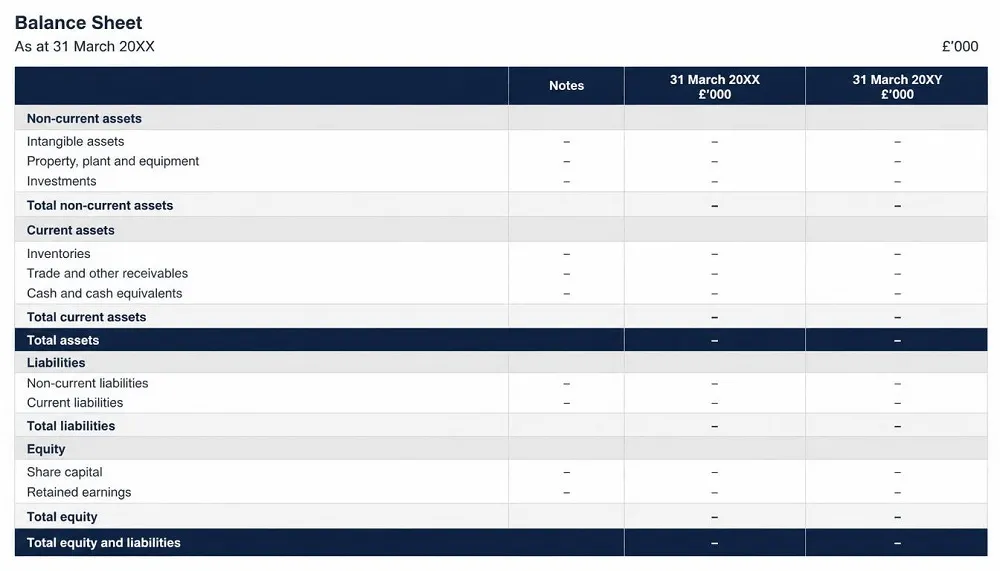
Most UK balance sheets use what is called a vertical format. Instead of listing assets on the left and liabilities on the right (a horizontal, older style you may still see in textbooks), the vertical format lists everything top to bottom in this order:
- Non-current (fixed) assets
- Current assets
- Current liabilities (often shown as a deduction to get “net current assets”)
- Non-current liabilities
- Net assets
- Equity (share capital and reserves)
This layout ends with “net assets” matching “total equity”, which is the same accounting equation shown in a slightly different order.
Balance Sheet vs Profit and Loss Account: What’s the Difference?
These two reports are often confused because they usually arrive together in a set of accounts.
| Balance Sheet | Profit and Loss Account | |
|---|---|---|
| Covers | One specific date | A period, usually a year |
| Shows | What is owned and owed | Income earned and costs spent |
| Answers | “What is this business worth right now?” | “Did this business make a profit?” |
| Also called | Statement of financial position | Income statement |
A business can be profitable on its profit and loss account and still run into trouble if its balance sheet shows too much debt or too little cash. That is why lenders and investors look at both together.
How to Read a Balance Sheet: A Step-by-Step Approach
You do not need an accounting qualification to get useful information from a balance sheet. Try this order:
- Check it balances. Total assets should equal total liabilities plus equity.
- Look at cash. Is there enough to cover the bills due soon?
- Compare current assets to current liabilities. This tells you about short-term financial health.
- Look at the trend. Compare this year’s figures to last year’s, shown side by side on most UK balance sheets.
- Check the debt level. How much of the business is funded by loans versus the owner’s own money?
Checking the Current Ratio
The current ratio is one of the simplest checks you can do. Divide current assets by current liabilities.
Using the Riverside Joinery example: £13,700 (current assets) ÷ £6,700 (current liabilities) = 2.0
A ratio above 1.0 generally means the business can cover its short-term bills. A ratio that is very high might mean cash is sitting idle rather than being put to work.
Checking Working Capital
Working capital is current assets minus current liabilities. For Riverside Joinery, that is £13,700 minus £6,700, which comes to £7,000. A positive number is a good sign. A negative one suggests the business may struggle to pay what it owes in the next year without borrowing more or chasing in cash.
How to Read a Balance Sheet UK Companies House Filing
Every UK limited company must file annual accounts, and the balance sheet is the one part that always has to be included, no matter how small the company is.
What you will see on a filed balance sheet depends on the size of the company:
- Micro-entities can file a simplified balance sheet with far fewer figures broken down, plus a required statement confirming the accounts were prepared under micro-entity provisions.
- Small companies file a slightly more detailed version, sometimes choosing an “abridged” balance sheet if all shareholders agree.
- Larger companies must file full accounts with detailed notes.
Micro-Entity Balance Sheet Explained UK
A company usually qualifies as a micro-entity if it meets at least two of these three conditions: turnover of no more than £1 million, a balance sheet total of no more than £500,000, and no more than 10 employees on average. If a company qualifies, it can file a much shorter balance sheet at Companies House, often without a detailed breakdown of debtors, creditors or stock. Many owners also choose to leave out the profit and loss account from what gets filed publicly, which is sometimes called filing “filleted” accounts, while still submitting full figures to HMRC.
Small Company vs Micro-Entity Accounts
A small company (one that is not small enough to be a micro-entity) can still file an abridged balance sheet, but the disclosure requirements are a bit higher than for a micro-entity. If you are unsure which category your company falls into, it is worth checking the current thresholds on the Companies House website or asking your accountant, since these limits have been reviewed in recent years.
Explain the Purpose of a Balance Sheet (and How Often You Need One)
The purpose of a balance sheet is to give a clear, honest picture of a business’s financial position at a fixed point in time, so owners, lenders, investors, and HMRC can judge how stable the business is.
For limited companies, a balance sheet must be prepared at least once a year, at the company’s financial year end, as part of the statutory accounts filed with Companies House and HMRC. Many business owners choose to prepare one more often, such as quarterly or monthly, purely to keep a closer eye on cash and debt levels rather than waiting for year end to find out how things stand.
Balance Sheet Explained UK Template: What to Include
If you are building your own balance sheet from scratch, whether in a spreadsheet or accounting software, make sure it includes:
- Company name and the balance sheet date
- This period’s figures and the previous period’s figures side by side
- Non-current assets, broken down by type
- Current assets, broken down by type
- Current liabilities
- Non-current liabilities
- Net assets figure
- Equity section (share capital and reserves)
- A director’s printed name and signature, required for anything filed at Companies House
- The required micro-entity statement, if applicable
Common Mistakes People Make Reading a Balance Sheet
- Confusing profit with cash. A business can look profitable but still have very little cash if customers are slow to pay.
- Ignoring the previous year’s column. A single year’s figures tell you far less than comparing two years side by side.
- Assuming a large “total assets” figure means a healthy business. A business loaded with debt-funded assets can be riskier than a smaller one with little debt.
- Missing the notes. Even simplified accounts sometimes reference notes that explain unusual figures, and skipping them can lead to the wrong conclusion.
Balance Sheet Explained UK 2026: What’s Changed
Company size thresholds for micro-entity and small company status were updated for financial years starting from 6 April 2025 onwards, which affects filing requirements for many businesses reporting during 2026. Alongside this, HMRC’s Making Tax Digital rollout for Income Tax is increasing pressure on sole traders and landlords with qualifying income over £50,000 to keep digital, accurate records, which indirectly supports better quality balance sheet reporting even where a formal balance sheet is not the document filed with HMRC. If you are preparing accounts this year, it is worth checking the current thresholds rather than relying on older figures, since they do shift from time to time.
Frequently Asked Questions
What do balance sheets do?
They show what a business owns, what it owes, and what is left for the owners, all on one specific date, giving a snapshot of financial health.
How do balance sheets work?
They list assets, liabilities and equity so that assets always equal liabilities plus equity. If a business buys something, borrows money, or earns a profit, the balance sheet updates to reflect that change while still balancing.
Is a balance sheet a legal requirement?
Yes, for UK limited companies. It is a mandatory part of the statutory accounts filed with Companies House and HMRC every year, regardless of company size.
How often do balance sheets need to be prepared?
At minimum, once a year at the company’s financial year end. Many businesses also prepare one monthly or quarterly for their own internal use, even though only the annual version needs to be filed.
Final Thoughts
A balance sheet is not as complicated as it first looks. Once you understand that assets always equal liabilities plus equity, the rest of the document is just detail sitting underneath that one simple rule. Whether you are reading your own company’s accounts for the first time or checking a supplier’s financial health before signing a contract, knowing how to scan a balance sheet in a few minutes is a genuinely useful skill for anyone running or working with a UK business.
For a deeper look at how these figures feed into working out what a company is actually worth, see our guide on how to value a business.