
How to Create a Business Budget: The Complete UK Guide
A business budget is a financial plan that sets out how much money your business expects to earn and spend over a fixed period, usually a month, a quarter or a year. It gives you a clear picture of your income and costs so you can plan ahead, avoid overspending and make confident decisions about where your money goes.
Whether you’re running an established company or you’ve just started trading, a well-built budget is one of the most useful tools you have. This guide walks through exactly how to create one, what to include, and how UK tax obligations fit into the process, with a full worked example and a free template you can copy straight away.
What Is a Business Budget?
A business budget is a written financial plan showing your expected income and expenses over a set period, used to guide spending decisions and track whether your business is on target.
Unlike a rough mental estimate, a proper budget breaks your finances into categories such as revenue, fixed costs, variable costs and tax, so you can see exactly where every pound is expected to go before you spend it.
Business Budget vs Business Plan
A budget is not the same as a business plan, though the two are closely linked. Your business plan sets out your goals, market and strategy; your budget is the financial detail that supports it, showing whether those plans are actually affordable. Most lenders and investors will expect to see both.
Why UK Small Businesses Need a Budget
Poor cost estimation is a recurring cause of small business difficulty in the UK. Owners who underestimate rent, staffing, insurance and tax often find themselves short of cash within the first year, not because the business idea is flawed, but because spending was never mapped against income in advance.
A budget solves this by giving you an early warning system. If costs start creeping above plan, or revenue falls short, you see it in the numbers weeks before it becomes a genuine problem.
Business Budget vs Cash Flow Forecast
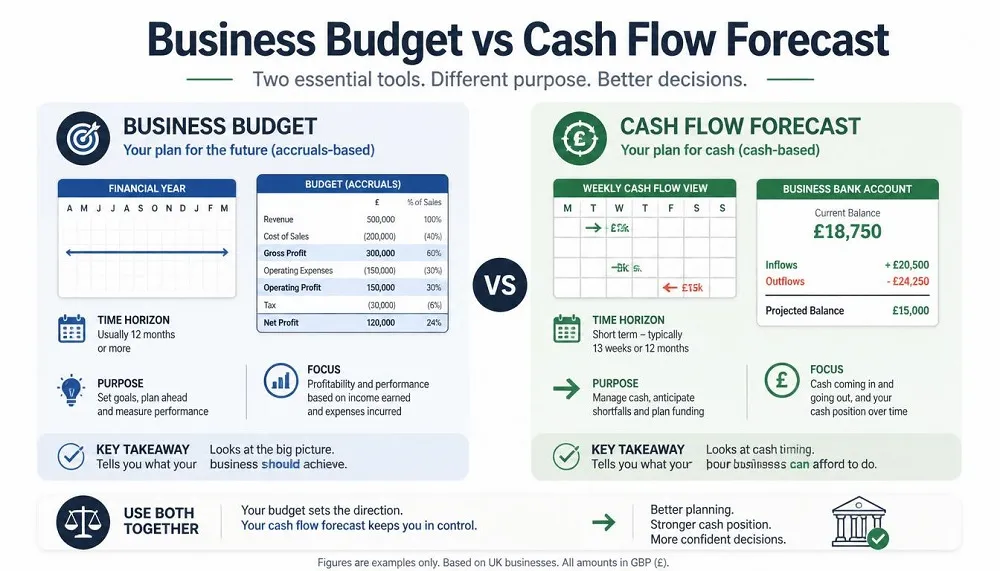
A business budget sets targets for your income and expenses over a period, while a cash flow forecast predicts when money will actually move in and out of your bank account. A budget tells you what you plan to earn and spend; a forecast tells you when that cash will physically arrive or leave.
| Business Budget | Cash Flow Forecast |
|---|---|
| Purpose | Sets financial targets and spending limits |
| Time horizon | Usually monthly, quarterly or annual |
| What it measures | Total planned income and expenditure |
| When to update | Reviewed monthly or when circumstances change |
How the Two Work Together
Your budget and your cash flow forecast should sit side by side. A budget might show you’ll be profitable across the year, while your cash flow forecast reveals a gap in March because a large client payment is delayed. Businesses that only track one of the two are often caught out by timing issues even when their underlying numbers look healthy.
For a full breakdown of how to build a rolling cash flow forecast, see our guide to business cash flow management.
Business Budget vs Startup Costs: Which Do You Need First?
If you haven’t launched yet, your first priority is estimating your startup costs, the one-off expenses involved in getting your business trading, such as equipment, registration fees and initial stock.
Once you’re operating, this guide picks up where startup planning leaves off. Your ongoing business budget covers the recurring income and expenses of running the business month to month, rather than the one-time cost of setting it up.
What to Include in a Business Budget
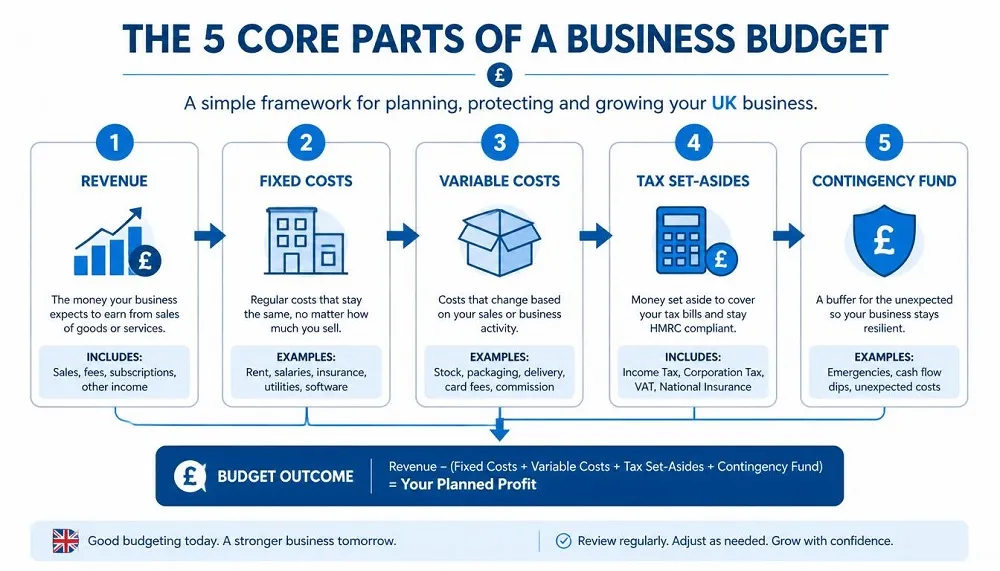
A complete budget covers five core areas.
Revenue
List every source of income your business expects, including product sales, service fees, subscriptions and any other recurring revenue. If you’ve been trading for a year or more, base this on actual historic figures rather than optimistic guesswork.
Fixed Costs
These are costs that stay broadly the same each month regardless of how much you sell: rent, salaries, loan repayments, software subscriptions and business insurance.
Variable Costs
These change with your level of activity: raw materials, delivery costs, sales commissions and utility bills that rise or fall with usage.
One-Off and Capital Expenses
Occasional costs such as new equipment, office refurbishment or a one-time legal fee. These are easy to forget but can significantly affect a month’s figures if left out.
Contingency Fund
A reserve set aside for unplanned costs, equipment failure, a late-paying client or a sudden supplier price increase. A common benchmark is to hold three to six months of operating expenses in reserve, building this gradually by setting aside around five to ten per cent of monthly revenue.
Budgeting for UK Tax Obligations
UK businesses should typically set aside money for VAT (20 per cent of taxable sales if registered), Corporation Tax (19 to 25 per cent of profits for limited companies, depending on profit level) and Income Tax and National Insurance for sole traders and employees. Building these into your budget from day one avoids a painful surprise at year end.
| Tax | Who It Applies To | Typical Rate | Set Aside |
|---|---|---|---|
| VAT | Businesses over the registration threshold | 20 per cent standard rate | On taxable sales, once registered |
| Corporation Tax | Limited companies | 19 per cent on profits up to £50,000, rising to 25 per cent above £250,000, with marginal relief in between | On net profit |
| Income Tax and National Insurance | Sole traders and employees | Varies by income band | On profit or salary |
VAT
You must register for VAT once your taxable turnover passes the current threshold, which stands at £90,000 in any rolling 12-month period. Once registered, most sales carry the standard 20 per cent rate, which should be treated as money you’re collecting on HMRC’s behalf rather than your own revenue. For the full registration process, see our guide to VAT registration in the UK.
Corporation Tax
Limited companies pay Corporation Tax on their profits. Smaller companies with profits up to £50,000 pay a reduced rate of 19 per cent, while companies with profits above £250,000 pay the main rate of 25 per cent, with marginal relief tapering the rate for profits in between. Build an estimated Corporation Tax line into your budget as soon as you start making a profit, rather than waiting until your tax return is due.
Income Tax, National Insurance and PAYE
Sole traders pay Income Tax and National Insurance on business profits through Self Assessment, while limited companies must run PAYE for any salaried staff, including directors. Both should appear as budget lines, not afterthoughts.
How to Create a Business Budget: Step by Step
Step 1: Gather Your Financial Data
Pull together bank statements, invoices, and, if available, your profit and loss statement and balance sheet. If you’re newer to trading, use realistic industry benchmarks instead of historic data.
Step 2: Calculate Your Total Revenue
Add up income from all sources over the past six to twelve months and use this as your baseline. New businesses should estimate conservatively rather than optimistically.
Step 3: List and Categorise Your Expenses
Separate every cost into fixed, variable and one-off categories, as outlined above. Being thorough here is what prevents nasty surprises later in the year.
Step 4: Set Aside Tax and Contingency Funds
Add dedicated lines for VAT, Corporation Tax or Income Tax, and your contingency reserve. Treat these as fixed obligations, not optional extras.
Step 5: Calculate Projected Profit or Loss
Subtract your total expenses, including tax and contingency, from your total revenue. A positive figure means you’re projected to make a profit; a negative figure means you need to increase revenue or reduce costs before committing to further spending.
Step 6: Allocate and Review
Decide how any surplus will be used, whether that’s reinvestment, debt repayment or savings, and set a fixed date each month to review actual figures against your budget.
Worked Example: A Simple UK Business Budget
The table below shows a simplified monthly budget for a small UK service business with one employee.
| Category | Monthly Budget (£) | Notes |
|---|---|---|
| Revenue | 8,000 | Based on average of last 6 months |
| Rent | 600 | Fixed |
| Salaries | 2,200 | Fixed, includes employer NI |
| Insurance | 80 | Fixed |
| Software subscriptions | 120 | Fixed |
| Materials and supplies | 900 | Variable, scales with sales |
| Marketing | 500 | Variable |
| VAT set-aside | 1,000 | 20 per cent of taxable sales, if registered |
| Corporation Tax set-aside | 380 | Estimated at 19 per cent of profit |
| Contingency fund | 400 | 5 per cent of revenue |
| Total expenses | 6,180 | |
| Projected profit | 1,820 | Revenue minus total expenses |
This structure works for most small service and product businesses; simply adjust the category amounts to reflect your own figures.
Free Business Budget Template (UK)
Copy the structure below into a spreadsheet to track your own budget against actual figures each month.
| Category | Budgeted (£) | Actual (£) | Variance (£) |
|---|---|---|---|
| Revenue | |||
| Fixed costs | |||
| Variable costs | |||
| One-off costs | |||
| VAT set-aside | |||
| Corporation Tax or Income Tax set-aside | |||
| Contingency fund | |||
| Net profit or loss |
Fill in the “budgeted” column at the start of each month, then complete “actual” and “variance” once the month closes. A consistently large variance in any category is a sign that column needs a closer look.
How to Create a Business Budget in Excel, Google Sheets or Accounting Software
Excel or Google Sheets Method
Both platforms work well for the template above. Set up one column per category, add a SUM formula for totals, and use conditional formatting to highlight any month where actual spending exceeds budget. This approach costs nothing and suits businesses with straightforward finances.
Using Accounting Software
Platforms such as Xero, Sage and QuickBooks can pull transactions directly from your bank feed, reducing manual entry and keeping your budget based on real figures rather than estimates. This becomes more useful as your transaction volume grows. If managing this alongside day-to-day trading feels like too much, a bookkeeping service can take on the ongoing tracking for you.
Business Budgeting Methods: Which Approach Suits Your Business?
| Method | How It Works | Best For | Effort Level |
|---|---|---|---|
| Zero-based | Every expense is justified from zero each period, rather than carried over | Businesses wanting tight cost control | High |
| Top-down | Owner or management sets overall targets, then allocates to categories | Small businesses with a clear owner-led vision | Low to medium |
| Bottom-up | Built from detailed estimates for each department or activity | Businesses with several staff or departments | Medium to high |
| Fixed | Set once and left unchanged for the period | Stable, predictable businesses | Low |
| Flexible | Adjusted as revenue or activity changes | Seasonal or fast-growing businesses | Medium |
Most sole traders and small limited companies start with a simple top-down or fixed approach, then move towards zero-based or flexible budgeting as the business grows and spending becomes harder to predict from memory alone.
How Much Should You Budget for Each Category?
As a general guide, many small UK businesses allocate their budget roughly as follows. Treat these as a starting point rather than a fixed rule, since the right split depends heavily on your industry and business model.
| Category | Typical Share of Budget |
|---|---|
| Staff and payroll | 25 to 30 per cent |
| Operational costs (rent, utilities, supplies) | 30 to 35 per cent |
| Marketing | 10 to 20 per cent |
| Tax set-aside | 20 to 25 per cent of profit |
| Contingency | 5 to 10 per cent |
Reviewing and Managing Your Budget
Weekly Cash Checks vs Monthly Budget Reviews
A short weekly check of your bank balance and upcoming payments helps you catch short-term problems early, while a fuller monthly review comparing budgeted figures against actual results is where you spot longer-term trends and adjust course.
What to Do When Actual Numbers Differ From Budget
A single unusual month is rarely a concern. A category that consistently overshoots its budget month after month is a signal worth investigating, whether that means renegotiating a supplier contract, adjusting pricing, or revising the budget itself to reflect reality.
Scenario Planning
Testing “what if” scenarios turns your budget into a decision-making tool rather than a static document. For example, before deciding whether you can afford to bring on your first team member, model the full cost, including salary, employer National Insurance and any additional software or equipment, against your current budget. Our guide on hiring your first employee sets out exactly what to factor in.
Common Business Budgeting Mistakes to Avoid
- Copying another business’s budget structure instead of building one around your own costs
- Leaving out tax set-asides until a bill arrives
- Treating VAT collected from customers as available cash rather than money held for HMRC
- Reviewing the budget once a year instead of monthly
- Underestimating one-off costs such as equipment repairs or legal fees
- Ignoring seasonal dips in revenue when setting monthly targets
Getting Help With Your Business Budget
Many owners manage their first budget alone using a simple spreadsheet, then bring in a bookkeeper or accountant once transaction volume grows or tax obligations become more complex. A professional can sense-check your assumptions, flag risks you might miss, and keep your figures accurate for both planning and Self Assessment or Corporation Tax purposes. If you’re considering this route, our guide to bookkeeping services in the UK explains what to expect and how much it typically costs.
Frequently Asked Questions
What is a business budget?
A business budget is a financial plan setting out your expected income and expenses over a set period, usually monthly, quarterly or annually, used to guide spending and track performance.
How often should I review my business budget?
Review your full budget at least monthly, alongside a quick weekly check of your cash position, so you catch variances while they’re still small and manageable.
What’s the difference between a budget and a cash flow forecast?
A budget sets targets for income and expenses over a period, while a cash flow forecast predicts exactly when money will move in and out of your bank account. Both are useful together rather than as substitutes for each other.
How much should a small business set aside for emergencies?
A common benchmark is three to six months of operating expenses, built gradually by setting aside around five to ten per cent of monthly revenue once the business is profitable.
Do I need accounting software to create a budget, or can I use a spreadsheet?
A spreadsheet is perfectly sufficient for straightforward finances. Accounting software becomes more useful once transaction volume grows, since it can pull bank data automatically and reduce manual entry.
What’s the difference between a budget for a sole trader and a limited company?
Sole traders budget for Income Tax and National Insurance through Self Assessment, while limited companies must additionally budget for Corporation Tax and run PAYE for any salaried staff. See our comparison of sole trader versus limited company structures for the full picture.
How do I create a budget for a startup that hasn’t launched yet?
Start by estimating your one-off launch costs rather than an ongoing monthly budget. Our guide to startup costs for a small business covers exactly how to calculate these before you move on to an operating budget like the one in this guide.
Written by the Businessmine editorial team, specialists in UK small business finance and planning. This guide is reviewed regularly to reflect current HMRC tax thresholds and rates.