Sole Trader vs Limited Company in the UK: Which Structure Is Right for You
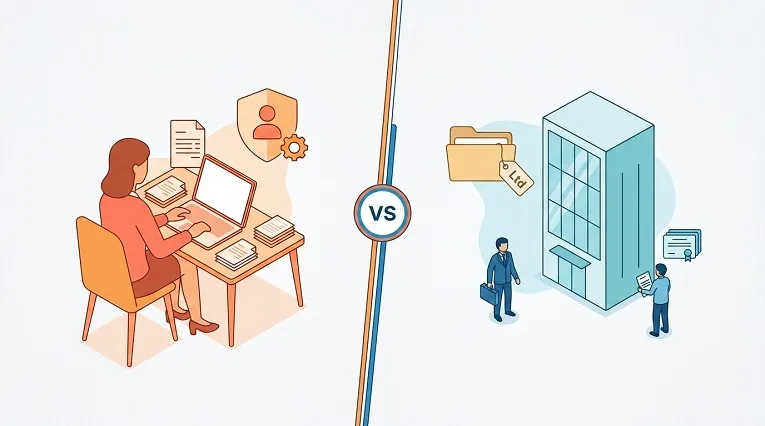
Starting a business in the UK comes down to one early decision that shapes almost everything else: should you trade as a sole trader, or set up a limited company? It affects your tax bill, your personal risk, how much paperwork lands on your desk, and even how clients see you.
There is no single right answer. The best structure depends on your profit level, your appetite for admin, and how much risk you’re carrying. This guide walks through the real differences, with current 2026/27 tax figures, so you can make the call with confidence.
Quick Answer: Sole Trader or Limited Company at a Glance
If you want the short version first, here it is.
| Factor | Sole Trader | Limited Company |
|---|---|---|
| Legal status | Same legal entity as you | Separate legal entity |
| Liability | Unlimited personal liability | Limited to company assets |
| Setup cost | Free to register with HMRC | From around £12 to £100+ to incorporate |
| Tax paid | Income Tax + Class 4 NI | Corporation Tax, then personal tax on what you draw |
| Admin | Self-assessment once a year | Annual accounts, confirmation statement, Corporation Tax return, plus personal Self Assessment |
| Best for | Lower profits, simplicity, testing an idea | Higher profits, risk protection, growth plans |
Now let’s look at why each of these holds true.
What Is a Sole Trader?
A sole trader is a self-employed person who runs their business as an individual. There is no legal split between you and the business. You earn the income, you keep the profit after tax, and you are personally answerable for whatever the business owes.
Setting up is straightforward. You register for Self Assessment with HMRC, usually by 5 October following the tax year in which you started trading. From there, you report your income and expenses once a year and pay tax on the profit. Many freelancers, tradespeople, and consultants in the UK trade this way because it gets them earning quickly without paperwork getting in the way.
You can earn up to £1,000 in a tax year from self-employment before you need to register at all, thanks to the trading allowance. Once you go past that, registration becomes a legal requirement.
What Is a Limited Company?
A limited company is a separate legal entity, registered with Companies House. It exists independently of the people who own and run it. You, as the founder, typically become both a director (who runs the company) and a shareholder (who owns it), and these can be the same person in a one-person company.
Because the company is its own legal “person,” it can own assets, sign contracts, and take on debt in its own name. The company’s finances are kept apart from your personal finances, and the company pays its own tax on its profits before anything reaches you personally.
Setting one up means choosing a unique company name, registering with Companies House, appointing at least one director, identifying anyone with significant control, and filing a memorandum and articles of association. Most people complete this online in under 24 hours, though getting the structure right (especially shareholdings) is worth doing carefully from day one.
The Real Difference Between Sole Trader and Limited Company
Legal identity
This is the foundation everything else builds on. As a sole trader, you and the business are legally one and the same. As a limited company director, you and the business are legally separate, even if you’re the only person involved.
Personal liability
Because a sole trader has no legal separation from the business, you are personally responsible for any debts, legal claims, or losses the business creates. If a client doesn’t pay, a supplier sues, or the business fails owing money, your personal assets, including savings and potentially your home, can be at risk.
A limited company limits that exposure. If the company runs into financial trouble, your personal liability is generally capped at the value of your shares (unless you’ve given a personal guarantee, which lenders sometimes require for loans). This is the single biggest reason risk-averse business owners choose to incorporate.
Sole Trader vs Limited Company Tax: 2026/27 Figures Explained
Tax is usually the deciding factor people search for, so let’s get specific using the rates that apply for the 2026/27 tax year.
How sole traders are taxed
As a sole trader, your business profit is added to any other income you have and taxed through Income Tax and National Insurance.
- Personal Allowance: the first £12,570 of income is tax-free
- Basic rate: 20% on profit between £12,571 and £50,270
- Higher rate: 40% on profit between £50,271 and £125,140
- Additional rate: 45% above £125,140
- Class 4 National Insurance: 6% on profits between £12,570 and £50,270, then 2% above that
- Class 2 National Insurance: voluntary at £3.50 a week, mainly relevant for protecting your State Pension record at low profit levels
There is no separate “business tax” for sole traders. Everything flows through your personal Self Assessment return.
How limited companies are taxed
A limited company pays Corporation Tax on its profits first, before any money reaches you personally.
- Small profits rate: 19% on profits up to £50,000
- Main rate: 25% on profits above £250,000
- Marginal relief: applies on profits between £50,000 and £250,000, tapering the rate gradually between 19% and 25%
Once Corporation Tax is paid, you take money out of the company, typically as a salary, dividends, or a mix of both.
Salary and dividends explained
A salary is treated as a normal employment cost. It reduces the company’s taxable profit, but it’s subject to Income Tax and National Insurance like any employee’s pay. A dividend, by contrast, is a payment from the company’s post-tax profit. It isn’t a deductible business expense, and it isn’t subject to National Insurance, but it is subject to dividend tax.
For 2026/27, every individual gets a £500 tax-free Dividend Allowance. Above that, dividend tax is charged at 10.75% in the basic rate band, 35.75% in the higher rate band, and 39.35% in the additional rate band. These rates rose by 2 percentage points from April 2026, which matters because many older articles still quote the previous 8.75% and 33.75% rates.
Most directors structure their pay as a small salary, often around the Personal Allowance or the National Insurance secondary threshold, combined with dividends for the rest. This keeps the National Insurance bill low while still using tax-free allowances efficiently.
Worked Example: Tax at £30,000, £60,000, and £100,000 Profit
Numbers make this real. Here’s how the two structures compare at three profit levels, assuming a sole director with no other income and no other employees (so no Employment Allowance available).
£30,000 profit
As a sole trader, you’d pay roughly £3,486 in Income Tax and £1,283 in Class 4 NI, leaving around £25,231 in your pocket.
As a limited company, after 19% Corporation Tax (£5,700), the company would have £24,300 left to distribute. Taking a salary up to the Personal Allowance and the rest as dividends keeps the personal tax bill low, but the company-level Corporation Tax means total take-home is broadly similar to, and sometimes slightly below, sole trader status at this profit level once accountancy fees are factored in.
£60,000 profit
Here, the picture starts to shift. As a sole trader, a meaningful slice of profit falls into the 40% higher rate band, alongside 2% Class 4 NI, pushing the effective tax rate up noticeably.
As a limited company, the first £50,000 of profit is taxed at 19% Corporation Tax, with marginal relief applying above that. Income is then extracted as salary and dividends, with dividend tax rates of 10.75% or 35.75% depending on the band. For many directors at this level, the combined Corporation Tax and dividend tax bill comes in lower than the equivalent sole trader Income Tax and NI bill, though the gap has narrowed since the April 2026 dividend tax rise.
£100,000 profit
At higher profits, the comparison gets more nuanced. Sole traders start losing their Personal Allowance once income passes £100,000 (it tapers away completely by £125,140), which increases the effective tax rate sharply in that band. Limited company directors can manage this more flexibly by choosing how much to draw each year and retaining surplus profit in the company for future use, effectively timing when personal tax is paid.
At full extraction in the same tax year, the gap between the two structures can be smaller than people expect once 2026/27 dividend rates are applied, particularly without the Employment Allowance. The real advantage at this level often isn’t the headline tax rate. It’s the flexibility a limited company gives you to leave profit in the business and draw it down in a lower-income year.
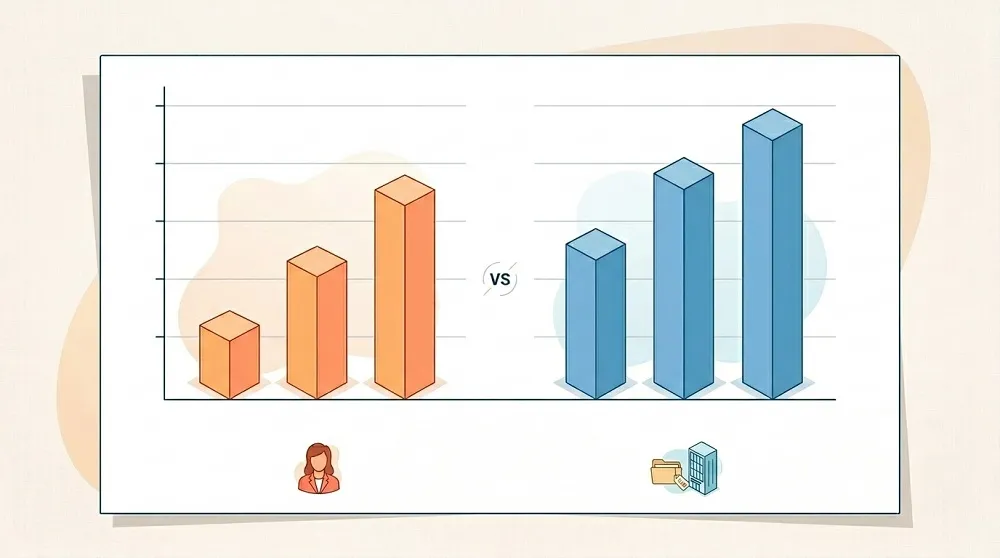
These figures are illustrative and rounded for clarity. Your actual position depends on expenses, other income, pension contributions, and whether you qualify for reliefs like the Employment Allowance. Speak to an accountant before making a final decision.
Admin and Compliance: What Each Structure Actually Involves
Sole trader paperwork
- Register for Self Assessment with HMRC
- Keep records of income and expenses
- File one self-assessment tax return per year
- Pay Income Tax and Class 4 NI by 31 January, with payments on account in some cases
- Register for VAT if turnover exceeds £90,000
That’s largely it. Many sole traders manage their own books, especially in the early years.
Limited company paperwork
- File a confirmation statement with Companies House each year
- Prepare and file annual accounts with both Companies House and HMRC
- File a Corporation Tax return (CT600) and pay Corporation Tax, usually within nine months of the company’s year end
- Run payroll if paying yourself a salary, including PAYE reporting
- File a personal Self Assessment return to report dividends and any other income
- Keep statutory registers and records of people with significant control
This is a meaningfully bigger workload, and it’s the main reason most limited company directors use an accountant, typically costing somewhere between £1,000 and £3,000 a year depending on complexity.
Setup Cost and Time
Registering as a sole trader is free and usually takes a few minutes online through GOV.UK. You can start trading immediately, as long as you register before the 5 October deadline in your second tax year of trading.
Setting up a limited company through Companies House typically costs around £12 to £50 if you do it yourself online, or more if you use a formation agent that bundles in registered office services, document templates, or accounting support. The process itself is usually completed within 24 hours once you submit the application.
Liability and Risk: Protecting Your Personal Assets
This is where the two structures diverge most sharply in practical terms, not just on paper.
If you’re a sole trader and your business can’t pay a debt, a supplier invoice, or a legal claim, creditors can pursue your personal assets to recover what’s owed. That includes savings, and in serious cases, your home.
A limited company creates a legal barrier between business debts and your personal finances. If the company fails, your personal liability is generally limited to what you’ve invested in shares, except where you’ve personally guaranteed a loan or acted negligently or fraudulently as a director.
If your work carries real financial risk, perhaps you take on large contracts, hold significant stock, or could face a costly claim, that liability gap is often reason enough to incorporate, regardless of the tax outcome.
Credibility, Contracts, and IR35
Some clients, especially larger businesses and public sector organisations, prefer or require contractors to operate through a limited company rather than as a sole trader. Having “Ltd” after your name can also signal a more established operation, even for a one-person business.
If you’re a contractor, IR35 is worth understanding before you incorporate. IR35 rules are designed to catch cases where someone works through a limited company but, in practice, works like an employee of the client. If you’re caught by IR35 on a contract, much of the tax advantage of operating through a company disappears for that engagement, because tax is collected closer to employment rates. This doesn’t mean incorporation is pointless for contractors, but it does mean the tax benefit shouldn’t be assumed automatically.
Registering a limited company also protects your business name. Companies House won’t allow another company to register an identical or very similar name. Sole traders can trade under a chosen name, but without registering a trademark separately, that name has no legal exclusivity, and someone else could legally use something very similar.
When Should You Switch from Sole Trader to Limited Company?
No fixed profit figure triggers a switch for everyone, but a few signals tend to come up repeatedly among business owners who do incorporate.
Signs it’s time to incorporate
- Your profits are consistently above £40,000 to £50,000 a year, where Corporation Tax and dividend planning often start to outperform sole trader tax
- You’re taking on contracts with meaningful financial or legal risk
- A client requires you to operate through a limited company
- You want to bring in a business partner, investor, or co-shareholder
- You plan to retain profit in the business for future investment rather than drawing everything out immediately
- You want a more credible, scalable structure as the business grows
If none of these apply yet, staying a sole trader for now is a perfectly sound, often smarter, choice.
How to Switch from Sole Trader to Limited Company
Switching is common, and HMRC and Companies House have a defined path for it.
Step-by-step process
- Choose and register a company name with Companies House, checking that it isn’t already taken
- Incorporate the company, appointing at least one director and shareholder, and confirming people with significant control
- Register for Corporation Tax with HMRC, usually done as part of incorporation
- Tell HMRC you’re stopping self-employment, using the “stopping self-employment” service in your online HMRC account
- File a final Self Assessment return as a sole trader, covering income up to the date you stopped trading
- Open a business bank account in the company’s name, separate from your personal and old sole trader accounts
- Transfer or novate existing contracts where needed, since some client agreements may need to be reissued in the company’s name
- Update invoices, your website, and supplier records to reflect the new company name and registration details
- Notify clients and suppliers of the change so payments and contracts are directed correctly
Most of this can be done within a few weeks, though contract transfers with larger clients sometimes take longer.
Can You Be a Sole Trader and Run a Limited Company at the Same Time?
Yes. It’s legal to be self-employed as a sole trader for one activity while also being a director of a limited company for another. HMRC treats them as entirely separate sources of income and requires separate record-keeping for each. This setup is common when someone runs a side business alongside a separate company, or is winding one structure down while building the other up. The key requirement is keeping the finances, invoicing, and tax reporting for each completely distinct.
Common Mistakes People Make in This Decision
- Choosing based on tax alone. Liability protection and credibility matter just as much for many businesses, especially those with real financial risk.
- Underestimating limited company admin. The extra paperwork is real and ongoing, not a one-off setup cost.
- Assuming incorporation always saves tax. At lower profit levels, and after the April 2026 dividend tax rise, the gap has narrowed and can even favour staying a sole trader.
- Ignoring IR35 as a contractor. Incorporating without checking IR35 status can mean paying for limited company admin without getting the tax benefit.
- Switching too early. Incorporating before there’s a clear financial or risk reason can add cost and complexity without a matching benefit.
Sole Trader vs Limited Company: A Simple Decision Framework
Ask yourself these questions honestly:
- Is my profit consistently above £40,000-£50,000 a year?
- Do I need protection from personal liability because my work carries real financial or legal risk?
- Do clients require or strongly prefer a limited company?
- Do I want to retain profit in the business rather than draw it all out each year?
- Am I comfortable taking on more admin, or paying an accountant to handle it?
If you answered yes to two or more of these, a limited company is worth serious consideration. If you answered mostly no, staying a sole trader is likely the more efficient and simpler choice for now.
Frequently Asked Questions
Is it better to be a sole trader or a limited company for tax?
It depends on your profit level. At lower profits, sole trader status is often simpler and just as tax-efficient. With higher and more consistent profits, a limited company can offer tax-planning flexibility through salary and dividend structuring, though the gap has narrowed since the April 2026 dividend tax increase.
When should I switch from sole trader to limited company?
Most people consider switching once profits are consistently above £40,000 to £50,000 a year, when they take on more financial risk, or when a client requires a limited company structure.
How much does it cost to set up a limited company in the UK?
Registering directly with Companies House typically costs around £12 to £50. Using a formation agent with added services usually costs more, often £50 to £150.
Can I be a sole trader and run a limited company at the same time?
Yes, as long as you keep the income, expenses, and tax reporting for each completely separate.
Do sole traders pay more tax than limited companies?
Often yes, at higher profit levels, but not always at lower incomes. The answer depends on your specific profit, expenses, and how you plan to draw money from the business.
Is it easy to switch from a sole trader to a limited company?
Yes, the process is well established. It involves registering the company with Companies House, telling HMRC you’ve stopped being self-employed, filing a final Self Assessment return, and updating your business bank account, contracts, and invoices.
Conclusion
Sole trader status wins on simplicity. You can start fast, keep your own books, and manage everything through one annual tax return. A limited company wins on protection and flexibility. It separates your personal finances from business risk and gives you more control over how and when you’re taxed as profits grow.
Neither structure is permanent. Many successful UK businesses start as sole traders and incorporate later, once profit, risk, or client requirements make the switch worthwhile. The right move is the one that matches where your business actually is today, not where you hope it will be in five years. When the numbers or the risk profile change, you can change with them.