

How to Register a Business with Companies House: The Complete Step-by-Step Guide
More than 750,000 new companies are registered in the UK every year. That tells you two things: it is one of the most straightforward business processes in the world, and it is also one of the most commonly searched.
If you are starting a limited company, forming an LLP, or simply trying to understand what Companies House actually does and why it matters, you are in the right place. This guide covers everything you need to know, from choosing your business structure to getting your Certificate of Incorporation and handling the first month after registration.
Whether you are a first-time founder, a freelancer going limited, or an international entrepreneur setting up a UK company from abroad, this guide walks you through the entire process clearly and completely.
Quick Reference: Companies House Registration at a Glance
| What | Detail |
|---|---|
| Cost (online) | £100 |
| Cost (by post) | £124 |
| Processing time | 24 hours online; 8-10 working days by post |
| What you get | Certificate of Incorporation + Company Registration Number |
| Who needs to register | Limited companies, LLPs, PLCs |
| Who does NOT need to register | Sole traders, general partnerships |
What Is Companies House and What Does It Do?
Before you register, it helps to know exactly what you are signing up to and why this organisation exists.
The Role of Companies House in UK Business Registration
Companies House is a UK government executive agency sponsored by the Department for Business and Trade. Its primary job is to incorporate and dissolve limited companies and limited liability partnerships across England and Wales, Scotland, and Northern Ireland.
When you register a company, Companies House creates a permanent record of its existence. It stores your company name, registered office address, director details, shareholder information, annual accounts, and confirmation statements. All of this is held on a publicly searchable register that anyone can access for free at any time.
That public register is not just a bureaucratic formality. It exists to give businesses, lenders, clients, and suppliers a way to verify that the companies they deal with are real, legitimate, and compliant. A company number is a signal of credibility. It tells the world your business is properly formed, legally separate from you personally, and accountable.
What Information Is Publicly Visible on the Register?
This is something many new founders do not think about until it is too late. When you register a company, certain information about you becomes publicly accessible.
Specifically, the register shows:
- Your registered office address
- Each director’s name, date of birth (month and year only), nationality, occupation, and service address
- Shareholder names and the number of shares held
- People with Significant Control (PSC) information
- Filed accounts and confirmation statements
Your residential address is kept private if you provide a separate service address, which you should always do. Your full date of birth is also protected from full public view. However, your name and service address will be visible. Bear this in mind when choosing your registered office and service address at the start.
Who Is Required to Register with Companies House?
A common question is whether every business in the UK needs to register. The answer is no. Here is a clear breakdown:
Must register with Companies House:
- Private limited companies (Ltd)
- Public limited companies (PLC)
- Limited liability partnerships (LLP)
- Overseas companies with a UK registered branch
Do NOT register with Companies House:
- Sole traders (register with HMRC for Self Assessment instead)
- General partnerships (register with HMRC instead)
If you are currently a sole trader and wondering whether to register as a limited company, the next section will help you decide.
Choosing the Right Business Structure Before You Register
This is the most important decision you will make before you open the Companies House website. Get the structure wrong and you could end up with the wrong tax treatment, the wrong level of liability protection, or a compliance burden that does not match your business size.
Sole Trader vs Limited Company: Key Differences Explained
Most people comparing their options are deciding between staying a sole trader or forming a private limited company. Here is how they differ:
| Factor | Sole Trader | Limited Company |
|---|---|---|
| Registration | HMRC only | Companies House + HMRC |
| Legal identity | You and the business are the same | Separate legal entity from you |
| Personal liability | Unlimited | Limited to your share value |
| Tax | Income Tax + National Insurance | Corporation Tax |
| Privacy | High | Lower (public register) |
| Admin burden | Minimal | Annual accounts, confirmation statements |
| Credibility with clients | Generally lower | Generally higher |
As a sole trader, there is no separation between you and your business. If the business has debts, those are your debts personally. As a limited company director, the company is a separate legal entity. If it runs into financial trouble, your personal assets are generally protected.
That said, a limited company comes with real obligations. You will need to file annual accounts and a confirmation statement with Companies House every year, submit a Corporation Tax return with HMRC, and potentially deal with payroll if you pay yourself a salary. The admin is manageable, but it is not zero.
Private Limited Company (Ltd): The Most Common Choice
For most UK founders, the private limited company by shares is the right structure. It gives you limited liability protection, a separate legal identity, and a credibility boost with clients and investors. You can have a single director who is also the only shareholder, which is common for solo consultants and freelancers going limited.
Ownership is built around shares. You decide how many shares to issue and at what nominal value. If it is just you, 100 shares at £1 each is a completely standard starting point.
Limited Liability Partnership (LLP)
An LLP sits between a traditional partnership and a limited company. It is popular with professional services firms like solicitors, accountants, and architects because it combines limited liability protection with the tax transparency of a partnership.
Members of an LLP pay Income Tax on their share of profits individually rather than the LLP paying Corporation Tax as an entity. You need at least two members, and at least two of them must be designated members (similar to directors in a limited company).
LLPs are registered with Companies House using a separate process from Ltd companies, covered later in this guide.
Public Limited Company (PLC)
A PLC allows you to offer shares to the public and is the required structure for companies listed on a stock exchange. It requires a minimum share capital of £50,000, and at least 25% of that must be paid up before the company can trade or borrow.
For the vast majority of startups and growing businesses, a PLC is not the right structure. The compliance burden is significantly higher than a private limited company.
Company Limited by Guarantee
This structure is common for non-profit organisations, charities, clubs, and community interest companies. Instead of shareholders, it has members who act as guarantors. Each guarantor agrees to contribute a set amount if the company is wound up, typically just £1.
There are no shares and no share capital. It is registered through Companies House using the standard online service, but you will need to select the guarantee structure during the application.
Which Structure Is Right for You?
Here is a simple framework to help you decide:
- Trading alone with straightforward income? Start as a sole trader, consider Ltd later.
- Solo founder building a product or service business? Private limited company (Ltd).
- Professional firm with two or more co-founders who want equal status? LLP.
- Non-profit, charity, or community group? Company limited by guarantee.
- Planning to list on a stock exchange or raise public capital? PLC, with professional legal support.
When in doubt, speak to an accountant before you register. The right structure from day one will save you time, tax, and paperwork later.
What You Need Before You Start: Pre-Registration Checklist
One of the most common mistakes people make is opening the Companies House online service without having everything ready. The application can time out, and you will need to start again. Take twenty minutes to gather everything listed below before you log in.
1. A Unique Company Name
Your company name must be unique on the Companies House register. It also cannot be so similar to an existing name that it would cause confusion. Beyond uniqueness, there are specific rules your name must follow:
- It must end in “Limited” or “Ltd” (or the Welsh equivalents “Cyfyngedig” or “Cyf” if you are registering in Wales)
- It cannot be offensive or misleading
- It cannot suggest a government connection or imply royal patronage without approval
- Words like “Bank,” “Royal,” “Trust,” “Authority,” and “Chartered” are classified as sensitive words and require additional documentation or government approval
Use the Companies House name availability checker at beta.companieshouse.gov.uk before you commit to a name. And do not stop there. Also check the UK Intellectual Property Office (IPO) trade mark database. A name can be available on the Companies House register but still be a registered trade mark owned by someone else. Using it could expose you to legal action.
Over 8% of online applications are rejected, and name issues account for a significant portion of those rejections. Spending five minutes checking now saves days of delay later.
2. A Registered Office Address
Every limited company must have a registered office address. This is the official address of your company on the public register, and all formal correspondence from Companies House and HMRC will go here.
Key rules:
- It must be a physical UK address, not a PO Box
- It must be in the same country as your company’s registration (an England and Wales company cannot use a Scottish address)
- It will be permanently visible on the public register
Your options for a registered office are:
- Your home address (visible publicly, and permanently on record even after you move)
- A business premises address (if you have one)
- A virtual office address (a professional service providing a registered address, often with mail handling)
- A company formation agent’s address (included in many formation packages)
If privacy is a concern, do not use your home address. Once it is on the register, removing it is a formal process. A virtual office address typically costs between £30 and £100 per year and is worth every penny if you work from home.
3. Director Details
Every private limited company needs at least one director. Here is what you need to know about eligibility and what information is required:
Eligibility:
- Must be 16 years of age or older
- Cannot be a person who is disqualified from acting as a director by a court order
- Cannot be an undischarged bankrupt
Information required for each director:
- Full legal name (must match your official ID)
- Date of birth
- Nationality
- Occupation
- Service address (this is public)
- Residential address (this is kept private but must be provided)
A company secretary is optional for private limited companies under the Companies Act 2006. You do not need to appoint one unless your articles of association specifically require it.
4. Shareholder or Guarantor Information
For a company limited by shares, you need at least one shareholder. The director and shareholder can be the same person, which is the case for most solo founders.
You will need to provide:
- Name and address for each shareholder
- Number of shares being issued to each person
- The class of shares (ordinary, preference, etc.)
For a company limited by guarantee, you need at least one member (guarantor), and you will specify the guarantee amount each member commits to.
5. Share Structure and Share Capital
You need to decide how many shares to issue and at what nominal value before you start the application. For most straightforward companies, 100 ordinary shares with a nominal value of £1 each is the standard starting point.
If you have co-founders, you will split the shares according to agreed ownership percentages. For example, two equal co-founders might each hold 50 shares out of 100 total.
A few practical tips here:
- Keep your initial share structure simple. Complex arrangements with multiple share classes can complicate the process of opening a business bank account.
- Ordinary shares give the holder voting rights and the right to dividends. Preference shares typically receive dividends first but may carry no voting rights.
- You can issue more shares later, but changing the structure retrospectively takes time and legal paperwork.
6. People with Significant Control (PSC)
The PSC register is a legal requirement under the Companies Act 2006 as amended. Failing to declare your PSC is a criminal offence, so this is not optional.
A PSC is any individual who:
- Holds more than 25% of the company’s shares
- Controls more than 25% of the company’s voting rights
- Has the right to appoint or remove the majority of directors
- Has the right to exercise significant influence or control over the company
For most solo founders, they are their own PSC. If you own 100% of the shares, you meet the threshold.
You will need to provide:
- Full name and date of birth
- Nationality and country of residence
- Service address (public) and residential address (private)
- Nature of control (e.g., ownership of more than 25% of shares)
- Date from which control applies
7. SIC Code (Standard Industrial Classification Code)
A SIC code is a five-digit number that tells Companies House and HMRC what type of business activity your company carries out. You must provide at least one, and you can provide up to four.
SIC codes are grouped into sections A through U, covering everything from agriculture to financial services to creative arts. Finding the right one matters because HMRC uses it when setting up your Corporation Tax record. An incorrect code can lead to confusion or delay when you register for tax.
Here are some commonly used SIC codes to help you get started:
| SIC Code | Business Activity |
|---|---|
| 62020 | Information technology consultancy activities |
| 70229 | Management consultancy activities (other) |
| 47910 | Retail sale via mail order or internet |
| 56101 | Licensed restaurants |
| 74100 | Specialised design activities |
| 69201 | Accounting and auditing activities |
| 85590 | Other education |
| 99999 | Dormant company |
| 74990 | Non-trading or dormant company (not yet trading) |
You can search for your code using the condensed SIC code list available on the Companies House website. If your business does more than one thing, select the code that best represents your primary activity first.
8. Memorandum and Articles of Association
These two documents form the legal foundation of your company. Many new founders are unsure what each one does, so here is a clear explanation.
Memorandum of Association: This is a short legal declaration signed by the founding members confirming they agree to form the company. During online registration through Companies House, the memorandum is generated automatically based on the information you enter. You do not write or upload it separately.
Articles of Association: These are the internal rules governing how the company operates. They cover how decisions are made, how directors are appointed and removed, how shares are transferred, and how shareholder meetings are run.
Companies House provides a set of Model Articles which serve as the default. For most straightforward limited companies with a single director and one or two shareholders, the Model Articles are perfectly adequate.
You only need bespoke articles if your company has:
- Multiple share classes with different rights
- Investment or shareholder agreements that require specific governance terms
- Restrictions on share transfers (common with investor-backed companies)
If you need bespoke articles, have a solicitor draft them before you register. Uploading incorrectly drafted bespoke articles is one of the less common but harder-to-fix rejection causes.
9. GOV.UK One Login (Identity Verification)
This is the step that almost no other registration guide covers properly, and it is now a legal requirement.
Under the Economic Crime and Corporate Transparency Act 2023, Companies House requires all company directors to verify their identity before a company can be incorporated. This is done through GOV.UK One Login, the government’s central identity verification system.
How to complete identity verification:
- Go to the GOV.UK One Login service at signin.account.gov.uk
- Create an account using your email address and a secure password
- Verify your identity using a valid UK passport, UK driving licence, or a biometric residence permit
- Once verified, you receive a unique personal code
This personal code is what links your verified identity to the company registration application. If you have multiple directors, each one must complete this process independently and provide their own personal code during the application.
The good news is you only do this once. Your personal code stays valid and can be reused for future filings and any other companies you are involved with.
Do not leave this step until you are mid-application. Completing identity verification before you start the registration process saves time and prevents the application from stalling.
How to Register a Business with Companies House: Step-by-Step
Now that you have everything ready, here is exactly how the registration process works. There are three methods available, and the right one depends on your situation.
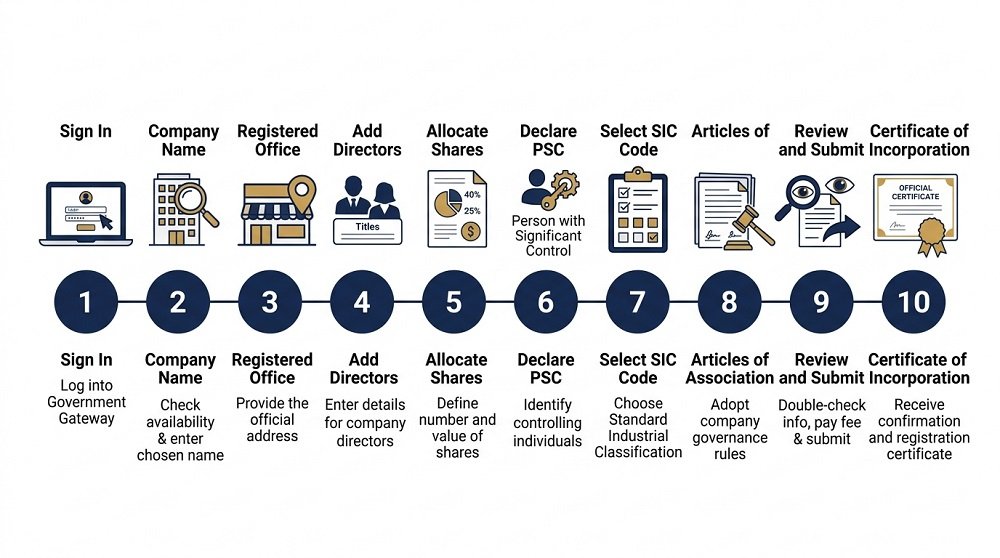
Method 1: Register Online via GOV.UK (Recommended)
The online service is faster, cheaper, and significantly less likely to result in a rejected application. If you can use it, you should.
- Where: companieshouse.gov.uk (navigate to “Register a company”)
- Cost: £100, payable by debit or credit card
- Processing time: Usually within 24 hours, sometimes as fast as 3 to 6 hours
- Same-day registration: Submit before 3pm on a working day for same-day processing
Step 1: Sign Into Your Companies House Account
Go to the Companies House Web Incorporation Service and sign in or create a free account. You will be prompted to link your GOV.UK One Login and enter the personal code you received during identity verification. This confirms your identity is attached to the application.
Step 2: Enter Your Company Name
Type your proposed name into the search field. The system will run a live availability check. Do not assume that because a name was available when you checked it yesterday it is still available now. Names can be registered by others in the time between your search and your submission. Check it again right before you click submit.
Make sure the name you enter is exactly the name you want. Spelling mistakes, spacing errors, and incorrect punctuation cannot be corrected without paying a fee to change the company name later.
Step 3: Enter Your Registered Office Address
Select the country of registration for your company (England and Wales, Scotland, or Northern Ireland). Then enter your registered office address in full. The system will ask you to confirm that you consent to correspondence being sent to this address on behalf of the company.
Step 4: Add Directors and Their Details
Enter each director’s personal code from their GOV.UK One Login verification. You will then fill in their full name, date of birth, nationality, and occupation. You will provide two addresses for each director:
- Service address: This is publicly visible on the Companies House register
- Residential address: This is kept private by Companies House and is not shown on the public register
If you choose to appoint a company secretary (optional for private limited companies), enter their details here too.
Step 5: Add Shareholders and Allocate Shares
Enter the full name and address for each shareholder. Then enter the number of shares being issued to each person and the nominal value per share. Confirm the share class. For most companies this will be ordinary shares. The system calculates your total issued share capital automatically.
Step 6: Confirm Your People with Significant Control (PSC)
You will be prompted to identify all PSCs. Enter the required details including name, date of birth, nationality, address, and the nature of control they exercise over the company. You also need to confirm the date from which their control applies. For founders registering a new company, this will typically be the date of incorporation.
Step 7: Select Your SIC Code or Codes
Search the SIC code directory within the application and select between one and four codes. If you have already identified your code from the pre-registration checklist, this step takes less than a minute. If you are registering a dormant company, select SIC code 99999.
Step 8: Confirm Your Articles of Association
The application will default to the Model Articles. Accept these unless you are uploading bespoke articles. If you are using bespoke articles, upload them here. The Memorandum of Association is generated automatically and does not need to be separately prepared or uploaded.
Step 9: Review Everything and Submit
Go through the summary screen carefully. Check the company name spelling character by character. Verify that all director details match the relevant official ID documents exactly. Confirm PSC information is complete and accurate. When you are satisfied, pay the £100 fee by debit or credit card and submit the application.
Step 10: Receive Your Certificate of Incorporation
Once your application is approved, Companies House sends a confirmation email and issues your Certificate of Incorporation digitally. You can download it from your Companies House account. It contains:
- Your registered company name
- Your unique Company Registration Number (CRN)
- The date of incorporation
- The country of registration
Store this document safely. You will need it to open a business bank account, register for Corporation Tax, and as proof of your company’s legal existence. A paper copy can be requested from Companies House if needed.
Method 2: Register by Post Using Form IN01
Postal registration is slower, more expensive, and far more likely to result in rejection. That said, it is the required method for certain situations:
- Registering a public limited company (PLC)
- Using a Welsh language company name
- Submitting bespoke articles that cannot be uploaded digitally
How it works:
- Download Form IN01 from the Companies House website
- Complete every section fully and accurately
- Send the completed form with a cheque for £124 made payable to “Companies House”
- Post to: Companies House, Crown Way, Cardiff, CF14 3UZ
- Processing time: 8 to 10 working days
It is worth knowing that 53% of paper applications are rejected, compared to just over 8% for online applications. If postal registration is your only option, have an accountant or solicitor review your form before you send it.
Method 3: Register Through a Company Formation Agent
Formation agents are third-party companies approved by Companies House to submit incorporation applications on your behalf. They use official API connections to Companies House, so the submission process is the same speed as filing directly online.
Using a formation agent makes sense if:
- You are not confident navigating the online process alone
- You are a non-UK resident and want guided support
- You want a registered office address included in the package
- You are registering a company with a more complex structure
Cost: Formation agent packages range from around £9.99 to over £150, depending on what is included. Some packages include a registered office address service, mail handling, and company secretary services bundled in.
Here is a clear comparison between registering directly and using an agent:
| Factor | DIY via GOV.UK | Formation Agent |
|---|---|---|
| Government fee | £100 | £100 (included or added) |
| Agent fee | None | £9.99 to £150+ |
| Speed | 24 hours | 24 hours (same) |
| Guidance during process | None | Usually yes |
| Registered office included | No | Often yes |
| Best suited for | Confident founders | First-timers, non-UK residents |
| Risk of error | Moderate | Lower |
If you use a formation agent, make sure they are registered with Companies House as an approved filing agent. Always read the small print on what is included in the package price versus what costs extra.
Companies House Registration Costs and Timelines at a Glance
Here is a summary of all registration costs and processing times so you can plan ahead:
| Method | Government Fee | Processing Time |
|---|---|---|
| Online via GOV.UK | £100 | Within 24 hours (can be 3-6 hours) |
| Same-day online (before 3pm) | £100 | Same working day |
| Postal (Form IN01) | £124 | 8 to 10 working days |
| Via formation agent | £100 + agent fee | 24 hours |
Beyond the registration fee itself, budget for these additional potential costs:
- Registered office address service: £30 to £100 per year
- Formation agent package (if used): £9.99 to £150+
- Bespoke articles of association (if needed): from £200 via a solicitor
- Business bank account: free to £25 per month, depending on the provider
What Is a Certificate of Incorporation?
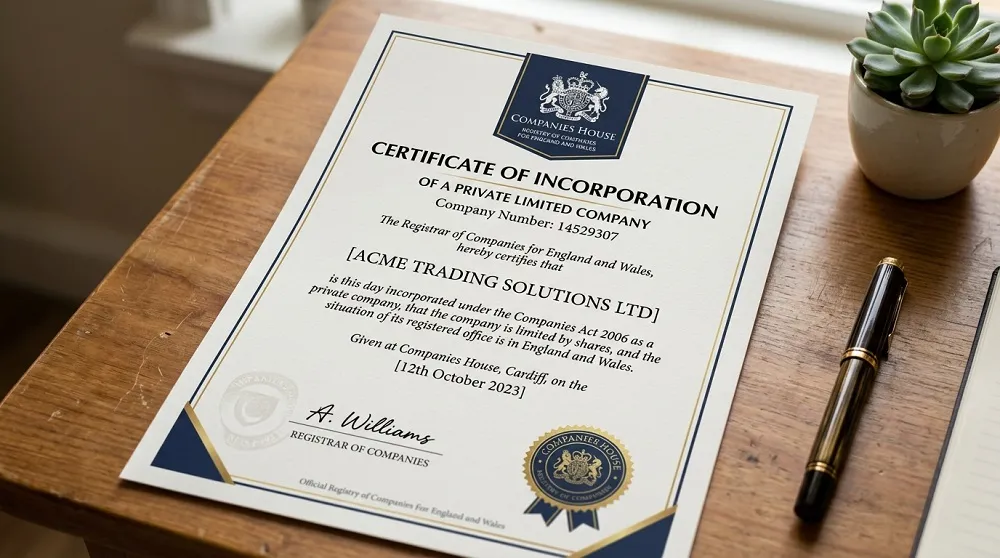
Your Certificate of Incorporation is the legal proof that your company exists. Companies House issues it automatically once your application is approved.
What the Certificate Contains
- Your company name exactly as registered
- Your unique Company Registration Number (CRN)
- The date of incorporation
- The country of registration (England and Wales, Scotland, or Northern Ireland)
Why It Matters
Think of the Certificate of Incorporation as your company’s birth certificate. Without it, you cannot prove your company is a legitimate legal entity. You will need it to:
- Open a business bank account (every UK bank will ask for it)
- Register for Corporation Tax with HMRC
- Apply for business credit or finance
- Sign contracts in the company’s name
- Satisfy due diligence checks from clients, suppliers, and investors
Download it immediately after registration and keep a copy in a safe location. Digital copies stored in cloud storage work well. If you lose it, you can obtain a certified copy from Companies House for a small fee.
The Impact of the Economic Crime and Corporate Transparency Act 2023
Most registration guides either ignore this Act entirely or mention it in passing. That is a mistake, because it has directly changed what you need to do when registering a company today.
What Changed for Business Registration
The Economic Crime and Corporate Transparency Act 2023 gave Companies House significantly greater powers to check, challenge, and reject applications. Before this Act, Companies House essentially accepted applications at face value. Now, it has the authority to:
- Require identity verification from all directors and PSCs (via GOV.UK One Login)
- Reject or query applications where information appears suspicious or inconsistent
- Remove inaccurate information from the register without the company’s consent
- Scrutinise company names that appear designed to mislead or suggest false authority
- Reject registered office addresses that are clearly not genuine (e.g., addresses where the company has no legitimate connection)
- Require all companies to provide and maintain a registered email address
The “registered email address” requirement is new and worth highlighting. Companies House uses this to contact companies directly about compliance matters. It is not published on the public register, but it must be kept active and monitored.
What This Means for New Applicants in 2026
If you are registering a company this year, the practical implications are:
- Identity verification via GOV.UK One Login is mandatory for all directors before the application is submitted
- Your registered office must be a genuine address where you or your agent can receive and act on correspondence
- Your company name must not attempt to imply government status, connections, or approvals that do not exist
- Your registered email address must be functional and monitored after incorporation
The overall effect of the Act is that the register is more trusted and more accurate than it has ever been. For legitimate businesses, the extra steps are minor inconveniences. For the minority who were exploiting the old system, the doors are now much harder to open.
Registering a Dormant Company with Companies House
Dormant company registration is a topic almost every guide skips. But it is a genuinely useful option for founders who want to protect a company name without starting to trade immediately.
What Is a Dormant Company?
A dormant company is a company that has been incorporated but has had no significant accounting transactions since it was registered. In practice, this means it has not traded, received income, paid wages, or made purchases (beyond the registration fee itself).
Common reasons to register a dormant company include:
- Reserving a company name for future use
- Protecting a brand name while you develop a product or service
- Holding an asset (such as intellectual property or property)
- Planning ahead for a future business venture
How to Register a Dormant Company
The registration process is identical to registering an active limited company. You go through the same online service, provide the same information, and pay the same fee. The key differences are:
- Select SIC code 99999 for a dormant company
- If the company is not yet trading but will trade in future, use SIC code 74990 instead
- You must notify HMRC within 3 months of incorporation that the company is dormant and not yet trading
Ongoing Obligations for Dormant Companies
Dormant does not mean forgotten. You still have annual filing obligations:
- Dormant company accounts: A simplified version of annual accounts, filed with Companies House within 9 months of your financial year end
- Confirmation statement: Filed once a year to confirm your company’s details are up to date
- Companies House notifications: Any changes to directors, registered office, or PSC must still be reported
The filing burden for a dormant company is low, but it is real. Missing deadlines results in fines and, if ignored long enough, the company being struck off the register.
Registering a UK Company as a Non-UK Resident
One of the less visible facts about UK company law is that there is no residency requirement to own or direct a UK limited company. You do not need to be a UK citizen or live in the UK.
Can a Non-UK Resident Register a Company with Companies House?
Yes. Non-UK residents can register a UK private limited company or LLP through the same online process as UK residents. The requirements are the same, with a few additional practical considerations.
Step-by-Step: How Non-UK Residents Register a UK Company
- Get a UK-registered office address. This is non-negotiable. A virtual office service or formation agent can provide one. Most providers offer UK address services from around £30 to £100 per year.
- Complete GOV.UK One Login identity verification. You will need a valid biometric passport. The GOV.UK One Login system accepts most international passports through its identity verification process.
- Submit the application online. The process is identical to that of a UK resident. Enter your registered office address, director details (using your overseas residential address), and all required information.
- Receive your Certificate of Incorporation digitally. It will be issued to your Companies House account email.
Additional Considerations for International Founders
Business bank account: Traditional UK high-street banks often require in-person visits to open an account, which creates a real problem for overseas founders. Fintech and challenger banks such as Tide, Revolut Business, Monzo Business, and Airwallex typically offer fully remote, app-based account opening and are well suited to non-UK resident directors. Requirements vary, so check each provider’s eligibility criteria.
Corporation Tax: Your UK company will be subject to UK Corporation Tax on its profits, regardless of where the directors are based. Appoint a UK-based accountant early. They can handle your HMRC registration, help with your first tax return, and advise on any double taxation treaty implications if you are also paying tax in your home country.
Director information on the public register: Your name, service address, and other details will still appear on the Companies House public register, the same as for any UK director.
Why Do Companies House Applications Get Rejected and How to Fix It
Over 8% of online applications are rejected. For postal applications, the rejection rate rises to 53%. Understanding why applications fail gives you a significant advantage.
The Most Common Rejection Reasons and How to Avoid Them
| Rejection Reason | What to Do Instead |
|---|---|
| The company name is too similar to an existing name | Run the name checker right before submitting, not just days earlier |
| The company name contains a sensitive word without prior approval | Either remove the sensitive word or obtain written approval before applying |
| The company name is offensive or misleading | Choose a name that accurately represents the business |
| Director’s information does not match official ID | Enter details exactly as they appear on your passport or driving licence |
| The sole director is a company rather than an individual | Appoint at least one human director |
| The director is under 16 years old | Appoint an eligible director |
| PSC not declared or declared incorrectly | Identify every qualifying PSC and complete all required fields |
| Identity verification not completed | All directors must complete GOV.UK One Login before submission |
| Bespoke articles contain errors or are improperly formatted | Have a solicitor review bespoke articles before uploading |
| Paper form incomplete or fee incorrect | Use the online service whenever possible |
Practical Tips for a Successful First Application
The biggest single thing you can do to avoid rejection is file online. The online portal has built-in validation that catches many errors before you submit. If you must file by post, have a qualified professional review your form.
Verify your company name availability at the last possible moment before submission. Double-check that every director has completed GOV.UK One Login and has their personal code ready. Use Model Articles unless you have a specific reason not to. And read through the summary screen slowly before you click submit. It only takes a few minutes and can save a week of delay.
What to Do After Registering with Companies House
Getting your Certificate of Incorporation is a genuine milestone. But it is the beginning of the process, not the end. Here is exactly what to do and when.
Your Post-Registration Action Plan: Week by Week
Within 24 Hours of Incorporation
- Download and save your Certificate of Incorporation in at least two locations (email and cloud storage)
- Note your Company Registration Number (CRN) and store it somewhere easy to access
- Log into your Companies House WebFiling account and set your registered email address
- Check your first confirmation statement due date (you have 12 months from incorporation, then 14 days to file it)
In the First Week
- Register for Corporation Tax with HMRC. You must do this within 3 months of starting to trade. Doing it early avoids any risk of a late registration penalty. You will need your CRN, registered office address, and the date you started trading.
- Open a business bank account. Keep business and personal finances completely separate from day one. You will need your Certificate of Incorporation to open the account. Most high street banks also want your company registration number and proof of identity for each director.
- Issue share certificates. These are paper (or digital) documents confirming each shareholder’s ownership. They are not filed with Companies House but should be kept in your company’s statutory records.
- Set up your statutory registers. Every company must maintain a register of directors, a register of members (shareholders), and a PSC register. You can keep these digitally or in paper form.
Within the First Month
- Register for VAT if your taxable turnover is expected to exceed £85,000 in any 12-month period. You can also register voluntarily below this threshold, which allows you to reclaim VAT on business purchases.
- Register as an employer (PAYE) if you plan to pay yourself a salary or hire staff. This is done through HMRC’s online portal.
- Get business insurance. Employers’ Liability insurance is a legal requirement if you employ anyone. Professional indemnity, public liability, and other cover will depend on your business type.
- Display your company details. Every limited company must display its registered name and company number on its website, emails, letterheads, and invoices.
- Register with the ICO for data protection if your business collects, stores, or processes personal data. Most businesses do, and the annual fee starts at £40.
Ongoing Annual Filing Obligations
Once you are up and running, you have two key annual obligations with Companies House and several with HMRC:
| Obligation | Filed With | Deadline |
|---|---|---|
| Annual accounts | Companies House | 9 months after the financial year-end |
| Confirmation statement | Companies House | Once per year, file within 14 days of the due date |
| Corporation Tax return (CT600) | HMRC | 12 months after the end of the accounting period |
| Corporation Tax payment | HMRC | 9 months and 1 day after the accounting period end |
| VAT returns (if registered) | HMRC | Quarterly or monthly |
| Self Assessment (if taking dividends) | HMRC | 31 January each year |
Missing deadlines with Companies House results in automatic fines. Missing HMRC deadlines adds interest and surcharges. Set calendar reminders as soon as you know your financial year-end date.
How to Register for Corporation Tax with HMRC
After incorporation, HMRC does not automatically know your company exists. You need to tell them.
Register online via HMRC’s Business Tax Account at hmrc.gov.uk. You will need your Company Registration Number, your registered office address, and the date you started trading (or the date you intend to start trading). HMRC will post your Unique Taxpayer Reference (UTR) to your registered office within around 14 days. This UTR is your company’s reference number for all future Corporation Tax correspondence.
Even if your company is not yet trading, you must still notify HMRC. In that case, you tell them the company is dormant, which removes the requirement to file a tax return until trading begins.
Opening a Business Bank Account
Every limited company should have its own bank account. Mixing personal and business finances creates accounting nightmares and can cause problems with HMRC.
Most traditional UK banks require your Certificate of Incorporation, proof of ID for each director, and sometimes a meeting with a relationship manager before they will open a business account. The process can take one to four weeks.
Challenger banks, including Tide, Starling Bank, Monzo Business, Revolut Business, and ANNA, offer fully digital account opening that can be completed in hours rather than weeks. For most small limited companies, these are practical and cost-effective options.
Protecting Your Home Address on the Public Register
If you provided your home address as the director’s service address, or registered your home as the company’s registered office, that address is now publicly visible. This is a concern for many founders who work from home.
You can address this in two ways:
- Change the registered office address to a virtual office or registered agent address going forward (file the change via WebFiling)
- Apply to suppress your residential address from historical filings by submitting a request to Companies House
Going forward, always use a service address that is not your home address. This keeps your residential address off the register entirely.
Registering an LLP (Limited Liability Partnership) with Companies House
An LLP is registered through Companies House, but the process differs from registering a limited company.
How LLP Registration Differs from a Limited Company
- Members, not directors and shareholders. An LLP has members. There are no shares and no shareholder structure.
- At least two designated members required. Designated members carry additional legal responsibilities (similar to directors) such as maintaining the register, filing accounts, and notifying Companies House of changes.
- LLP Agreement. This is a private contract between members that governs profit sharing, decision-making, and the relationship between members. Unlike articles of association, it is not filed with Companies House and does not need to follow any specific format.
- Tax treatment. An LLP is transparent for tax purposes. Each member pays Income Tax and National Insurance on their share of the profits. The LLP itself does not pay Corporation Tax.
- Registration cost: The same as a limited company. £100 online or £124 by post.
Who Should Register as an LLP?
An LLP works well for:
- Professional services firms (solicitors, accountants, architects, surveyors)
- Businesses with multiple founders who want equal status and direct personal tax treatment
- Firms where tax transparency is preferred over the Corporation Tax regime
If you are a solo operator, an LLP is not for you. You need at least two members.
LLP Post-Registration Obligations
- File annual accounts with Companies House
- Submit a confirmation statement once per year
- Each member registers individually with HMRC for Self Assessment
- The LLP files an annual partnership tax return (SA800) with HMRC
Frequently Asked Questions About Registering with Companies House
How much does it cost to register a business with Companies House?
It costs £100 to register online via GOV.UK. Postal registration using Form IN01 costs £124. If you use a formation agent, you will pay their fee on top of (or sometimes inclusive of) the government charge. Most formation packages range from £9.99 to £150 depending on what is included.
How long does Companies House registration take?
Online applications are usually processed within 24 hours. Many are approved within 3 to 6 hours of submission. If you submit before 3pm on a working day, same-day registration is possible. Postal applications take 8 to 10 working days.
Do I need to register with Companies House as a sole trader?
No. Sole traders do not register with Companies House. Instead, they register with HMRC for Self Assessment. You only need to register with Companies House if you are forming a limited company, LLP, or PLC.
Can I use my home address as my registered office?
Yes, but it will be permanently visible on the public Companies House register. If you later move, your old address will remain in historical filings. Consider using a virtual office address or registered agent address from the start if you want to keep your home address private.
What is a Person with Significant Control (PSC)?
A PSC is anyone who holds more than 25% of the company’s shares or voting rights, or who has the power to appoint or remove the majority of directors. For most solo founders, they are their own PSC. Declaring a PSC is a legal requirement under the Companies Act 2006, and non-disclosure is a criminal offence.
Can I change my company name after registering?
Yes. You pass a special resolution among shareholders and then file the change with Companies House. There is a fee. The new name must meet all the same rules as the original registration. Until the change is approved, the old name remains the legal name.
Can a non-UK resident register a company with Companies House?
Yes. There is no UK residency requirement. You need a UK-registered office address and a valid passport for GOV.UK One Login identity verification, and an awareness of your UK Corporation Tax obligations after incorporation.
What is the difference between a memorandum and articles of association?
The memorandum of association is a founding document declaring that the initial members have agreed to form the company. For online registrations, it is generated automatically and requires no action from you. The articles of association are the rules governing how your company is run, covering decisions, share transfers, and director powers. Most companies use the Model Articles provided by Companies House.
Key Takeaways
- Limited companies, LLPs, and PLCs must register with Companies House. Sole traders and partnerships do not.
- Online registration costs £100 and typically completes within 24 hours. Postal registration costs £124 and takes 8 to 10 working days.
- Before you start, gather your company name, registered office address, director details, PSC information, share structure, SIC code, and articles of association.
- All directors must complete GOV.UK One Login identity verification before applying. This is a legal requirement under the Economic Crime and Corporate Transparency Act 2023.
- After registration, register for Corporation Tax with HMRC within 3 months of starting to trade.
- File your confirmation statement and annual accounts every year to stay compliant.
- Non-UK residents can register a UK company using the same process, provided they have a UK-registered office address and a valid passport for identity verification.
- If you are unsure about your structure or your articles of association, speak to an accountant or solicitor before you register. Getting it right from the start costs far less than fixing it later.
Related Guides:
- How to file a confirmation statement with Companies House
- How to register for Corporation Tax after incorporation
- How to file annual accounts as a small limited company
- How to register for VAT in the UK
- Sole trader vs limited company: which is right for your business?
This guide is for informational purposes. Tax, legal, and compliance requirements change regularly. Always verify current requirements with Companies House, HMRC, or a qualified professional before registering your company.