
Business Overdraft UK: The Complete 2026/27 Guide
Most UK businesses hit the same problem sooner or later: money goes out before it comes in. Payroll lands before the invoice clears. VAT is due before the busy season pays off. A business overdraft exists to bridge exactly this kind of gap, giving you access to extra funds through your business current account without applying for a fresh loan every time cash flow gets tight.
This guide explains what a business overdraft is, how it works, what it costs, who qualifies, and how it compares with other UK business finance options. It is for general information only and is not financial advice. Always check current rates and terms directly with your bank before applying.
What Is a Business Overdraft?
A business overdraft is a short-term borrowing facility attached to your business current account. It lets you spend beyond your available balance, up to a limit your bank agrees in advance, and you only pay interest on the amount you actually use.
In short: a business overdraft is a pre-agreed line of credit linked to your business bank account. You draw on it when cash is tight and repay it when money comes back in, with interest charged daily only on the overdrawn balance.
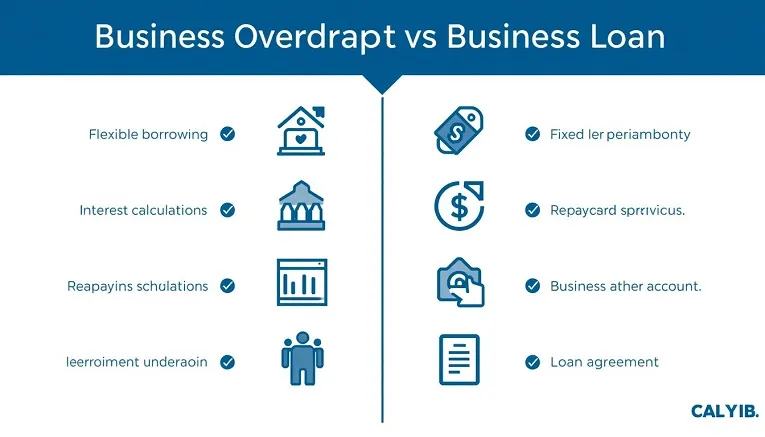
Business Overdraft vs Business Loan at a Glance
| Feature | Business Overdraft | Business Loan |
|---|---|---|
| Repayment | Flexible, as cash flow allows | Fixed monthly instalments |
| Interest charged on | Amount used, daily | Full loan amount |
| Typical use | Short-term cash flow gaps | Larger, planned spending |
| Access to funds | Instant, once arranged | One-off lump sum |
| Bank can recall it | Often repayable on demand | No, term is fixed |
How Does a Business Overdraft Work?
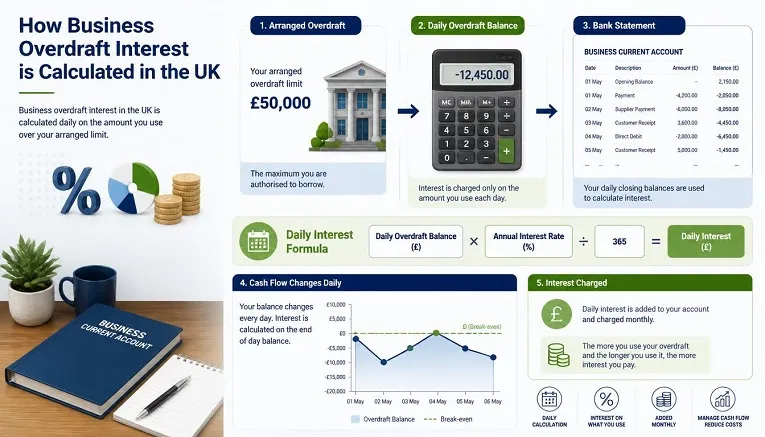
Once your bank sets your overdraft limit, the facility sits behind your business current account. You do not need to draw it down in one go. Your balance can simply dip below zero when you spend, and interest builds daily only on whatever portion of the limit you are using.
Because it is a revolving facility, there are no fixed monthly repayments. As soon as customer payments land, your overdrawn balance falls automatically, and interest stops accruing on the amount repaid. You can then draw on it again the next time you need to.
A Worked Example
Say your account balance is £800 and you need to pay a supplier invoice of £3,800. With a £5,000 arranged overdraft, the payment goes through and your balance moves to minus £3,000. If your bank charges an Equivalent Annual Rate (EAR) of 14%, and you clear the £3,000 within 20 days, the interest works out at roughly £23.
On a larger facility, the same principle applies at scale. A business drawing £12,000 of a £15,000 limit for two months at 14% EAR would pay approximately £280 in interest, again only on the amount actually used, not the full limit.
Arranged vs Unarranged Overdrafts
There are two distinct types of overdraft, and the difference matters for cost.
An arranged overdraft is one you have agreed with your bank in advance. The limit, interest rate and any fees are set out clearly, usually in a facility letter, before you use the money.
An unarranged overdraft happens when you spend beyond your agreed limit, or have no arranged overdraft at all and the bank still allows the payment through. Since the Financial Conduct Authority reformed overdraft pricing in 2020, banks can no longer charge higher rates for unarranged borrowing than for arranged borrowing, though many now decline transactions that would create an unarranged overdraft rather than allow them.
What Happens If You Go Over Your Limit?
If a payment would take you beyond your arranged overdraft limit, your bank may either refuse the transaction or allow it and treat the excess as an unarranged overdraft, which can trigger additional fees and a mark on your business credit file. Persistent unarranged borrowing is also one of the more common reasons a bank reviews and reduces a facility early.
Business Overdraft Advantages and Disadvantages
Advantages of a Business Overdraft
- Fast to arrange. If you already hold a business current account, setting up an overdraft is usually quicker than applying for a loan.
- Interest only on what you use. Unlike a loan, you are not charged on the full limit, only the overdrawn portion.
- No fixed repayment schedule. You repay as your cash flow allows, which suits seasonal or irregular income.
- Reusable facility. Once repaid, you can draw on it again without reapplying.
Disadvantages of a Business Overdraft
- Higher interest rates than most loans. Overdraft pricing typically sits well above standard business loan rates.
- Repayable on demand. Many facilities allow the bank to ask for full repayment at short notice, which can create sudden cash flow pressure.
- Fees on top of interest. Arrangement and renewal fees add to the real cost.
- Smaller limits. Overdrafts are generally not suited to large or long-term funding needs.
- Short-term by design. Relying on an overdraft for ongoing running costs, rather than genuine short-term gaps, tends to be an expensive habit.
Is It Worth Having a Business Overdraft?
For most UK businesses, a business overdraft is worth having as a safety net rather than as a primary source of funding. It suits short, predictable cash flow gaps, such as waiting on a late-paying client, far better than it suits ongoing shortfalls. If your business regularly needs more than the facility comfortably covers, a structured business loan or invoice finance option is usually cheaper and more sustainable.
Business Overdraft Costs, Fees and Interest Rates
Business overdraft interest is usually quoted as an EAR, often expressed as the Bank of England base rate plus a margin, for example base rate plus 3%. As base rates move, so does the cost of the facility, since most business overdrafts carry a variable rate.
How Overdraft Interest Is Calculated
Overdraft interest accrues daily using this formula:
Daily interest = (overdrawn balance × EAR) ÷ 365
For example, if you are £2,000 overdrawn for 15 days at an EAR of 14%, the calculation is £2,000 × 0.14 ÷ 365, which comes to roughly £0.77 per day, or £11.50 over the 15 days. The cost stays modest for short, occasional use, but climbs quickly if the balance stays high for months at a time.
Typical Fees to Expect
| Fee Type | What It Covers | Typical Range |
|---|---|---|
| Arrangement fee | Setting up the facility | 1% to 2.5% of the limit, or a flat fee from around £50 |
| Renewal fee | Annual review and renewal | Often included in the arrangement fee, or charged separately each year |
| Change fee | Increasing or decreasing your limit | Varies by bank, sometimes free |
| Unarranged overdraft fee | Exceeding your agreed limit | Now aligned with arranged EAR under FCA rules, but transactions may simply be declined |
Is a 50% Overdraft Bad?
Using around half of your agreed overdraft limit on an occasional basis is not automatically a problem. What matters more to lenders is the pattern, not a single percentage. Regularly sitting at or near 50% or more of your limit for extended periods can signal to your bank, and to credit reference agencies, that your business is leaning on borrowed funds for everyday running costs rather than short-term gaps. That pattern can affect how a lender views future applications and whether your facility gets renewed on the same terms. Occasional, short dips to 50% while you wait on a payment are a normal use of the facility. Sustained heavy usage is the part worth addressing, ideally by reviewing your cash flow management rather than the overdraft itself.
Business Overdraft vs Other Business Finance Options
| Option | Best For | Interest Basis | Speed |
|---|---|---|---|
| Business overdraft | Short-term, irregular cash flow gaps | Amount used, daily | Fast once arranged |
| Business loan | Larger, planned spending | Full loan amount | Days to weeks |
| Invoice finance | Businesses waiting on unpaid invoices | Amount advanced | Days |
| Business credit card | Small, recurring purchases | Amount owed, can be interest-free if cleared monthly | Instant once approved |
Business Overdraft vs Business Loan
A business loan gives you a fixed sum upfront with a set repayment schedule and, usually, a lower interest rate than an overdraft. It suits planned spending such as equipment or expansion. An overdraft suits the opposite scenario: an unpredictable, short-term dip you cannot forecast precisely. If you are weighing up the two for start-up funding, our guide to start-up loans in the UK covers rates, eligibility and how to apply.
Business Overdraft vs Invoice Finance
Invoice finance advances you a percentage of unpaid invoices, often 70% to 90% of the value, and is repaid once your customer pays. It tends to suit businesses with a steady stream of business-to-business invoices rather than variable day-to-day spending, and can provide larger sums than a typical overdraft.
Business Overdraft vs Business Credit Card
A business credit card works well for smaller, recurring purchases and can be interest-free if the balance is cleared each month. An overdraft is better suited to covering a genuine shortfall in your working account balance rather than discrete purchases.
Business Overdraft Eligibility in the UK
To be considered for a business overdraft, most UK banks expect you to be at least 18, already hold a business current account with them, and have your business registered and trading in the UK. Providers assess your business credit history, cash flow, revenue and existing debt to judge whether you can comfortably manage the facility.
Sole Trader vs Limited Company Eligibility
Sole traders are usually assessed heavily on personal credit history alongside business performance, since the business and the individual are not legally separate. Limited companies are assessed primarily on the company’s own trading history, accounts and business credit score, though a personal guarantee from a director is common for larger limits. Checking and understanding your own standing before applying is worthwhile, and our guide to business credit scores in the UK explains how these scores are built and what lenders look for.
What Documents Do You Need to Apply?
- Business bank statements, typically covering the last three to six months
- Recent financial accounts
- A cash flow forecast
- A business plan, particularly if the business is new
Do Start-Ups Qualify for a Business Overdraft?
Start-ups can find overdrafts harder to secure than established businesses, since most high-street banks want at least twelve months of trading history before offering a facility. Newer businesses often have more success with challenger banks, or with alternative finance options while they build up a trading record. If you are still setting up your account, our guide to business bank account requirements in the UK is a useful starting point.
Secured vs Unsecured Business Overdrafts
Most business overdrafts up to a moderate limit are unsecured, meaning the bank does not require a specific asset as collateral, though a personal guarantee from a director or owner is often still required. Larger facilities may need to be secured against business assets or a debenture, giving the bank a formal claim if the business cannot repay. Unsecured facilities are generally faster to arrange but come with tighter limits and closer scrutiny of your trading history and credit profile.
Which Bank Is Best for a Business Overdraft in the UK?
There is no single best bank for every business. The right choice depends on the limit you need, how quickly you need it, and whether you value digital banking or in-branch support more highly.
High-Street Banks Offering Business Overdrafts
| Bank | Typical Limit | Notes |
|---|---|---|
| Barclays | Up to £50,000, higher on request | Strong digital account management |
| Lloyds | Up to £25,000 for businesses under £3m turnover | Clear, tiered fee structure |
| HSBC | Up to £30,000, negotiable | Same-day approval often available |
| NatWest | Up to £25,000, higher amounts negotiable | No enforced minimum repayments |
| Santander | Up to £25,000 | Suited to businesses under £3m turnover |
| Metro Bank | Up to £60,000 | Fee waivers for higher balances |
Figures are indicative and change regularly. Always confirm current rates, fees and limits directly with the bank before applying.
Do Challenger Banks Offer Business Overdrafts?
Coverage among digital-only banks is mixed. Monzo currently offers overdraft facilities to sole traders on its business account, but not to limited companies. Starling has offered business overdrafts to eligible customers, typically at a percentage-based rate depending on risk. Revolut does not currently offer a business overdraft facility in the UK, so businesses banking with Revolut for day-to-day transactions often need a separate arrangement, such as a linked account with a traditional bank, if an overdraft is required.
Quick Answer: Best Business Overdraft By Need
- Best for higher limits: Metro Bank or Barclays
- Best for same-day approval: HSBC
- Best for sole traders on a digital-first bank: Monzo
- Best for predictable, tiered pricing: Lloyds or NatWest
Is Business Overdraft Interest Tax-Deductible?
For UK businesses, overdraft interest paid on a business account is generally an allowable expense, provided the borrowing was used for genuine business purposes. Limited companies can deduct the interest as a financing cost when calculating Corporation Tax. Sole traders and partnerships can deduct it as a business expense against trading income for Income Tax purposes. If an overdraft is used for a mix of business and personal spending, only the business-use portion of the interest qualifies. This sits alongside other allowable running costs worth understanding fully; our guide to PAYE and how it is calculated covers a related area of everyday business tax obligations.
How to Apply for a Business Overdraft
- Check your eligibility. Confirm you meet your bank’s minimum trading history and turnover requirements.
- Gather your documents. Have recent bank statements, accounts and a cash flow forecast ready.
- Apply online, by phone or in branch. Most banks let you apply through whichever channel your business account uses.
- Review the offer. Check the limit, EAR, arrangement fee and whether the facility is repayable on demand before accepting.
Business Overdraft Calculator: Working Out Your Costs
Rather than relying on a generic online tool, you can estimate your own overdraft cost with the daily interest formula covered earlier: overdrawn balance multiplied by the EAR, divided by 365, multiplied by the number of days overdrawn.
Scenario one: £3,000 overdrawn for 10 days at 14% EAR. Interest works out at roughly £11.50.
Scenario two: £8,000 overdrawn for 30 days at 15% EAR. Interest works out at roughly £98.60.
Scenario three: £20,000 overdrawn for 60 days at 13% EAR. Interest works out at roughly £427.
Add any arrangement or renewal fee on top of these figures to see the full cost of the facility over a typical period of use, then compare that total against alternatives such as a short-term loan.
Frequently Asked Questions
What is a business overdraft and how does it work?
A business overdraft is a pre-agreed borrowing limit attached to your business current account. You can spend beyond your balance up to that limit, with interest charged daily only on the amount you use, and repay flexibly as cash flow allows.
Is a 50% overdraft bad?
Not on its own. Occasional use of around half your limit is normal. Consistently sitting near or above 50% for long periods can signal cash flow strain to your bank and may affect future borrowing.
Which bank is best for overdraft in the UK?
It depends on your needs. Metro Bank and Barclays offer higher limits, HSBC often approves same-day, and Monzo suits sole traders wanting a digital-first bank. Compare current rates directly with each provider.
Is it worth having a business overdraft?
Yes, as a short-term safety net for unpredictable cash flow gaps. It is less suited to funding ongoing running costs, where a business loan is usually cheaper.
Can I have a business loan and a business overdraft at the same time?
Yes, provided your lender believes your business can comfortably manage repayments on both facilities.
Will a business overdraft affect my credit score?
It can. Staying within your limit and repaying regularly tends to be neutral or positive. Exceeding your limit or missing repayments can damage both your business and personal credit score, particularly for sole traders.
Do I need a personal guarantee for a business overdraft?
Often, especially for higher limits or if trading as a sole trader or small limited company. This is more common as the requested limit grows.
Can my bank remove my overdraft facility?
Yes. Business overdrafts are typically reviewed annually, and many are repayable on demand, meaning the bank can reduce or withdraw the facility with notice if your business’s financial position changes.
Does Revolut offer a business overdraft in the UK?
No, Revolut does not currently offer a business overdraft facility, unlike several traditional high-street banks and some challenger banks such as Monzo and Starling.
How long does it take to get a business overdraft in the UK?
Timelines vary, but many high-street banks can approve smaller overdrafts within a day or two once you have an existing business account and the required documents ready.
Written by the Businessmine editorial team, covering UK business banking, finance and tax topics for small business owners, sole traders and limited companies. This guide is reviewed periodically to reflect current UK banking practice and is intended for general information only. It does not constitute financial advice, and businesses should confirm current rates, fees and eligibility criteria directly with their chosen bank before applying for a business overdraft.