
If you run a business in the UK, you are legally required to keep certain records, and for a set minimum period. Sole traders and partnerships must keep records for at least five years after the 31 January Self Assessment deadline. Limited companies must keep records for at least six years from the end of the financial year they relate to. Get this wrong and HMRC can charge a penalty of up to £3,000 per tax year, on top of any extra tax, interest and Companies House late filing fines.
This guide sets out exactly what counts as a business record, how long you need to keep each type, what happens if you fall short, and a simple template you can start using today.
What Counts as a Business Record in the UK?
A business record is any document that supports the figures on your tax return, your accounts, or your company’s legal status. HMRC does not prescribe a single format. Records can be kept on paper, digitally, or within accounting software, provided they are accurate, complete and easy to read when requested.
Financial Records
These cover the money moving in and out of your business: sales invoices, purchase invoices, business expenses, cash books, mileage logs, and bank statements. If you are VAT registered, this also includes your VAT account and copies of VAT invoices.
Statutory and Company Records
Limited companies carry extra obligations under the Companies Act 2006. This includes details of directors, shareholders and company secretaries, the register of people with significant control (PSC), minutes of board meetings and resolutions, and any debentures or indemnities the company has issued.
Employment and Payroll Records
If you employ staff, you must keep records of wages paid, tax and National Insurance deducted, and statutory payments such as sick pay or maternity pay. These sit alongside the records covered in our guide to payroll for small businesses in the UK.
How Long Do You Have to Keep Business Records in the UK? Quick Answer
Sole traders and partnerships must keep records for at least five years after the 31 January submission deadline of the relevant tax year. Limited companies must keep records for at least six years from the end of the financial year they relate to. VAT-registered businesses must generally keep VAT records for six years, and employer payroll records must be kept for at least three years, though many accountants recommend six years for consistency.
Business Record Retention Periods: Full Comparison Table
Use this table as your quick reference. The retention period always runs from a specific date, not from the date the record was created, so check the “starts from” column carefully.
| Business Type or Record | Minimum Retention Period | Starts From |
|---|---|---|
| Sole trader / partnership records | 5 years | 31 January Self Assessment deadline for that tax year |
| Limited company accounting records | 6 years | End of the financial year they relate to |
| VAT records | 6 years | End of the VAT period |
| PAYE and payroll records | 3 years (6 years recommended) | End of the tax year they relate to |
| Corporation Tax records | 6 years | End of the accounting period |
| Statutory registers, board minutes, VAT MOSS | 10 years | Date the company stops being registered |
| Business insurance documents | 7 years | End of the policy |
Two situations extend these minimums automatically. If HMRC opens a compliance check into a tax year, you must keep the related records until the check is closed, however long that takes. If you file your tax return or Company Tax Return late, the clock on your retention period is effectively pushed back to match, since HMRC can still enquire into a late return.
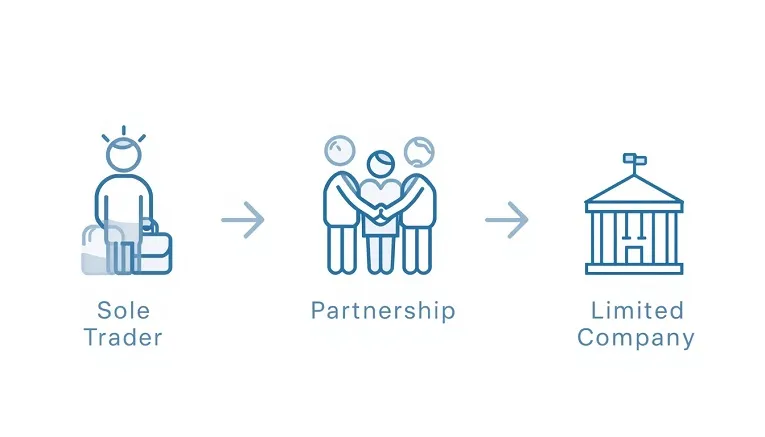
Sole Trader and Partnership Record Keeping Requirements
If you are self-employed, the five-year rule is tied to the 31 January Self Assessment deadline, not the tax year itself. For example, if you filed your 2025/26 return by the 31 January 2027 deadline, you would need to keep the supporting records until at least 31 January 2032.
As a sole trader or partner, you should retain:
- Records of all sales and other income, including invoices and till records
- Records of every business expense, with the date, amount and purpose
- Business bank and credit card statements
- Details of any assets bought for the business
- VAT records, if you are registered
- Personal income details relevant to your Self Assessment return
Many sole traders use bookkeeping software to keep this organised from day one rather than relying on a shoebox of receipts. Our guide on starting a bookkeeping business in the UK and our overview of bookkeeping services and pricing both cover how outsourcing this task works in practice, if you would rather hand it to a professional.
Limited Company Record Keeping Requirements
Limited companies face a heavier record keeping burden than sole traders, and it comes from two directions: HMRC and Companies House. Under the Companies Act 2006, directors have a personal legal duty to keep adequate accounting records, and failing to do so can lead to a fine or, in serious cases, disqualification as a director.
The Six Year Rule
As a baseline, limited companies must keep accounting records for six years from the end of the financial year they relate to. If your company’s financial year ends on 31 March 2026, you must keep those records until at least 31 March 2032.
What Accounting Records Must Include
- All money received and spent by the company, with an explanation of what it was for
- Details of assets the company owns
- Debts the company owes or is owed
- Stock held at the end of the financial year, and the stocktaking records used to work this out
- All goods bought and sold, including buyer and seller details, unless you run a retail business
Read our guide to the Corporation Tax for small businesses in the UK for how these figures feed into your company’s tax return, and our comparison of sole trader versus limited company structures if you are still deciding which route suits you.
When You Need to Keep Records for 10 Years
Three situations push the retention period to ten years rather than six: the company’s statutory books and registers kept while the business was trading, VAT Mini One Stop Shop (MOSS) records, and minutes of board meetings and resolutions. If you registered your company through Companies House, our step-by-step guide to registering a business with Companies House explains where these statutory obligations begin.
HMRC Record Keeping Requirements Explained
HMRC’s core requirement is simple to state and easy to underestimate in practice: your records must be accurate, complete and accessible, and they must allow you, and HMRC if asked, to work out your tax liability correctly. HMRC does not care whether your system is a spreadsheet, a shoebox of receipts, or dedicated software, only that the end result is reliable.
If HMRC opens a compliance check, they may ask to see the records behind specific figures on your return. This is one reason to keep everything logically filed by tax year rather than scattered across accounts, folders and inboxes. If you already have an HMRC business tax account set up, our guide to the HMRC business tax account covers how to check what HMRC holds on file for you and where enquiries typically start.
Digital Versus Paper Records
There is no general legal requirement to store every record digitally, but paper records must remain legible for the full retention period, which is harder than it sounds for thermal till receipts that fade within months. Scanning paper records as you go, and backing them up, protects you against both fading ink and lost paperwork.
VAT, PAYE and Corporation Tax Record Retention
Different tax regimes carry slightly different retention rules, and it is worth keeping them separate in your filing system rather than assuming one rule covers everything.
| Record Type | Retention Period | Related Guide |
|---|---|---|
| VAT records | 6 years | VAT registration in the UK |
| PAYE and payroll records | 3 years minimum | PAYE explained |
| Employer National Insurance records | 3 years minimum | Employer National Insurance contributions |
| Corporation Tax records | 6 years | Corporation Tax for small businesses |
If your business turnover is close to the VAT threshold, it is worth reading our full breakdown of when and how to register for VAT, since registration brings the six-year VAT record rule into effect immediately.
Making Tax Digital and Digital Record Keeping
Making Tax Digital (MTD) is changing how UK businesses are expected to keep records, moving the requirement from “keep good records” to “keep digital records in compatible software.” VAT-registered businesses already need to use MTD-compatible software, and MTD for Income Tax is being phased in for sole traders and landlords with qualifying income above certain thresholds.
This does not change how long you need to keep records, but it does change the format. Spreadsheets alone are unlikely to satisfy MTD unless linked to compatible bridging software. For a full walkthrough of what MTD means for your business, see our guide to Making Tax Digital in the UK, and if you are choosing a system, our comparison of the best Making Tax Digital software covers the leading options.
What Happens If You Do Not Keep Proper Records?
The consequences of poor record keeping fall into three categories: financial penalties, tax assessments, and personal liability for directors.
HMRC Penalties
HMRC can charge a penalty of up to £3,000 per tax year for failing to keep adequate records, separate from any additional tax, interest or penalties raised because of inaccurate figures on your return. If HMRC cannot verify your figures, they may also raise an estimated assessment, which tends to be less favourable than working from your own accurate records.
Companies House Penalties
Companies House data shows how seriously this is enforced in practice. In the 2024 to 2025 year, Companies House issued 317,985 penalties for late filing of accounts, even though 98.5 percent of companies filed their annual accounts on time and 97.1 percent filed confirmation statements on time. The penalties fall hardest on the small minority who miss deadlines, and poor record keeping is usually the underlying cause.
Director Liability
Under the Companies Act 2006, directors have a personal duty to ensure the company keeps adequate accounting records. Persistent or serious failure can, in extreme cases, lead to disqualification as a director, on top of any financial penalty against the company itself.
What If You Lose Your Business Records?
If records are lost, damaged or destroyed, tell HMRC as soon as you become aware of it rather than waiting until you are asked for them. HMRC is generally more accommodating when a business flags the issue early and shows a genuine effort to recreate what is missing.
To reconstruct lost records:
- Request duplicate bank and credit card statements from your bank
- Ask suppliers and customers for copies of invoices or receipts
- Use any available email confirmations or online order history
- Where a figure genuinely cannot be recovered, use a clearly marked provisional or estimated figure on your return, and update it once you have better evidence
Self-Employed Record Keeping Template and Example
You do not need expensive software to keep compliant records, particularly in the early stages of self-employment. A simple spreadsheet with the following columns satisfies HMRC’s requirements, provided you keep it up to date and accurate.
| Date | Description | Income | Expense | Category | Notes / Receipt Reference |
|---|---|---|---|---|---|
| 03/07/2026 | Invoice 0021, ABC Ltd | £850.00 | Sales | Paid by bank transfer | |
| 05/07/2026 | Office supplies | £42.30 | Consumables | Receipt scanned, ref 018 | |
| 12/07/2026 | Fuel, client visit | £28.60 | Travel | Mileage log entry 6 |
The principle behind this example applies whatever tool you use: every entry should have a date, a clear description, an amount, a category, and a way to trace it back to the original document. If you later move to accounting software, this same structure transfers across directly, and it is also the format most accountants ask new clients to provide if they have been keeping records manually.
How to Set Up a Business Record Keeping System
A workable system does not need to be complicated, but it does need to be consistent. Three broad options suit most small UK businesses.
Spreadsheets
Suitable for very early-stage sole traders with low transaction volumes. Cheap and flexible, but manual, and not MTD-compliant on its own once digital record keeping becomes mandatory for your income level.
Accounting Software
The most common choice once a business has regular transactions. Software automatically timestamps entries, stores digital copies of receipts, and produces the reports you need for your balance sheet and profit and loss statement at year end.
Outsourced Bookkeeping
Many growing businesses reach a point where handing records to a professional bookkeeper saves more in time and error-avoidance than it costs. Our guide to bookkeeping services, prices and packages in the UK covers what this typically costs and how to choose a provider.
Legal Basis for UK Record Keeping Requirements
UK record keeping obligations are not a single rule but a combination of several pieces of legislation, each covering a different angle of the business.
- Companies Act 2006 sets out the duty for limited companies to keep adequate accounting records, and the personal responsibility this places on directors.
- Income Tax (Trading and Other Income) Act 2005 underpins HMRC’s Self Assessment record keeping requirements for sole traders and partnerships.
- Value Added Tax Act 1994 and related regulations set the six-year VAT record retention period for VAT-registered businesses.
- Limitation Act 1980 means most general business documents, such as contracts, should be kept for six years after they expire, so they remain available if a civil claim is brought against the business.
None of these Acts require a specific format or storage method, only that records are complete, accurate and available for the required period.
Frequently Asked Questions
How long do business records need to be kept in the UK?
Sole traders and partnerships must keep records for at least five years after the 31 January Self Assessment deadline. Limited companies must keep records for at least six years from the end of the financial year they relate to.
What are the legal requirements for record keeping?
Records must be accurate, complete and accessible, and must support the figures on your tax return or company accounts. The specific rules come from the Companies Act 2006, the Income Tax (Trading and Other Income) Act 2005, and VAT legislation, depending on your business type.
What financial records are kept for 7 years?
Business insurance documents are typically kept for seven years after the policy ends. This sits outside the standard five or six year tax and company law minimums, so it is worth tracking separately in your filing system.
What happens if I do not keep proper business records?
HMRC can charge a penalty of up to £3,000 per tax year for inadequate records, and may raise an estimated tax assessment if your figures cannot be verified. Limited company directors can also face personal liability under the Companies Act 2006.
Do business records have to be kept on paper?
No. HMRC accepts digital records, provided they are complete, accurate and legible for the full retention period. Many VAT-registered and larger businesses are now required to keep digital records under Making Tax Digital.
How long do sole traders keep records after they stop trading?
The same five-year rule applies after a sole trader stops trading, counted from the 31 January deadline for the final relevant tax return, unless HMRC has an open enquiry, in which case records must be kept until that enquiry closes.
Key Takeaways
- Sole traders and partnerships: keep records for 5 years after the 31 January Self Assessment deadline
- Limited companies: keep records for 6 years from the end of the financial year
- VAT and Corporation Tax records: 6 years
- PAYE and payroll records: at least 3 years
- Statutory registers and board minutes: up to 10 years
- Business insurance documents: 7 years
- HMRC penalties for poor record keeping can reach £3,000 per tax year
- Tell HMRC immediately if records are lost or destroyed
About the Author
This guide was prepared by the Business Mine editorial team, who research and write practical UK business, tax and finance guides for sole traders, limited company directors and small business owners. Information is checked against current HMRC and Companies House guidance at the time of publication. This article is provided for general information only and does not constitute tax or legal advice; for advice specific to your circumstances, consult a qualified accountant or solicitor.