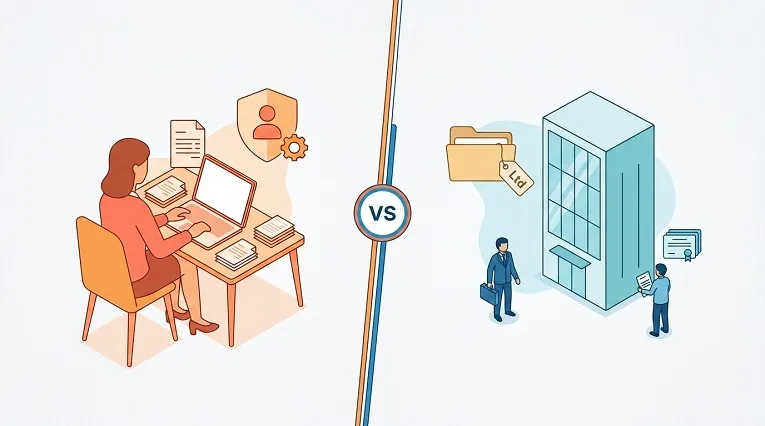

Closing a limited company is not just a case of stopping trading and walking away. Companies House still holds your company on the register. HMRC still expects final returns. Directors still carry legal duties until the company is formally dissolved.
This guide sets out the three ways to close a UK limited company, the current 2026 fees, the exact steps, and the mistakes that cause delays or personal liability.
Quick Answer
Most solvent UK companies close through voluntary strike off. You stop trading, settle every debt, file final accounts and a final Corporation Tax return, then submit form DS01 to Companies House. The current fee is £13 online or £18 by paper. If the company holds significant assets, a Members’ Voluntary Liquidation is usually more tax efficient. If the company cannot pay its debts, directors must use Creditors’ Voluntary Liquidation instead.
The Three Ways to Close a Limited Company
Every closure route in the UK falls into one of three categories. The right one depends entirely on whether your company is solvent or insolvent.
Voluntary Strike Off
This is the simplest and cheapest route. It suits a solvent company that has stopped trading, has no debts, and has already distributed its assets. You apply using Companies House form DS01.
Members’ Voluntary Liquidation (MVL)
An MVL is a formal liquidation process for a solvent company. It suits businesses holding more than around £25,000 in retained profit or assets, since it can offer significant tax advantages over strike off. A licensed insolvency practitioner must handle the process.
Creditors’ Voluntary Liquidation (CVL)
A CVL is for a company that cannot pay its debts as they fall due. It is a formal insolvency process run by a licensed insolvency practitioner and protects directors from some of the personal risk that comes with an insolvent company continuing to trade.
| Closure route | Suitable for | Main requirement | Main advantage | Main drawback |
|---|---|---|---|---|
| Voluntary strike off | Solvent, debt-free companies | Company must meet strike-off conditions | Cheapest and simplest route | Assets can pass to the Crown if left behind |
| MVL | Solvent companies with substantial assets/profits | Licensed insolvency practitioner | Potentially more tax-efficient distributions | Much higher cost |
| CVL | Companies unable to pay debts | Formal insolvency process | Deals with creditors properly | More expensive and complex |
Are You Solvent or Insolvent? Why It Changes Everything
A company is solvent if it can pay every debt it owes, including tax, in full within 12 months. A company is insolvent if it cannot pay its bills as they fall due, or if its total liabilities exceed its assets.
This single distinction decides your entire closure route. Choosing strike off for a company that cannot actually pay its debts is not a shortcut. It can expose directors to personal liability and, in serious cases, disqualification.
Strike Off vs MVL: A Worked Cost Comparison
Numbers make this decision clearer than general advice alone. Imagine a small consultancy closing with £40,000 in retained profit after Corporation Tax.
Taking that £40,000 out as a final dividend before a simple strike off means paying dividend tax on it, at rates up to 35.75% for a higher rate taxpayer once the £500 dividend allowance is used. That could mean several thousand pounds in extra personal tax on top of the £13 strike off fee.
Taking the same £40,000 through an MVL instead treats the distribution as capital rather than income. With Business Asset Disposal Relief applied, the effective rate can sit well below the higher dividend rate. Even after paying an insolvency practitioner’s fee, typically £1,500 to £3,000 for a straightforward case, the director often keeps considerably more of the £40,000 overall.
Below a certain profit level, this gap narrows enough that the MVL fee outweighs the tax saving, which is exactly why the informal £25,000 threshold gets quoted so often. Above it, an accountant will usually recommend running the actual numbers before defaulting to strike off.
Should You Make the Company Dormant Instead of Closing It?
Closing is not always the only option. If there is a genuine chance you will use the company again, for example a seasonal business or a project you plan to restart, making the company dormant rather than dissolving it can make more sense.
A dormant company still needs a confirmation statement filed every year and, in most cases, dormant accounts submitted to Companies House, but it avoids the cost and effort of forming a brand new company later. It also keeps your company name reserved. The trade-off is ongoing, if minimal, filing obligations. If you are confident you will never use the company again, closing it properly removes that admin permanently.
What You Need to Do Before Closing a Limited Company
Before applying to close a limited company, directors should make sure the company’s affairs are properly settled. This means stopping trading, collecting outstanding customer payments, paying suppliers and other creditors, resolving employee obligations, dealing with VAT and PAYE registrations, completing outstanding tax filings and deciding what should happen to any remaining cash or business assets. It is also sensible to review contracts, loans, leases, insurance policies and subscriptions before closure so that no continuing obligations are overlooked.
How to Close a Company by Voluntary Strike Off: Step by Step
Step 1: Stop Trading and Wait Three Months
Your company must not have traded, changed its name, or disposed of assets outside the ordinary course of closing down, for at least three months before you apply. HMRC and Companies House both check this.
Step 2: Settle Every Debt
Pay off suppliers, loans, and any other creditors in full. You cannot strike off a company with outstanding debts unless every creditor has genuinely been paid or has formally agreed to write the debt off.
Step 3: Deal With Final Tax Obligations
Tell HMRC you are closing the company. File your final Company Tax Return covering the period up to cessation, and pay any Corporation Tax owed. Our guide to Corporation Tax for small businesses explains how this final calculation works.
Deregister for VAT if the company is VAT registered, and close your PAYE scheme if you have run payroll. Leaving any of these open is one of the most common reasons HMRC objects to a strike off application.
Step 4: Distribute or Remove Every Asset
Empty the company bank account and close it. Transfer or sell business assets, including stock, equipment, and domain names. Anything left inside the company when it is dissolved automatically becomes the property of the Crown. Getting it back afterwards means restoring the company, which takes time and costs money.
Step 5: Submit Form DS01
The DS01 application should only be submitted once the company meets the eligibility requirements for voluntary strike off. Directors should check that the company has stopped trading, settled its liabilities, dealt with its assets and completed the necessary tax and payroll arrangements before applying. The application should not be treated as a way of avoiding outstanding debts or tax liabilities.

Step 6: Notify Interested Parties
Within seven days of applying, you must send a copy of the application to every shareholder, creditor, employee, pension trustee, and any director who did not sign, along with HMRC.
Step 7: Wait Out the Objection Period
Companies House publishes a notice in the Gazette, the UK’s official public record. If nobody objects within two months, the company is struck off and formally dissolved.
Members’ Voluntary Liquidation: When It Makes Sense
If your company holds more than roughly £25,000 in retained profit, an MVL is usually worth serious consideration instead of a simple strike off. The process lets a licensed insolvency practitioner distribute company funds as capital rather than income, which can then qualify for Business Asset Disposal Relief, taxing the distribution at a lower Capital Gains Tax rate rather than dividend tax rates.
The trade-off is cost. An MVL typically costs more than a strike off, since it requires a licensed insolvency practitioner throughout. For a company with substantial retained profit, the tax saving usually outweighs that fee by a wide margin, which is why an accountant will often recommend it over strike off once the numbers cross a certain threshold.
What Happens to Directors During Closure
Directors keep their legal duties right up until the company is dissolved. This includes making sure the company’s affairs are in order, that no creditor is treated unfairly, and that the closure information given to Companies House and HMRC is accurate.
Submitting a dishonest strike off application is a criminal offence. It can result in a fine and prosecution, and it can also trigger a restoration of the company later if HMRC or a creditor challenges the closure.
Record Keeping After the Company Closes
Closing the company does not end your record keeping obligations. Company records, including accounts, tax returns, payroll records, and bank statements, generally need to be kept for at least six years after dissolution. Our guide to business record keeping requirements covers exactly what to retain and for how long, which still applies even after the company itself no longer exists.
Can You Close a Company With Outstanding HMRC Debt?
Not through a straightforward strike off. HMRC actively monitors DS01 applications and will object if the company has unpaid tax, outstanding returns, or an open investigation. If the company genuinely cannot pay what it owes HMRC, a Creditors’ Voluntary Liquidation is the correct route, since it deals with unpaid debts formally rather than trying to close around them.
Employees and Closing a Limited Company
If the company employs staff, you must follow redundancy rules before closing, including proper notice and any redundancy pay owed. This applies whichever closure route you use. Skipping this step is a common source of employment tribunal claims against directors personally, so it is worth getting right before you file anything with Companies House.
Can You Close a Company and Start a New One?
Yes, this is entirely legal and common, whether for rebranding, restructuring, or moving into a different line of business. There are rules around reusing a very similar company name shortly after dissolution in some circumstances, so it is worth checking this specific point with an accountant if your new venture is closely related to the one you are closing.
Common Mistakes That Delay or Block a Closure
- Applying for strike off while the company still owes HMRC money
- Leaving money or assets in the company bank account before applying
- Not closing the VAT registration or PAYE scheme first
- Applying before the mandatory three-month non-trading period has passed
- Choosing strike off for a company that is genuinely insolvent
- Forgetting to notify all interested parties within seven days
| Mistake | Why it causes problems |
|---|---|
| Leaving HMRC debts unpaid | HMRC may object to the strike off |
| Leaving money in the company | Remaining assets can pass to the Crown |
| Applying too early | The company may not satisfy strike-off conditions |
| Ignoring VAT or PAYE | Outstanding registrations and returns can delay closure |
| Using strike off while insolvent | Directors can face significant legal and financial risks |
Frequently Asked Questions
How much does it cost to close a limited company in the UK?
A voluntary strike off costs £13 online or £18 by paper, following the Companies House fee changes from 1 February 2026. A Members’ Voluntary Liquidation or Creditors’ Voluntary Liquidation typically costs significantly more, since both require a licensed insolvency practitioner.
How long does it take to close a limited company?
A voluntary strike off typically takes around three months from application to dissolution, including the two-month objection period after the Gazette notice. Liquidation processes can take longer depending on the complexity of the company’s affairs.
What happens to money left in the company bank account?
Once the company is struck off, any remaining money or assets automatically become the property of the Crown. You should empty the account and close it before applying, since recovering funds afterwards means formally restoring the company.
Can I close a limited company with debts?
Not through voluntary strike off. If the company cannot pay what it owes, a Creditors’ Voluntary Liquidation is the correct route, run by a licensed insolvency practitioner.
Do I need an accountant to close a limited company?
Strike off can be handled by directors alone for a simple, debt-free company. An MVL or CVL requires a licensed insolvency practitioner by law, and an accountant is strongly recommended for the final tax return and to confirm which closure route suits your situation.
How long do I need to keep records after the company closes?
Company records generally need to be kept for at least six years after dissolution, including accounts, tax returns, and bank statements.
Is it better to make a company dormant or close it completely?
Dormant status suits a company you may use again, since it keeps the name reserved with minimal ongoing filing. Closing permanently suits a company you are certain you will never restart, since it removes all future filing obligations.
Key Takeaways
- Voluntary strike off suits a solvent, debt-free company and costs £13 online or £18 by paper
- Members’ Voluntary Liquidation often makes sense once retained profit passes around £25,000, and can meaningfully reduce tax compared with a final dividend
- Creditors’ Voluntary Liquidation is the correct route for an insolvent company
- Clear every debt, close VAT and PAYE, and empty the bank account before applying
- Consider dormant status instead of closure if you may use the company again
- Keep company records for at least six years after dissolution
Conclusion
The simplest way to decide how to close your company is to start with its financial position. A solvent, inactive company with no debts will often be suitable for voluntary strike off. A solvent company with substantial retained profits or assets may benefit from an MVL after comparing the professional fees with the potential tax treatment. If the company cannot pay its creditors, voluntary strike off should not be used as a substitute for an insolvency procedure.
This guide was prepared by the Business Mine editorial team, who research and write practical UK business, tax and finance guides. Information is checked against current Companies House and HMRC guidance at the time of publication. This article is provided for general information only and does not constitute legal or tax advice; for advice specific to your circumstances, consult a qualified accountant or licensed insolvency practitioner.