
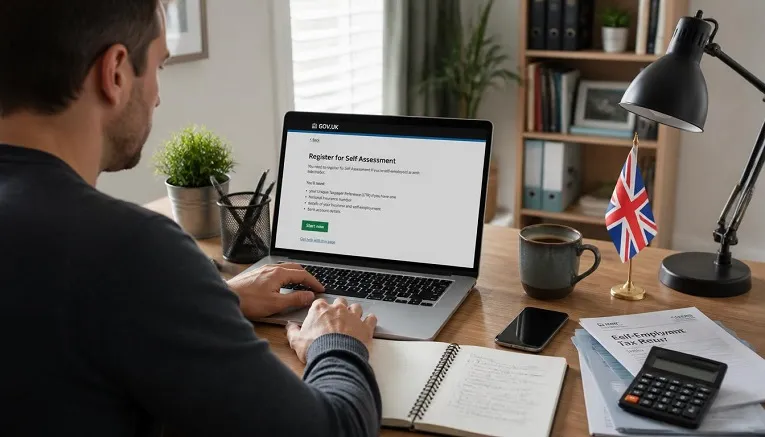
If you have started earning money by working for yourself, one of the first jobs on your list is telling HM Revenue and Customs (HMRC). Registering as self-employed is what allows HMRC to tax you correctly, credit your National Insurance record, and issue the reference number you will use for the rest of your trading life. This guide walks through exactly who needs to register, when to do it, and how to complete the process step by step.
What Does It Mean to Register as Self-Employed?
Registering as self-employed means telling HMRC that you are working for yourself so you can be enrolled for Self Assessment and pay the right Income Tax and National Insurance on your profits. In practice, this usually means registering as a sole trader, which is the simplest legal structure for someone running their own business.
Self-Employed vs Sole Trader vs Employed
“Self-employed” is a tax status, not a business structure. Most people who are self-employed operate as sole traders, meaning they run the business as an individual and keep all the profits after tax. You can also be self-employed as a partner in a business partnership. This is different from being employed, where an employer deducts Income Tax and National Insurance from your wages automatically through PAYE before you ever see the money.
If you are choosing between structures, it is worth reading our guide on sole trader vs limited company before you register, since the two paths have very different tax and reporting obligations.
Why HMRC Needs to Know
Once you register, HMRC opens a Self Assessment record in your name. This is how they know to expect a tax return from you each year, and it is how your National Insurance contributions get recorded correctly so your State Pension entitlement is not affected.
Do You Need to Register as Self-Employed? (Eligibility Checklist)
You will usually need to register as self-employed with HMRC if any of the following apply:
- Your total income from self-employment was more than £1,000 in a tax year
- You need to prove you are self-employed, for example to claim Tax-Free Childcare
- You want to pay voluntary National Insurance contributions to protect your State Pension record
- You are a partner in a business partnership
The £1,000 Trading Allowance Explained
HMRC gives every individual a tax-free trading allowance of £1,000 per tax year. If your total self-employment income, before expenses, stays under this amount, you generally do not need to register or declare it. Earn more than £1,000 and you will usually need to register, even if the extra income comes from a side project rather than a full-time business.
Signs You Count as Self-Employed
You are likely self-employed if you run the business yourself and take responsibility for its success or failure, you can decide how, when and where you work, you can hire other people at your own expense to help you, and you are not paid automatically through an employer’s payroll. If you are unsure, HMRC’s Employment Status Checker on GOV.UK can help confirm your status before you register.
When Do You Need to Register? (The 5 October Deadline)
HMRC’s rule is straightforward: you must register by 5 October following the end of the tax year in which you started trading. The UK tax year runs from 6 April to 5 April.
Worked Example: Calculating Your Deadline by Start Date
| You started trading in… | This falls in tax year… | Your registration deadline is… |
|---|---|---|
| June 2025 | 2025/26 | 5 October 2026 |
| December 2025 | 2025/26 | 5 October 2026 |
| April 2026 | 2026/27 | 5 October 2027 |
| February 2027 | 2026/27 | 5 October 2027 |
The tax year you started in is what matters, not the calendar date you register. Many people register as soon as they start trading rather than waiting until the deadline, since this avoids the paperwork piling up and gives you time to sort out your Government Gateway account without pressure.
Who Does NOT Need to Register?
Not everyone earning money outside traditional employment needs to register immediately. If your total trading income is £1,000 or less during the tax year and you do not need to complete a Self Assessment return for another reason, you will usually not need to register as self-employed. Likewise, individuals earning only employment income through PAYE or those whose income is fully covered by specific exemptions may not need to register. If your circumstances change, you should review your position before the registration deadline.
What Happens If You Register Late
Missing the 5 October deadline can lead to a penalty, even if you owe no tax once your return is filed. The exact penalty depends on how late you are and whether HMRC believes the failure was deliberate. It is always better to register as soon as you realise you should have, rather than waiting and hoping it goes unnoticed.
How to Register as Self-Employed with HMRC: Step-by-Step
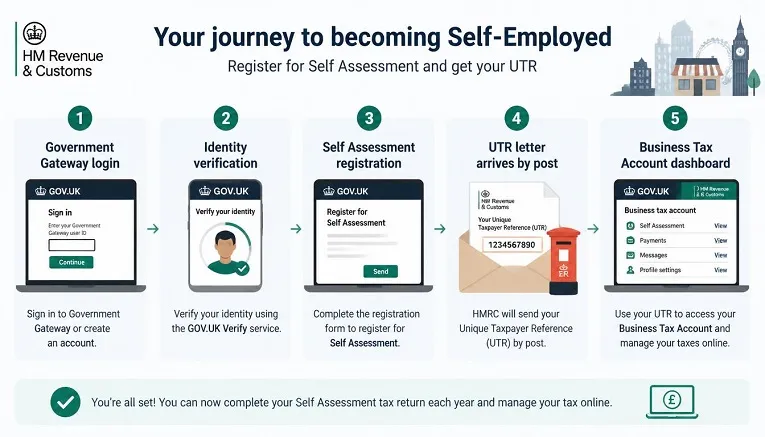
Step 1: Create a Government Gateway Account or Sign In with GOV.UK One Login
Head to the official registration service on GOV.UK. If you have never used HMRC’s online services before, you will need to set up a Government Gateway account or complete GOV.UK One Login, which HMRC has increasingly moved new registrants towards. You will need a valid email address to get started.
Step 2: Complete Identity Verification
For many new registrations, HMRC now asks you to verify your identity using the GOV.UK ID Check app or an equivalent verification step. This usually involves photographing an identity document, such as a passport or driving licence, and confirming a few personal details. It sounds like an extra hurdle, but it is designed to keep your tax record secure.
Step 3: Register for Self Assessment
Once your account is set up, select the option to register for Self Assessment and choose “sole trader” or “working for yourself” when asked why you are registering. You will be asked for:
- Your full name, date of birth and home address
- Your National Insurance number
- The date your self-employment started
- A description of what your business does
- Your business name, if you are trading under one other than your own
Step 4: Receive Your Unique Taxpayer Reference (UTR)
After you submit your registration, HMRC will post you a letter containing your 10-digit Unique Taxpayer Reference, or UTR. Keep this number safe. You will need it every time you file a Self Assessment tax return, contact HMRC about your business, or register for other taxes such as VAT.
Once your Business Tax Account is fully set up, it is worth reading our guide to the HMRC Business Tax Account so you know how to manage everything in one place going forward.
What Happens After You Register?
Understanding Your UTR
Your UTR is effectively your permanent identifier with HMRC for tax purposes. It does not change if you stop and later restart self-employment, so there is no need to register again from scratch if you already have one.
Setting Up Your Self Assessment Record
Once registered, your Government Gateway or One Login account will show a link to your Self Assessment record. This is where you will file your annual tax return, view any payments due, and update your details if your circumstances change.
Your First Tax Return Timeline
Your first Self Assessment tax return covers the tax year in which you registered, and the deadline for filing online and paying any tax owed is 31 January following the end of that tax year. It is sensible to start keeping records from day one so this first return is not a scramble.
Common Registration Timeline
Once HMRC receives your application, the registration process usually moves through several stages. First, your identity is verified. HMRC then creates your Self Assessment record and issues your Unique Taxpayer Reference (UTR). After receiving your UTR, you can access your Business Tax Account, keep digital records of your income and expenses, and prepare for your first Self Assessment tax return. Completing each stage promptly helps avoid delays and ensures your tax obligations are met from the beginning.
National Insurance for the Self-Employed
There are two types of National Insurance contribution that can apply to the self-employed.
| Class 2 | Class 4 | |
|---|---|---|
| Who pays it | Voluntary since April 2024, unless profits are below the Small Profits Threshold | Anyone with taxable profits above the Lower Profits Limit |
| How it’s charged | Flat weekly rate, paid voluntarily to protect your NI record | Percentage of profits, collected through Self Assessment |
| What it protects | State Pension and certain contributory benefits | No direct benefit entitlement; it is a straightforward tax on profits |
Voluntary Class 2 Contributions and State Pension
If your profits sit above the Small Profits Threshold, HMRC treats you as having paid Class 2 automatically, protecting your National Insurance record without any extra payment. If your profits fall below that threshold, you can still choose to pay Class 2 voluntarily at a low weekly rate, which is often worthwhile if you want an unbroken record for your State Pension.
Class 4 contributions apply once your taxable profits exceed the Lower Profits Limit and are charged in bands, with a lower percentage applying to profits above the Upper Profits Limit. Both Class 4 and Income Tax are calculated and paid together through your Self Assessment return, so it is worth budgeting for both rather than treating them as separate bills. Rates and thresholds are reviewed every tax year, so always check the current figures on GOV.UK before you calculate what you owe.
Registering for VAT: Do You Need To?
Registering as self-employed does not automatically register you for VAT. You only need to register for VAT once your VAT-taxable turnover goes over the current threshold in any rolling 12-month period. Some self-employed people register voluntarily below the threshold, for example if most of their clients are VAT-registered businesses that can reclaim the VAT charged. Our full VAT registration guide covers the current threshold and the registration process in detail.
Registering as Self-Employed for CIS (Construction Industry Scheme)
If you work as a subcontractor in the construction industry, your registration path is slightly different. You still need to register for Self Assessment in the usual way, but you will also need to register separately for the Construction Industry Scheme so that contractors can deduct tax correctly from your payments before you receive them. Registering for CIS is a one-off process, and it is only needed again if your business structure changes, for example if you later incorporate as a limited company.
Special Cases: Foster Carers and Self-Employment Registration
Foster carers occupy an unusual position for tax purposes. Foster care payments are treated as self-employment income, but most foster carers benefit from qualifying care relief, a special tax exemption that means many pay little or no Income Tax on their fostering income. Even so, foster carers are generally still expected to register for Self Assessment so HMRC can apply the relief correctly and confirm whether any tax is due. If you are unsure whether your fostering income falls within the relief threshold, it is worth speaking to an accountant familiar with foster care taxation before you register.
“I’ve Registered But Have No Income Yet” — What to Do
It is entirely normal to register before you have earned anything, particularly if you want to protect your National Insurance record from the day you started planning your business, or if you need proof of self-employment for something like a mortgage application or Tax-Free Childcare. If you register and then have no income to report in your first return, you simply file a nil or minimal return declaring what you did earn, even if that figure is zero. There is no penalty for having low or no profit; the important thing is filing the return itself on time.
How Long Does Registration Take?
Once you submit your registration, HMRC typically takes around 10 working days to process it and post your UTR, or up to 15 working days if you are registering from abroad. You can check the progress of your registration through your online account if it is taking longer than expected.
How to Deregister as Self-Employed
When and Why You Might Deregister
If you stop trading permanently, you should tell HMRC so they can close your Self Assessment record and stop expecting annual returns from you. You can do this online through your Business Tax Account or by contacting HMRC directly. You will usually still need to file one final return covering the period up to when you stopped trading.
Re-Registering Later
If you start self-employment again after deregistering, you generally do not need a brand new UTR. HMRC can often reactivate your existing record, though you will need to notify them again within the usual registration timeframe once you restart trading.
Record-Keeping Once You’re Registered
From the moment you register, HMRC expects you to keep accurate records of your income and expenses. Our guide to business record-keeping requirements explains exactly what to keep and for how long, and our overview of Making Tax Digital explains how digital record-keeping rules are changing for sole traders.
Common Mistakes to Avoid When Registering
- Waiting until the 5 October deadline instead of registering as soon as you start trading
- Forgetting to keep the UTR letter safe once it arrives
- Assuming registering for Self Assessment also registers you for VAT
- Not realising CIS subcontractors need a separate registration step
- Ignoring National Insurance thresholds and being caught out by an unexpected Class 4 bill
Frequently Asked Questions
How do I know if I count as self-employed?
You are generally self-employed if you run your own business, take on the financial risk yourself, and decide how and when you work, rather than following an employer’s instructions and payroll.
Can I be employed and self-employed at the same time?
Yes. Many people register as self-employed for a side business or freelance work while still being employed elsewhere. You will pay tax on both income sources, but through different systems: PAYE for your employment and Self Assessment for your self-employment.
Do I need to register if I earn under £1,000?
Not usually. The £1,000 trading allowance means income under this amount in a tax year does not normally need to be registered or declared, unless you want to register anyway to protect your National Insurance record or claim certain benefits.
How long does HMRC take to process my registration?
Around 10 working days for your UTR to arrive by post, or up to 15 working days if you are registering from outside the UK.
What happens if I register late?
You may face a penalty for late registration, calculated based on how late you are. It is always better to register as soon as possible rather than delay further.
How do I deregister as self-employed?
Notify HMRC through your Business Tax Account or by contacting them directly once you stop trading, and file a final Self Assessment return covering your last trading period.
Do I need a UTR before I start trading?
No. You can start trading and then register, provided you register within the correct deadline. Your UTR arrives after you have completed registration, not before.
Next Steps: Managing Your Business Once Registered
Registering is only the first step. Once you are set up, it is worth getting ahead of your obligations early. Take a look at our guides to business expenses you can claim, Making Tax Digital software options, and start-up funding through Start Up Loans to help your new business get off to a solid start.
This guide was written by the Businessmine editorial team, who specialise in practical, up-to-date guidance for UK sole traders and small business owners on registration, tax and compliance.