

Employer National Insurance Contributions UK: 2026/27 Rates, Thresholds and How to Calculate What You Owe
Employer National Insurance Contributions are a tax that UK employers pay to HMRC on top of an employee’s gross salary, once earnings pass a set threshold. Unlike the National Insurance an employee sees taken from their own payslip, employer National Insurance is not deducted from anyone’s pay. It is an extra cost that sits with the business, currently charged at 15% on earnings above £5,000 a year.
If you have ever looked at the cost of hiring someone and wondered why the number is higher than their salary alone, employer National Insurance is usually a big part of the answer.
Key takeaways
- Employers pay National Insurance at 15% on each employee’s earnings above the Secondary Threshold of £5,000 a year for 2026/27.
- This is separate from the National Insurance deducted from an employee’s own wages, and it is not shown on the employee’s payslip as a deduction from their pay.
- Eligible employers can reduce their bill by up to £10,500 a year through the Employment Allowance.
- Under-21s and apprentices under 25 attract little or no employer National Insurance on typical salaries.
- Directors of their own limited company are subject to slightly different rules around how National Insurance is worked out across the year.
What Is Employer National Insurance? (And Why It Exists)
National Insurance is one of the oldest parts of the UK tax system. It began life as a contributory scheme that built entitlement to state support, and it still funds things such as the State Pension, the NHS, and statutory payments like Maternity Allowance. Both employees and employers pay into it, but they pay in different ways and at different rates.
Employer National Insurance, formally known as secondary Class 1 National Insurance, is the employer’s own contribution. It sits alongside, not instead of, the National Insurance an employee pays on their own earnings.
Who Actually Pays It: Employer vs Employee National Insurance
This is where a lot of confusion starts, because both taxes share the same name and are calculated from the same payslip. The table below sets out the difference clearly.
| Employee National Insurance | Employer National Insurance | |
|---|---|---|
| Who pays it | The employee, from their own gross pay | The employer, as an extra cost on top of salary |
| Rate for 2026/27 | 8% between £12,570 and £50,270 a year, then 2% above | 15% on earnings above £5,000 a year |
| Where it appears | Deducted on the employee’s payslip | Not shown as a deduction, since it is not taken from the employee |
| Threshold | Primary Threshold, £12,570 a year | Secondary Threshold, £5,000 a year |
| Who reports it | Employer, through payroll | Employer, through the same payroll run |
For a closer look at how employee National Insurance fits into a payslip alongside Income Tax, our guide to PAYE explained walks through the employee side step by step.
What Employer National Insurance Actually Funds
The money collected through both employee and employer National Insurance goes into the National Insurance Fund, which pays for the State Pension, contribution-based unemployment support, and a share of NHS funding. Paying it correctly and on time is not just a compliance box to tick. It is part of how the wider system that your own employees will eventually rely on continues to work.
Employer National Insurance Rates 2026/27
For the 2026/27 tax year, which runs from 6 April 2026 to 5 April 2027, the figures are as follows.
| Figure | 2026/27 amount |
|---|---|
| Employer National Insurance rate | 15% |
| Secondary Threshold, annual | £5,000 |
| Secondary Threshold, monthly | £417 |
| Secondary Threshold, weekly | £96 |
| Upper Secondary Threshold, for under-21s and apprentices under 25 | £50,270 |
| Class 1A rate, on benefits in kind | 15% |
| Employment Allowance | £10,500 |
You begin paying employer National Insurance once an employee’s earnings for the relevant pay period pass the Secondary Threshold. Below that point, no employer National Insurance is due at all.
What Changed Between 2024/25 and 2026/27
The current rates are not new for this tax year. They followed a significant change made from April 2025, which has now carried through unchanged into 2026/27.
| Figure | 2024/25 | 2025/26 and 2026/27 |
|---|---|---|
| Employer National Insurance rate | 13.8% | 15% |
| Secondary Threshold, annual | £9,100 | £5,000 |
| Employment Allowance | £5,000 | £10,500 |
| Employment Allowance eligibility cap | £100,000 prior-year NI bill | No cap |
The combined effect of a higher rate and a much lower threshold means employers now pay National Insurance on a larger slice of every employee’s earnings than they did before April 2025. The increased Employment Allowance softens this for many small employers, which is covered in detail further down this guide.
How to Calculate Employer National Insurance
The calculation itself is straightforward once you know the formula.
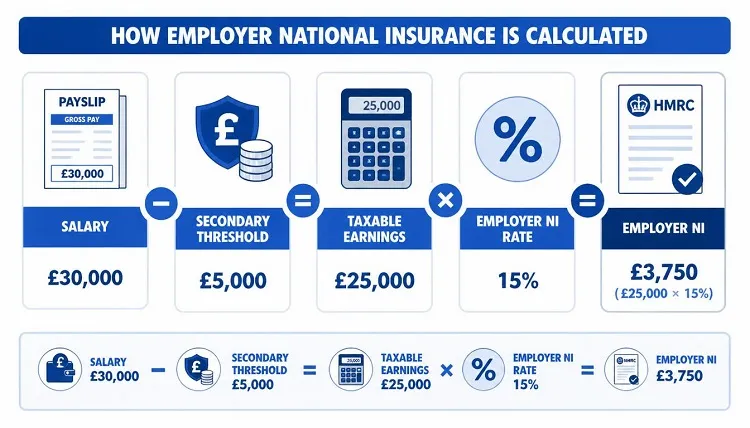
Employer National Insurance = (Annual salary minus £5,000) multiplied by 15%
Worked Example at Three Salary Levels
| Annual salary | Earnings above £5,000 threshold | Employer NI owed per year | Employer NI owed per month |
|---|---|---|---|
| £20,000 | £15,000 | £2,250 | £187.50 |
| £30,000 | £25,000 | £3,750 | £312.50 |
| £50,000 | £45,000 | £6,750 | £562.50 |
To take the middle example fully, an employee earning £30,000 a year has £25,000 of earnings above the £5,000 threshold. Multiplying £25,000 by 15% gives an annual employer National Insurance bill of £3,750, or £312.50 a month. This is entirely separate from whatever the employee themselves pays through their own deduction.
Monthly vs Weekly Payroll: Does It Change the Calculation?
Whether you run payroll weekly or monthly, the underlying method is identical. The Secondary Threshold is simply divided into weekly or monthly portions to match your pay frequency, so a weekly-paid employee is compared against the £96 weekly threshold rather than the £5,000 annual figure. The percentage rate and the overall annual liability stay the same either way.
Employer National Insurance Category Letters Explained
Not every employee is assessed in exactly the same way. HMRC assigns each employee a National Insurance category letter, and this determines which threshold applies to them.
| Category letter | Who it applies to | Employer NI threshold |
|---|---|---|
| A | Most employees aged 21 and over | £5,000 a year |
| M | Employees under 21 | £50,270 a year |
| H | Apprentices under 25 on an approved apprenticeship | £50,270 a year |
| C | Employees over State Pension age | £5,000 a year |
| V | Qualifying armed forces veterans, in their first 12 months of civilian employment | £50,270 a year |
Category A: The Standard Rate for Most Employees
Category A covers the majority of the UK workforce. It applies to most employees under State Pension age with no special circumstances, and it uses the standard £5,000 Secondary Threshold described throughout this guide.
Category C: Employees Over State Pension Age
Employees who have reached State Pension age no longer pay employee National Insurance themselves, but the employer’s own contribution still applies in the same way as for any other category A employee.
Class 1A and Class 1B National Insurance on Benefits and Expenses
Employer National Insurance is not limited to salary alone. If you provide certain benefits in kind, a separate charge applies.
Class 1A: Benefits in Kind
Class 1A National Insurance is charged at 15% on the taxable value of most benefits in kind you provide to employees, such as a company car, private medical insurance, or an interest-free loan above a set threshold. This is reported annually on a P11D form and is a cost to the employer, separate from the employee’s own Income Tax on the benefit.
Class 1B: PAYE Settlement Agreements
Class 1B applies where an employer has a PAYE Settlement Agreement with HMRC, allowing certain minor or irregular benefits to be settled in one payment rather than reported individually for each employee. It is also charged at 15% for 2026/27.
Payment Deadlines for Class 1A and 1B
Class 1A National Insurance is due by 22 July following the end of the tax year if paying electronically, or 19 July if paying by post. Class 1B is due slightly later, by 22 October.
Employment Allowance: Reducing Your Employer National Insurance Bill
Employment Allowance is the main relief available to reduce an employer National Insurance liability, and for many small businesses it makes a genuine difference to what actually gets paid.
Who Is Eligible and Who Is Not
Most employers can claim, and the previous restriction that stopped larger businesses claiming once their prior-year employer National Insurance bill passed £100,000 no longer applies. The main group who cannot claim is a company whose only employee is also its director, since a sole-director company with no other staff falls outside the scheme.
How Much You Can Claim
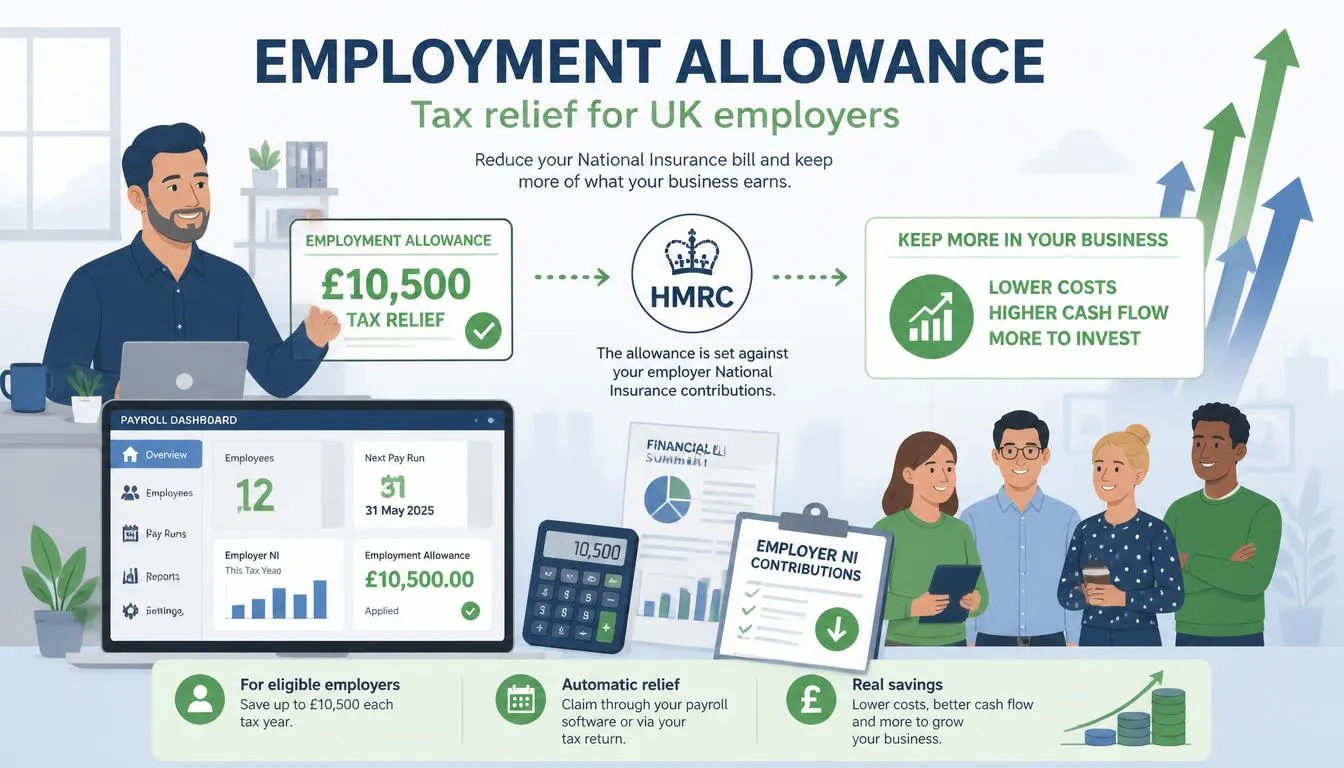
For 2026/27, eligible employers can reduce their employer National Insurance bill by up to £10,500 across the tax year. For a small business with a handful of modestly paid staff, this can offset a large part, or occasionally all, of the employer National Insurance otherwise due.
How to Claim It Through Payroll Software
Employment Allowance is claimed through payroll software rather than as a separate application to HMRC, and it is offset automatically against each National Insurance payment as it becomes due until the full allowance is used up for the year. Our guide to payroll for small businesses in the UK covers the range of software options that handle this calculation for you.
Director’s National Insurance: What Is Different
Company directors are technically employees for National Insurance purposes, but the rules around timing work slightly differently for them.
The Annual Earnings Period Explained
Rather than working out National Insurance pay period by pay period as with most staff, a director’s National Insurance is usually calculated on an annual earnings period basis. This means HMRC looks at the director’s total pay across the whole tax year, rather than treating each month in isolation. In practice this can smooth out National Insurance liability where a director’s pay varies significantly from month to month, for example through an annual bonus.
Salary vs Dividends: Why Many Directors Set Pay Near the Threshold
It is common for directors of their own limited company to set a modest salary close to the Secondary Threshold, and to take further income as dividends instead. Dividends are not subject to National Insurance at all, which is why this approach can reduce the combined National Insurance cost for both the company and the director personally. This is a genuinely useful strategy for many owner-managed businesses, though the right balance depends on personal circumstances, and it is worth discussing with a qualified accountant rather than treating any single approach as universal advice. Our comparison of sole trader versus limited company structures covers how this choice affects your wider tax position.
Employer National Insurance for Under-21s, Apprentices and Veterans
Hiring certain groups of employees can substantially reduce, or entirely remove, your employer National Insurance liability.
The Upper Secondary Threshold Explained
For employees under 21, apprentices under 25 on an approved apprenticeship, and qualifying veterans in their first year of civilian employment, the point at which employer National Insurance becomes due rises considerably, to the Upper Secondary Threshold of £50,270 a year rather than the standard £5,000.
Why This Can Mean Zero Employer National Insurance
Because most salaries sit below £50,270, hiring someone in one of these categories often means no employer National Insurance is payable at all on their earnings. This is a meaningful consideration for a small business weighing up different candidates or apprenticeship routes, on top of the wider recruitment picture.
Salary Sacrifice and Employer National Insurance
Salary sacrifice arrangements offer another route to reducing an employer National Insurance bill, and they are widely used alongside workplace pensions.
How Salary Sacrifice Works in Practice
Under a salary sacrifice scheme, an employee agrees to give up part of their gross salary in exchange for a non-cash benefit, most commonly a pension contribution. Because the sacrificed amount is no longer counted as salary, it is not subject to employer National Insurance, which lowers the employer’s bill while often improving the employee’s own take-home position too.
Common Salary Sacrifice Schemes
Workplace pension contributions are the most widely used example, though cycle to work schemes and certain childcare arrangements can also be structured this way. Any scheme needs to be set up correctly to remain compliant, so it is worth confirming the details with your payroll provider or accountant before introducing one.
How and When to Pay Employer National Insurance to HMRC
Employer National Insurance is not a separate annual bill. It is calculated and reported as part of your regular payroll cycle.
Reporting Through Real Time Information
Each time you run payroll, you submit a Full Payment Submission to HMRC on or before payday, detailing pay, Income Tax, and National Insurance for every employee. Our guide to your HMRC Business Tax Account explains how to access and manage your employer record where these submissions and payments are tracked.
Payment Deadlines
Income Tax and National Insurance collected through PAYE, including your own employer contribution, are due to HMRC by the 22nd of the following month if paying electronically, or the 19th if paying by post.
What Happens If You Pay Late
Late payment of employer National Insurance can lead to interest charged on the outstanding amount from the due date, and persistent late payment or non-payment can result in HMRC issuing a formal determination of what is owed and pursuing it as a debt. Late Full Payment Submissions carry their own separate penalties, starting from £100 a month and rising with the size of your payroll, so it is worth building payment deadlines into your regular routine rather than treating them as an afterthought.
Employer National Insurance and the True Cost of Hiring
Employer National Insurance is one of the main reasons the true cost of hiring someone is always higher than their headline salary.
Budgeting Employer National Insurance Into Your Hiring Costs
A useful starting point when budgeting for a new hire is to treat employer National Insurance as a genuine addition to salary, not an afterthought once the offer has already gone out. For many roles it adds a meaningful percentage on top of gross pay, before pension contributions and other costs are even considered.
How This Connects to Your First-Employee Checklist
If you are taking on your first member of staff, our guide to hiring your first employee in the UK covers the full picture of costs and legal steps involved, from registering with HMRC through to employers’ liability insurance. This guide focuses purely on getting the National Insurance figure itself right, so the two are best read together when you are planning a first hire.
Does Employer National Insurance Differ Across the UK?
Employer National Insurance rates and thresholds are set at a UK-wide level and apply identically whether your business and employees are based in England, Scotland, Wales, or Northern Ireland. This is different from Income Tax, where Scotland uses its own separate bands. If you employ staff across more than one part of the UK, you do not need separate National Insurance calculations for each nation, though Income Tax through PAYE may need to account for Scottish rates where relevant.
Employer National Insurance FAQs
What is employer National Insurance?
Employer National Insurance is a tax paid by UK employers on top of an employee’s gross salary, once earnings pass £5,000 a year. It is separate from the National Insurance deducted from the employee’s own pay and is charged at 15% for 2026/27.
How much National Insurance does an employer pay per employee?
It depends on salary. The formula is (annual salary minus £5,000) multiplied by 15%. An employee earning £30,000 a year, for example, costs the employer £3,750 in National Insurance across the year.
Do I have to pay employers’ National Insurance?
Yes, if you employ staff earning above the Secondary Threshold, paying employer National Insurance is a legal requirement, though the Employment Allowance may reduce or remove the bill for many small businesses.
Why am I paying employers’ National Insurance?
Employer National Insurance funds part of the UK welfare system, including the State Pension and NHS. It is a standard cost of employing staff in the UK, applied on top of salary rather than deducted from it.
How do I calculate my employer’s National Insurance?
Subtract £5,000 from the employee’s annual salary, then multiply the result by 15%. Payroll software will normally do this automatically for each pay period.
Is employer National Insurance due on Statutory Maternity Pay?
Yes, employer National Insurance applies to Statutory Maternity Pay in the same way as ordinary earnings, once it passes the Secondary Threshold, though employers can usually reclaim some or all of the Statutory Maternity Pay itself from HMRC separately.
Can I reduce my employer National Insurance bill?
Yes. The main routes are claiming Employment Allowance, using salary sacrifice for pension contributions, and hiring under-21s, apprentices, or qualifying veterans, all of which can lower or remove the liability.
Does employer National Insurance differ across Scotland, Wales, England, and Northern Ireland?
No. Employer National Insurance rates and thresholds are identical across the whole of the UK, unlike Income Tax, where Scotland applies its own separate bands.
Final Thought
Employer National Insurance is one of the least visible costs of running a UK payroll, precisely because it never appears as a line on an employee’s own payslip. Getting the rate, threshold, and any available reliefs right matters just as much as getting Income Tax and employee National Insurance right, since it directly affects what hiring someone actually costs your business. Once you understand the 15% rate above £5,000, how the Employment Allowance can offset it, and where reliefs for younger workers or apprentices apply, the calculation itself becomes routine rather than a source of budgeting surprises.
This article is accurate as of the 2026/27 tax year. Rates and thresholds can change, so always check the latest guidance on GOV.UK or speak to a qualified accountant for advice specific to your business.
About the author
Priya Ashworth is a UK-based payroll and employment tax writer with over eight years of experience covering PAYE, National Insurance, and small business compliance for accountancy and business publications. She writes to help first-time employers and small business owners understand their obligations clearly, without unnecessary jargon.