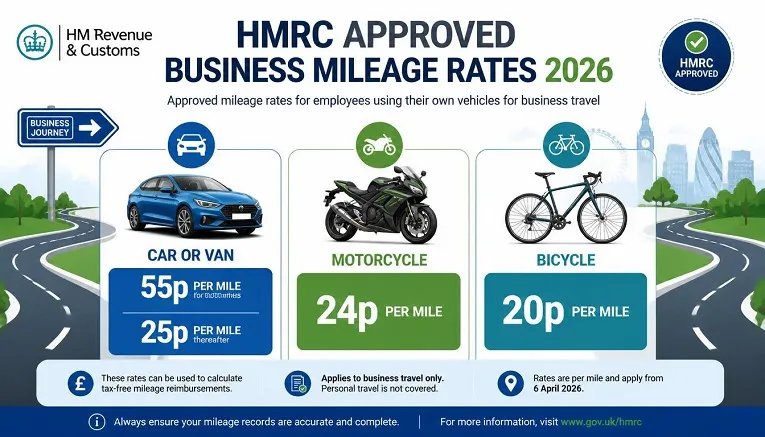
If you drive your own car for work, HMRC lets you recover the cost without keeping every fuel receipt. The flat-rate allowance does the maths: multiply your business miles by the approved rate. For 2026/27 that rate has risen. Cars and vans now pay 55p per mile for the first 10,000 business miles, up from 45p, from 6 April 2026. It is the first increase since 2011, and it is worth £1,000 extra on 10,000 miles: £5,500 instead of £4,500.
What is the business mileage allowance?
The business mileage allowance is HMRC’s Approved Mileage Allowance Payment scheme, usually shortened to AMAP. It sets a fixed tax-free rate per business mile driven in your own vehicle. Your employer, or your own limited company, can pay you up to that rate with no Income Tax and no National Insurance on it. If you are self-employed, you use the same rates as a simplified expense on your tax return instead of adding up your real motoring costs.
The rate is all-in, meant to cover fuel, insurance, road tax, servicing, MOT, tyres, repairs and depreciation in one figure. You do not claim 55p per mile and then add your insurance premium on top. The only extras you can claim separately are costs tied to a specific journey, such as tolls, congestion charges and parking fees.
It only applies to a vehicle you own personally. If the company owns or leases the car, AMAP does not apply. Company cars sit under a different set of rules based on the car’s list price and CO2 emissions, which our guide to company car tax explains in full.
HMRC mileage rates for 2026/27
The rates below apply to business miles driven on or after 6 April 2026. The increase was announced on 21 May 2026 and backdated to the start of the tax year, so April and May miles qualify too.
| Vehicle | First 10,000 business miles | Each mile over 10,000 |
|---|---|---|
| Cars and vans | 55p per mile | 25p per mile |
| Motorcycles | 24p per mile | 24p per mile |
| Bicycles | 20p per mile | 20p per mile |
There is also a 5p per mile passenger payment for each fellow employee you carry.
Two points catch people out. First, the 10,000-mile threshold is per person, per tax year, not per car and not per employer. Changing jobs does not reset it. Second, it resets every year on 6 April. For 2025/26, the return due by 31 January 2027, the old rates still apply: 45p for the first 10,000 miles, then 25p. Use the rate for the year the miles were driven, not the year you file.
What counts as business travel?
A business journey is a trip made wholly and exclusively for work: client visits, supplier trips, travel to a temporary workplace, and journeys between two workplaces. If you work from home, travel to a client or a temporary site is business mileage.
The daily commute does not count. Driving from home to your normal office, shop or other permanent workplace is ordinary commuting, and HMRC will not accept it. The test is whether the destination is permanent or temporary: a site you attend for a few weeks on a project is usually temporary, while a place you go to every working day is permanent.
For mixed journeys, only the business part is claimable, so keep the log honest about the route.
How sole traders claim mileage
Sole traders and partners have two methods, and you pick one per vehicle. Simplified expenses: multiply your business miles by the HMRC rates and enter the total as a business expense on your Self Assessment return. No fuel receipts or depreciation calculation. Actual costs: keep every receipt, work out the business percentage of your total motoring costs, and claim that share.
Simplified expenses suit most small businesses. It is quick, needs only a mileage log, and for an older or economical car often beats actual costs. There are two catches. You cannot use it for a vehicle if you have already claimed capital allowances on it. And once you choose the flat rate for a vehicle, you normally have to stay with it while that vehicle is used in the business. You can switch from actual costs to simplified expenses, but not the other way round, so choose carefully in the first year. See our capital allowances guide before you decide. One more restriction: if you claim the £1,000 trading allowance, you cannot claim any other business expenses, including mileage.
How limited company directors claim mileage
Directors count as employees here, so the company reimburses them under AMAP. Submit a mileage claim, the company pays up to 55p per mile for the first 10,000 business miles and 25p after that, and the payment is tax-free for you and deductible for the company. Keep it separate from salary and dividends, and pay it from the company bank account with a clear description.
If the company pays less than the approved rate, claim tax relief on the shortfall. Say it pays 40p per mile and you drive 5,000 business miles. The shortfall is 15p per mile, or £750. A basic rate taxpayer gets 20% of that back, which is £150. Claims up to £2,500 go on form P87; above that, file a Self Assessment return.
If the company pays you more than the approved rate, the excess is taxable earnings. It has to go through payroll and will appear on a P11D as a benefit. Paying exactly the approved rate avoids that paperwork, which is why most small companies stick to the HMRC figure. Keeping the car personal and claiming mileage is usually simpler and cheaper than a company car, which creates a benefit in kind charge every year. Employees are reimbursed the same way, and claim any shortfall on form P87 (up to £2,500) or through Self Assessment.
Simplified expenses or actual costs?
The right choice depends on the car and the mileage.
| Factor | Simplified expenses (flat rate) | Actual costs |
|---|---|---|
| Records needed | Mileage log only | Every receipt plus business percentage |
| What it covers | All running costs in one rate | Fuel, insurance, repairs, servicing, depreciation |
| Capital allowances | Not available on that vehicle | Available on the business share |
| Best for | Older or economical cars; high mileage | Expensive cars, high running costs, low mileage |
| Switching | Locked in once chosen for that vehicle | Can switch to simplified later |
A cheap car doing 12,000 business miles a year will almost always do better on the flat rate, which gives £6,000 at the 2026/27 rates, far more than the real running costs of a modest car. A £40,000 car doing 3,000 business miles a year may do better on actual costs plus capital allowances. Compare in the first year; the lock-in rule makes the first choice hard to undo.
The mileage log HMRC expects
HMRC does not demand a specific app or form, but it does expect a record made at the time. A log rebuilt from memory at year end is weak evidence. For each journey record the date, start and end points, business purpose, and miles. Keep odometer readings at the start and end of the tax year, and keep the log for at least five years after the 31 January filing deadline.
A spreadsheet, a notebook or a tracking app all work. The format matters less than the habit: log the trip on the day, note the client or meeting, and keep private miles in the same log so the split is visible. Our guide to business expenses sets out the record keeping rules for all your claims.
Worked example
Take a consultant driving 12,000 business miles in 2026/27 in her own car. Her simplified expenses claim is 10,000 miles at 55p (£5,500) plus 2,000 miles at 25p (£500). Total: £6,000. As a sole trader, that comes off her taxable profit, saving a basic rate taxpayer £1,200 in Income Tax, plus Class 4 National Insurance on top.
Suppose she also carries a colleague for 1,000 of those miles, adding the passenger payment of 5p per mile, another £50. Tolls and parking of £28 are claimable on top, since the flat rate does not cover journey-specific charges.
Five mistakes that cost small businesses money
First, claiming the commute. Home to a permanent workplace is not business travel. Second, using the wrong year’s rate: miles driven before 6 April 2026 are at 45p, even if you file later. Third, claiming simplified mileage and capital allowances on the same vehicle. HMRC will disallow one of them. Fourth, paying yourself more than the approved rate and forgetting the excess is taxable. Fifth, having no log at all. A claim with no records is the easiest one for HMRC to remove.
What to do this week
If you drive for work and you are not claiming mileage, start a log today and record every trip from now on. Check which rate applies to the year your miles were driven, work out whether simplified expenses or actual costs suit your car, and make sure your company reimburses you at the approved rate rather than a round number guessed years ago. The 55p rate is the first rise in 15 years, so many old spreadsheets still use 45p. Update them now.
Related reading
Director’s Loan Account UK: S455 Tax 2026/27
Trivial Benefits for Directors UK 2026/27: £50 Rule