Business expenses are the running costs you can legally deduct from your income before working out how much tax you owe. Get this right and you keep more of what you earn. Get it wrong, either by under claiming or by claiming the wrong things, and you either overpay HMRC or risk a penalty. This guide covers exactly what counts as an allowable business expense in the UK, for sole traders and limited companies, with current 2026/27 rates.
What Are Business Expenses in the UK?
A business expense is any cost you incur running your business that HMRC allows you to deduct from your income or profit before calculating tax. HMRC calls these “allowable expenses” for the self-employed, and simply “allowable expenses” for limited companies too, though the tax mechanics differ slightly between the two.
The test HMRC applies is the same across both structures: the cost must be incurred “wholly and exclusively” for the purposes of the trade. If a cost serves a personal purpose as well as a business one, only the business portion is deductible.
What Can Be Claimed as Business Expenses in the UK? Quick Answer
You can claim office costs, travel and mileage, staff costs, stock and materials, marketing, professional fees, insurance, business premises costs, and equipment, provided each cost is incurred wholly and exclusively for your business. Sole traders deduct these from income before Income Tax and National Insurance. Limited companies deduct them from profit before Corporation Tax. Client entertainment, personal costs and fines are never allowable, regardless of business structure.
5 Examples of a Business Expense
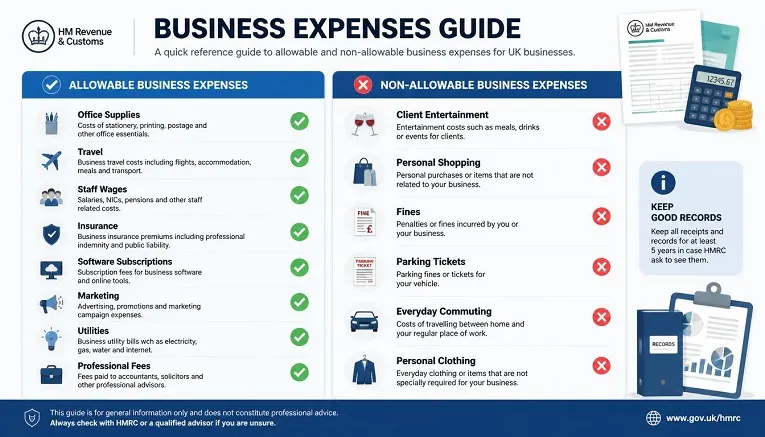
- Office supplies and stationery
- Business travel and mileage
- Staff wages and employer National Insurance
- Professional fees, such as accountancy and legal costs
- Business insurance, such as public liability or professional indemnity
List of Business Expenses UK: Sole Trader and Self-Employed
If you are self-employed, you can only claim for costs related to business purchases. The main categories are:
Office and Administration
- Stationery, printing and postage
- Phone and internet bills, business proportion only
- Software subscriptions and cloud storage
- Rent, rates, utilities and insurance for business premises
Travel
- Vehicle costs or mileage allowance
- Train, bus, taxi and air fares for business trips
- Parking, tolls and congestion charges
- Accommodation and subsistence when working away from your normal base
Staff Costs
- Salaries, employer National Insurance and pensions
- Subcontractor payments
- Training relevant to your existing trade
Stock and Direct Costs
- Goods bought for resale or raw materials
- Direct costs of providing a service
Financial Costs
- Bank charges and interest on business loans
- Accountancy and legal fees
- Business insurance premiums
For a wider view of how these figures feed into your accounts, see our guides to the balance sheet and profit and loss statement, and our overview of bookkeeping services and pricing if you would rather have a professional manage this for you.
Limited Company Expenses List UK
If you run a limited company, you are not self-employed, even if you are the sole director and shareholder. Instead, allowable expenses reduce the company’s taxable profit before Corporation Tax. Read our full guide to Corporation Tax for small businesses for how this fits into your annual filing.
Allowable limited company expenses include:
- Director and employee salaries, employer National Insurance and pension contributions
- Business travel and mileage, claimed at the same rates as sole traders
- Home office costs, if you work from home as a director
- Phone, internet, software and office equipment
- Professional fees, such as accountancy, legal and company secretarial costs
- Business insurance, including professional indemnity and employers’ liability
- Marketing, advertising and website costs
- Training that maintains or updates existing skills
- Staff entertainment, up to £150 per head per tax year
- Charitable donations to registered charities
Larger purchases, such as computers, vehicles or machinery, are usually claimed through capital allowances rather than as a straightforward expense. The Annual Investment Allowance currently lets most companies deduct up to £1 million of qualifying capital spending in the year of purchase. If you are still deciding between structures, our comparison of sole trader versus limited company covers how expense treatment differs between the two.
Business Mileage Expenses UK: Current Rates
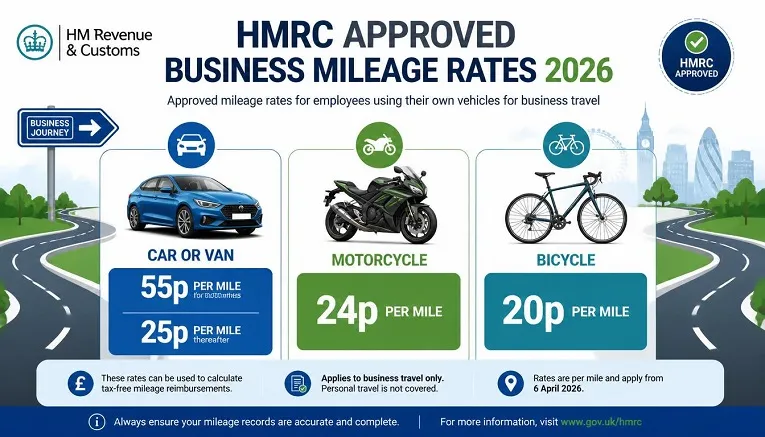
You can claim mileage instead of tracking actual vehicle running costs such as fuel, insurance and servicing. From 6 April 2026, HMRC’s approved mileage rate increased for the first time since 2011.
| Vehicle Type | First 10,000 Business Miles | Miles Above 10,000 |
|---|---|---|
| Car or van | 55p per mile | 25p per mile |
| Motorcycle | 24p per mile | 24p per mile |
| Bicycle | 20p per mile | 20p per mile |
Ordinary commuting between home and your regular workplace does not qualify as business mileage. Once you choose the mileage method for a particular vehicle, you must keep using it for that vehicle for as long as you use it in the business, and you cannot also claim capital allowances on the same vehicle. A simple mileage log with date, journey and miles driven is enough to support your claim.
Business Travel and Trip Expenses UK
Business travel expenses cover costs incurred while travelling away from your normal place of work. This includes train, bus, taxi and air fares, parking, and reasonable accommodation and subsistence when you are required to stay away overnight. Everyday travel to your regular workplace is not allowable, and neither is a meal bought near your normal base on an ordinary working day.
Business Entertainment Expenses UK: What You Can and Cannot Claim
This is one of the most commonly misunderstood areas, and the rules differ depending on who is being entertained.
Client Entertainment
Entertaining clients, customers or prospects, whether that is a meal, drinks or event tickets, is not an allowable expense for tax purposes. The business can still pay for it, but the cost cannot be deducted from taxable profit, and the VAT usually cannot be reclaimed either.
Staff Entertainment
Entertaining your own employees is treated differently. An annual event, such as a Christmas party or summer gathering, is allowable up to £150 per head per tax year, including VAT. Go even slightly over that limit and the whole cost becomes a taxable benefit, not just the excess.
Working From Home: Simplified Expenses
If you are self-employed and work from home for at least 25 hours a month, you can use HMRC’s simplified expenses flat rate instead of calculating the exact business proportion of your household bills.
| Hours Worked From Home Per Month | Flat Rate |
|---|---|
| 25 to 50 hours | £10 per month |
| 51 to 100 hours | £18 per month |
| 101 or more hours | £26 per month |
Simplified expenses are only available to sole traders and partnerships without a company as a partner. Limited companies must calculate actual home working costs instead. Once you choose simplified expenses for your home working, you must keep using that method for as long as you run that business.
What Items Are 100% Deductible?
Costs incurred wholly and exclusively for the business, with no personal use at all, are generally 100% deductible. Common examples include stock bought purely for resale, business-only software subscriptions, professional indemnity insurance, and stationery used entirely for work. The moment an item has any meaningful personal use, such as a mobile phone also used socially, you must apportion the cost and can only claim the business share.
What Business Expenses Are Not Allowable?
- Client entertainment, including meals, drinks and event tickets
- Fines and penalties, including parking tickets and late filing penalties
- Ordinary commuting between home and your regular workplace
- Personal expenses with no business purpose
- Clothing, other than genuine uniforms or protective clothing
- Dividends paid to shareholders
- Costs incurred before the “wholly and exclusively” test can reasonably apply
If you are unsure whether a specific cost qualifies, checking against HMRC’s guidance before you claim is safer than finding out during a compliance check. Our guide to business record keeping requirements in the UK covers how long you need to retain the evidence behind every claim.
Do I Need to Keep Receipts for Business Expenses in the UK?
Yes. HMRC can ask to see evidence behind any expense claim during a compliance check, and without a receipt, invoice or equivalent record, a claim can be disallowed. Digital copies are acceptable, and many business owners now scan or photograph receipts as they go rather than storing paper. Records must generally be kept for five years after the 31 January Self Assessment deadline if you are self-employed, or six years from the end of the accounting period for a limited company.
Business Expenses UK Calculator: How to Work Out Your Deduction
HMRC provides a free simplified expenses checker that compares the flat rate method against actual costs for vehicles, home working and living on business premises, helping you choose whichever gives the larger deduction. For mixed-use costs outside simplified expenses, such as a phone bill used partly for personal calls, work out the business percentage based on genuine usage, for example the proportion of call minutes or data used for work, and apply that percentage consistently.
Prepaid Cards and Credit Cards for Business Expenses UK
Many sole traders and limited companies use a dedicated business bank account, prepaid card or business credit card to keep expenses separate from personal spending from day one. This is not a legal requirement for sole traders, though limited companies must keep company money separate from personal funds. Beyond compliance, a dedicated account makes it far easier to produce clean records if HMRC ever asks questions, and it removes the guesswork of splitting a joint personal and business transaction after the fact.
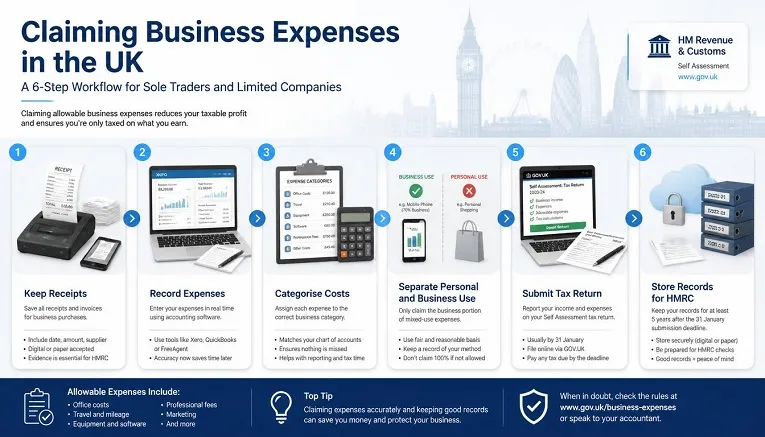
How to Claim Business Expenses UK
- Keep a receipt, invoice or equivalent evidence for every cost as you incur it
- Record the date, amount, supplier and business purpose, ideally in accounting software or a simple spreadsheet
- Categorise each expense consistently, matching the categories on your Self Assessment return or company accounts
- Apportion any mixed-use costs to reflect genuine business use only
- Total your allowable expenses and deduct them from your income or profit when you file
- Retain all supporting records for the required retention period in case of an HMRC enquiry
Our guide on bookkeeping fundamentals and comparison of Making Tax Digital software both cover tools that automate much of this process, particularly useful as Making Tax Digital becomes mandatory for more sole traders from April 2026.
Frequently Asked Questions
What can be claimed as business expenses in the UK?
Office costs, travel and mileage, staff costs, stock, marketing, professional fees, insurance and business premises costs can all be claimed, provided each cost is incurred wholly and exclusively for the business.
What are 5 examples of a business expense?
Office supplies, business travel or mileage, staff wages, professional fees such as accountancy costs, and business insurance are five common examples.
What am I allowed to write off as a business expense?
Any cost incurred wholly and exclusively for running your business, from stock and equipment to travel and professional fees. Costs with a personal element must be apportioned, and some items, such as client entertainment, are never allowable regardless of purpose.
What items are 100% deductible?
Costs with no personal use at all, such as stock bought purely for resale, business-only insurance, and stationery used entirely for the business, are typically 100% deductible.
Do I need to keep receipts for business expenses in the UK?
Yes. HMRC can request evidence for any claim, and records should be kept for at least five years after the Self Assessment deadline for sole traders, or six years for limited companies.
Can I claim business entertainment expenses?
Client entertainment is never allowable. Staff entertainment, such as an annual Christmas party, is allowable up to £150 per head per tax year.
Key Takeaways
- Expenses must be incurred wholly and exclusively for the business to be allowable
- Sole traders deduct expenses from income before Income Tax and National Insurance
- Limited companies deduct expenses from profit before Corporation Tax
- The mileage rate rose to 55p per mile for the first 10,000 miles from 6 April 2026
- Client entertainment is never allowable; staff entertainment is, up to £150 per head
- Keep receipts and records for at least 5 years (sole traders) or 6 years (limited companies)
- Use HMRC’s simplified expenses checker to compare flat rate and actual cost methods
About the Author
This guide was prepared by the Business Mine editorial team, who research and write practical UK business, tax and finance guides for sole traders, limited company directors and small business owners. Information is checked against current HMRC guidance at the time of publication. This article is provided for general information only and does not constitute tax or legal advice; for advice specific to your circumstances, consult a qualified accountant.